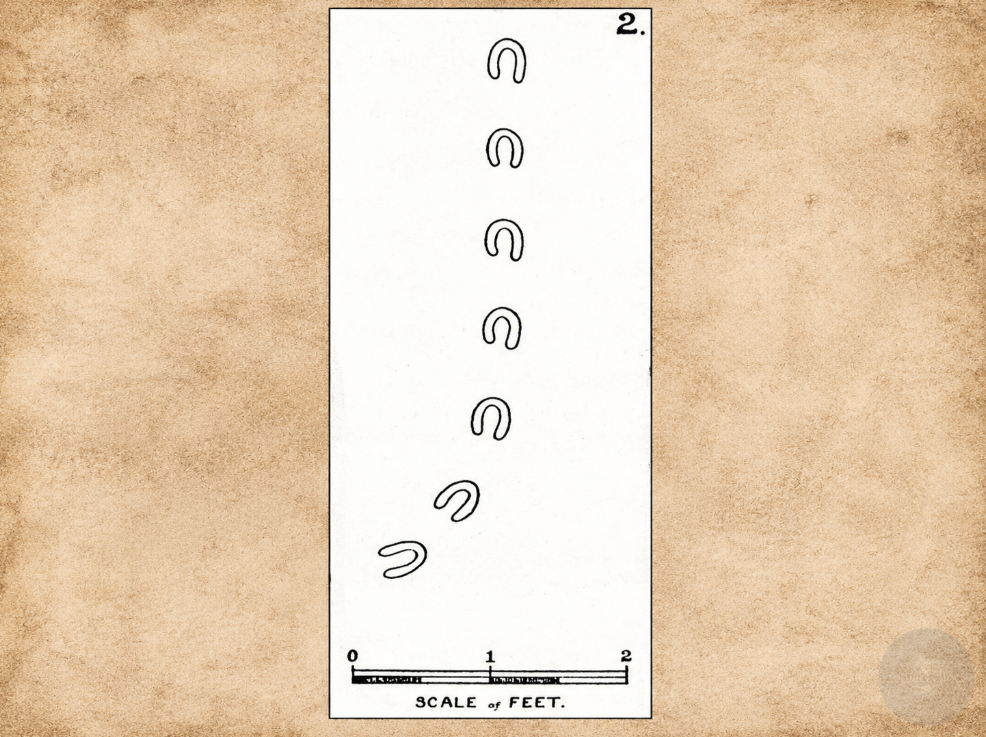
- On February 9, 1855, residents of Devon, England, discovered strange hoof-shaped footprints in freshly fallen snow.
- The tracks reportedly appeared across villages, gardens, rooftops, and high walls, covering an extraordinary distance.
- Some frightened residents believed the Devil himself had walked through Devon during the night.
- Contemporary newspapers investigated the phenomenon, while naturalists proposed explanations involving ordinary animals.
- More than 170 years later, the exact origin of the mysterious footprints remains uncertain.
On the morning of February 9, 1855, residents of Devon in southwestern England awoke to an extraordinary sight. Overnight snowfall had covered the countryside in white, but across the otherwise undisturbed snow stretched long lines of mysterious footprints resembling small animal hooves.
The tracks appeared in villages, gardens, fields, and enclosed courtyards. More disturbingly, witnesses claimed they continued across rooftops, over high walls, and through places seemingly impossible for an ordinary animal to reach. As news spread, an unsettling explanation began circulating: the Devil had visited Devon during the night.
A Trail That Seemed to Defy Nature
The mysterious marks were reported around the Exe Estuary and several communities in southern Devon, including Exmouth, Dawlish, and Teignmouth.
Many impressions were described as approximately four inches long and three inches wide, with distances of roughly eight to sixteen inches between successive marks. Unlike the paired footprints expected from many four-legged animals, the tracks often appeared in a single line.
Some accounts suggested that the trails extended for between 40 and 100 miles, although these figures referred to the wider geographical distribution of sightings rather than a continuously measured route.
What truly puzzled observers was their apparent disregard for obstacles. Witnesses described marks appearing on the tops of walls and roofs, while other trails reportedly stopped abruptly before continuing beyond barriers. Whatever had created the footprints seemed capable of reaching places that ordinary animals should have found difficult to cross.
Did the Devil Walk Through Devon?
Victorian England was deeply familiar with supernatural folklore, and unusual hoofprints immediately suggested a disturbing possibility to some observers.
In Christian imagery, the Devil was frequently depicted with cloven hooves. The resemblance between those traditional representations and the mysterious marks helped transform a strange natural occurrence into a frightening local legend.
Reports of the footprints spread beyond Devon, attracting attention from national newspapers. The Times discussed the extraordinary occurrence in February, while The Illustrated London News published descriptions and illustrations of the tracks.
The publicity intensified speculation. Some residents interpreted the marks through religious beliefs, while others insisted that a natural explanation must exist. Yet even skeptical observers struggled to account for every reported detail.
What Could Have Made the Footprints?
Several explanations emerged during the weeks following the discovery. Badgers were among the animals proposed as possible culprits. The naturalist Richard Owen examined the descriptions and suggested that certain unusual animal tracks might account for the phenomenon.
Another suggestion involved an escaped kangaroo, although the idea remained speculative and could not convincingly explain the entire geographical distribution of sightings.
Later researchers also considered whether ordinary footprints had been altered by changing weather conditions. Melting, refreezing, and wind can distort impressions in snow, potentially making familiar animal tracks appear much stranger than they originally were.
There is also the possibility that several different animals produced similar-looking marks in separate locations. As newspaper reports accumulated, these unrelated trails may have become part of a single dramatic narrative. None of these explanations has been conclusively demonstrated as the source of every reported footprint.
The Forgotten Evidence Rediscovered a Century Later
The mystery did not disappear entirely after 1855, but much of its original documentation remained scattered or forgotten. During the twentieth century, researchers recovered correspondence and tracings associated with Reverend Henry Thomas Ellacombe, a Devon clergyman who had collected information about the unusual marks.
These documents became important because they preserved details from people who had investigated the phenomenon close to the time it occurred. Historical researcher Mike Dash subsequently examined the surviving material in his study The Devil’s Hoofmarks: Source Material on the Great Devon Mystery of 1855.
The evidence revealed that descriptions of the footprints varied considerably. Not every witness had observed identical marks, and no complete, independently verified map established one continuous trail.
Nevertheless, the surviving correspondence and contemporary newspaper coverage confirm that the strange footprints were a genuine subject of investigation and public fascination in Victorian England.
Conclusion
More than 170 years after the mysterious tracks appeared, the Devil’s Footprints remain one of England’s most intriguing historical mysteries. The extraordinary claims about impossible routes and supernatural visitors cannot be verified, but the original reports demonstrate how deeply the incident unsettled Victorian observers.
Perhaps the marks were created by animals, distorted by unusual weather, and connected through rumor. Or perhaps an overlooked detail in the surviving evidence could eventually provide a more precise explanation. Whatever walked through Devon’s snow in February 1855, its footprints left a legend that has survived long after the snow itself disappeared.
Cosmic Highlights

FAQ
When did the Devil’s Footprints appear?
The most famous sightings occurred on the morning of February 9, 1855, following snowfall during the previous night. Additional reports appeared during February.
Where were the mysterious footprints found?
The tracks were reported across parts of East and South Devon, England, particularly around the Exe Estuary and communities including Exmouth, Dawlish, and Teignmouth.
How far did the Devil’s Footprints extend?
Historical accounts suggested sightings across an area extending approximately 40 to 100 miles. However, no verified survey established that all the marks formed one continuous trail.
Were the footprints really made by the Devil?
There is no evidence of a supernatural origin. Researchers have proposed ordinary animals, weather-related distortion, and the combination of separate tracks into one widely circulated story.
Has the mystery of the Devil’s Footprints been solved?
No single explanation has been conclusively established for every reported mark. The original observations are incomplete, and the physical footprints disappeared long ago.