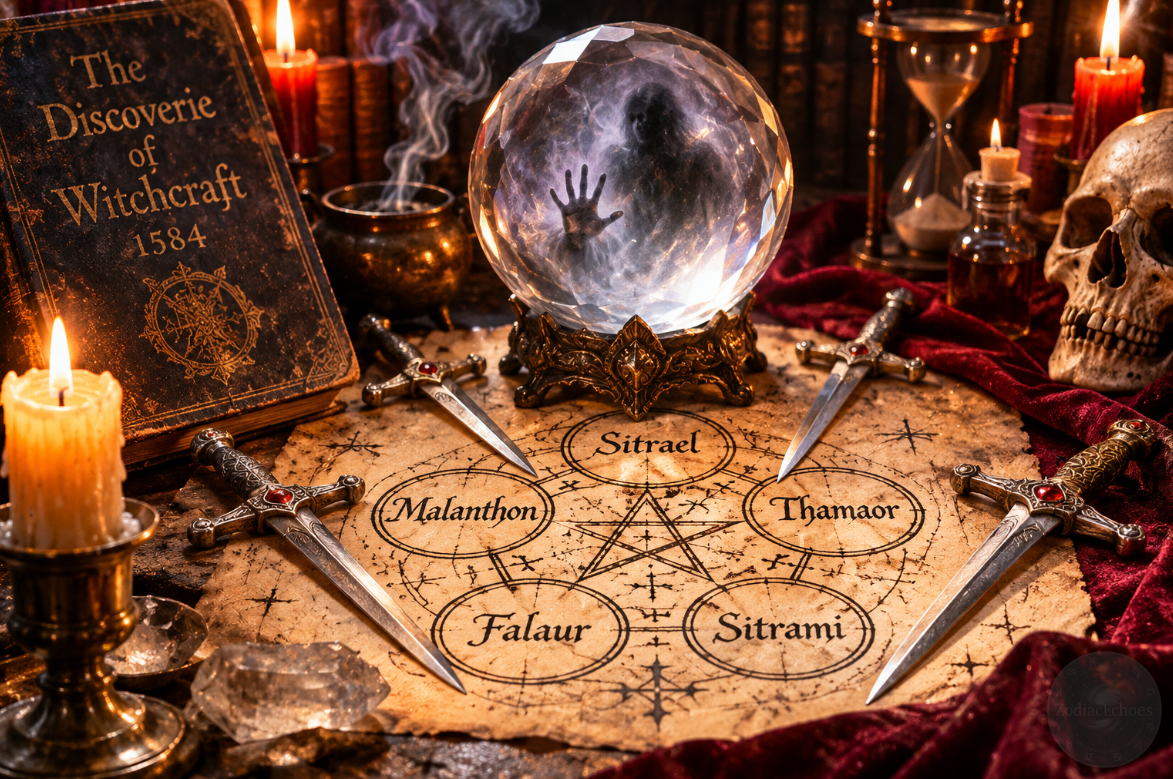
- Original Source: Reginald Scot’s The Discoverie of Witchcraft (1584), Book XV, Chapter 12.
- Five Infernal Kings: Sitrael, Malanthon, Thamaor, Falaur, and Sitrami.
- Ritual Objects: A crystal or beryl glass, five swords, and a diagram of five circles.
- Preparation: The text prescribes purification, prayers, and observance of the new Moon.
- The Objective: Command the five kings to place a knowledgeable spirit inside the crystal.
- The Claimed Result: The crystal turns black and becomes an instrument for obtaining answers.
In 1584, an English book described a disturbing ceremony in which five infernal kings were summoned and commanded to imprison another spirit inside a crystal. The operation required five swords, a complex arrangement of circles, several days of religious preparation, and a lengthy conjuration invoking divine authority over supernatural beings.
The most extraordinary moment came near the end. According to the instructions, the five kings would command a lesser spirit to enter the crystal. The stone would then turn black, supposedly demonstrating that the invisible entity had been captured. The magician could thereafter question the imprisoned spirit about hidden knowledge, secret events, and matters beyond ordinary human understanding.
This ritual survives in Reginald Scot’s The Discoverie of Witchcraft, first published in London in 1584. Although Scot included the ceremony to expose and criticize the claims of conjurers, he preserved a remarkably detailed account of how the operation was supposed to work.
The Original 1584 Grimoire and Its Crystal Ritual
Reginald Scot was an English writer who challenged the witch-hunting beliefs of his age. His Discoverie of Witchcraft examined alleged supernatural powers, magical deceptions, and the practices attributed to ceremonial magicians.
Book XV contains a collection of conjurations, magical diagrams, and descriptions of spirit-summoning ceremonies. Among them is Chapter 12, entitled “How to enclose a spirit in a christall stone.”
The original text appears in Book XV, Chapter 12, describing the preparation, the invocation of the five infernal kings, and the alleged imprisonment of a spirit inside a crystal. Unlike later occult manuals that merely refer to the operation, Scot’s book preserves its sequence: preparation, construction of the circles, invocation of the kings, confinement of the spirit, and the final use of the crystal.
ORIGINAL 1584 EDITION
The Five Infernal Kings and Their Names
The ritual names five entities described as infernal kings or masters: Sitrael, Malanthon, Thamaor, Falaur, and Sitrami. They are not presented as ordinary ghosts or wandering spirits. Instead, they supposedly possess authority over lesser supernatural beings.
The magician’s objective is to compel these five rulers to provide one spirit skilled in arts and sciences. This distinction is central to the ceremony. The five kings are summoned to perform the imprisonment; the resulting captive is intended to become the magician’s source of information.
The manuscript tradition contains minor variations in spelling. The conjuration itself uses Malantha in one passage, while the surrounding instructions give Malanthon or Malanthan. The text places the kings in the northern region, traditionally associated with formidable spiritual powers in several ceremonial systems. Their names are also written into the ritual diagram, giving each a designated position.
The First Stage: Preparation Under the New Moon
The operation begins with a specific lunar condition. The magician must begin at the new Moon, wearing fresh, clean clothing and observing ritual purification. The original text calls for washing or shaving, confession, fasting on bread and water, and recitation of the seven penitential psalms and the litany.
These religious preparations form an essential part of the ritual’s claimed authority. The practitioner is instructed to continue the prescribed devotional preparation for five days. The sixth day is reserved for the principal operation.
This combination of Christian prayers and infernal conjuration may seem contradictory, but it reflects a common feature of early ceremonial magic: the magician claims authority over spirits through the names and power of God. The five kings are not worshipped. They are commanded to obey.
The Second Stage: Five Swords and Five Circles
The next instructions introduce the objects that make this ritual visually distinctive. The text requires five bright swords, one for each infernal king. In a secluded location, the magician is told to mark out a circle and associate the first sword with the name Sitrael. The same procedure is then repeated for the remaining four names. Each king receives a designated position, forming the arrangement reproduced in the original diagram.
The text specifies that the circles should measure nine feet across and associates the operation with the astrological signs Cancer, Scorpio, or Pisces, during a planetary hour of the Moon or Jupiter. These details are not incidental decorations. They establish the ritual’s timing, spatial organization, and relationship between the magician and the five supernatural rulers.
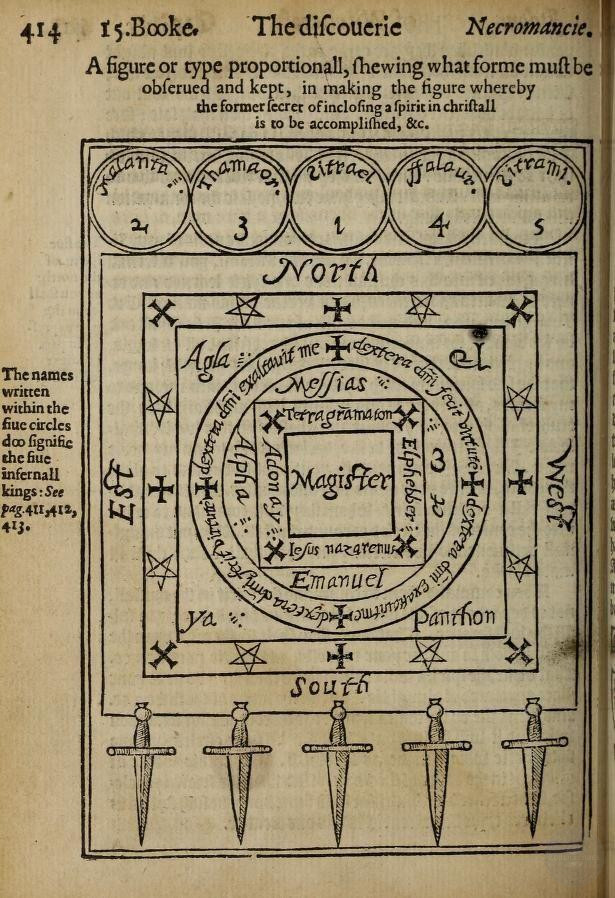
The five-circle diagram accompanying “How to enclose a spirit in a christall stone,” showing the positions associated with Sitrael, Malanthon, Thamaor, Falaur, and Sitrami. Reginald Scot, The Discoverie of Witchcraft (1584), Book XV, p. 414. Original first-edition illustration.
The diagram is important because it preserves the actual historical arrangement. A modern pentagram or generic occult circle would not accurately represent this operation.
The Third Stage: Calling the Infernal Kings
Once the circles have been prepared, the magician turns toward Sitrael while holding the crystal. The invocation addresses all five kings and calls upon Christian divine authority to compel their appearance. The original conjuration invokes God, Christ, the Virgin Mary, the saints, angels, celestial bodies, and the elements. It then commands the kings to appear visibly and obey the magician’s requests.
The text instructs the practitioner to repeat the conjuration five times. According to the ritual’s extraordinary promise, the five kings would then arrive from the north, accompanied by a great company. They were expected to appear as human kings, descend from their horses, kneel before the magician, and offer their obedience.
The practitioner would then demand a promise that they would not depart without permission. This passage is among the most theatrical in the entire ceremony. It imagines a supernatural procession in which powerful infernal rulers are reduced to servants through ritual words.
The Fourth Stage: Imprisoning the Spirit Inside the Crystal
The central operation begins after the five kings have supposedly submitted. The magician commands them to provide a spirit knowledgeable in every art and science, capable of revealing truths about the physical and spiritual world. The request is made under the authority of the divine name Tetragrammaton.
The five kings are then expected to summon a subordinate spirit and command it to enter the center of the crystal. At this moment, the magician places the crystal between the circles. The text describes a remarkable transformation: the crystal becomes black.
This change supposedly indicates that the spirit has entered the stone. The five kings are then ordered to ensure that the captive cannot leave without permission. The ritual does not describe the crystal as an ordinary decorative gemstone. It is intended to become a permanent instrument of supernatural communication.
The Fifth Stage: Questioning the Captive Spirit
After the imprisonment, the magician dismisses the five infernal kings. The crystal remains. According to the original instructions, the practitioner can now look into the stone and ask questions. The imprisoned spirit is expected to reveal hidden knowledge and provide truthful answers whenever called upon.
This is the real objective of the entire ceremony. The magician does not summon five kings simply to witness their appearance. Their purpose is to deliver a permanent supernatural informant.
The ritual therefore combines two forms of ceremonial magic: spirit evocation and crystal divination. The kings are summoned through conjuration, while the lesser spirit is confined within an object that can supposedly be consulted repeatedly. The text also recommends an additional binding formula if the practitioner fears the spirit.
Why the Crystal Was Supposed to Turn Black
The claim that the crystal turns black is one of the operation’s most distinctive details. Crystal divination ordinarily involves gazing into a reflective or transparent surface in search of images, visions, or messages. Here, however, the change in the stone’s appearance is connected directly with the confinement of a supernatural being. The magician is instructed to interpret the darkening as part of the process by which the spirit enters its new prison.
The surviving text does not explain a physical mechanism for the transformation. Instead, it presents the blackened crystal as a supernatural result of the kings’ obedience. The image of a transparent stone becoming dark gives the ritual a particularly unsettling character: the crystal is no longer merely a window into the invisible world, but the supposed prison of something brought from it.
Why Reginald Scot Preserved This Ceremony
Scot’s decision to print the ritual was not an endorsement. He opposed many contemporary claims about witchcraft and supernatural powers and sought to expose the methods and assertions of those who practiced or promoted conjuration. His skeptical commentary appears throughout the book.
Nevertheless, his work has become an important historical source precisely because it preserves detailed magical instructions that might otherwise have disappeared. The crystal ceremony offers a rare combination of specific names, a multi-day preparation, ceremonial objects, a complete sequence of commands, and an accompanying diagram.
The text documents what the ritual promised, rather than proving that spirits could actually be imprisoned. For historians of magic, however, the preserved instructions reveal how elaborate the imagined relationship between humans and supernatural beings had become by the sixteenth century.
Conclusion: The Crystal Prison of the Five Kings
The ritual of the five infernal kings is one of the strangest operations recorded in The Discoverie of Witchcraft. Its objective was not simply to witness a ghost or receive a single prophecy. The magician sought to obtain a spirit that could be questioned repeatedly, using five infernal rulers to force the entity into a crystal. The five swords, the names written into the circles, the lunar timing, and the elaborate conjurations all served this one purpose.
The original 1584 publication preserves both the procedure and its historical diagram, allowing modern readers to examine the operation without relying on invented symbols or later fictional embellishments. Its most memorable promise remains the moment when a clear crystal supposedly turned black because an invisible spirit had been trapped inside.
Cosmic Highlights
FAQ
What is the ritual of the five infernal kings?
It is a ceremonial operation recorded in Reginald Scot’s The Discoverie of Witchcraft (1584), describing how five supernatural rulers were supposedly compelled to imprison another spirit inside a crystal.
Who are the five infernal kings?
The ritual names Sitrael, Malanthon, Thamaor, Falaur, and Sitrami, with minor spelling variations in the historical text.
What was the purpose of the crystal?
The crystal was intended to contain a knowledgeable spirit that could answer the magician’s questions about hidden matters.
Why did the ritual require five swords?
The text associates each sword with one of the five infernal kings and uses them in the preparation of the ceremonial arrangement.
When was the ritual supposed to begin?
The instructions prescribe preparation beginning at the new Moon, with the main operation associated with Cancer, Scorpio, or Pisces and a planetary hour of the Moon or Jupiter.
What happened when the spirit entered the crystal?
According to the grimoire, the crystal would turn black, indicating that the spirit had entered it.
Where is the original diagram?
The original five-circle diagram appears on printed page 414 of the 1584 edition of The Discoverie of Witchcraft.
Can I download the original historical book?
Yes. The photographic scan of the 1584 first edition is available through the PDF link provided in the opening section of this article.