- Amityville’s story began with a documented family murder, followed by the Lutz family’s disputed haunting claims.
- The Conjuring drew on the Perron family’s account of life in a Rhode Island farmhouse.
- The Conjuring 2 dramatized the Enfield poltergeist case in a London home.
- The houses’ histories continued through later residents, media attention and, in Rhode Island, a paranormal-tourism business.
A house does not stop existing when its story reaches the cinema. Other people move in, rooms are redecorated, and an address that once meant little outside a neighbourhood becomes recognizable to strangers around the world. For the occupants, a famous horror connection can turn an ordinary home into somewhere the public feels it already knows.
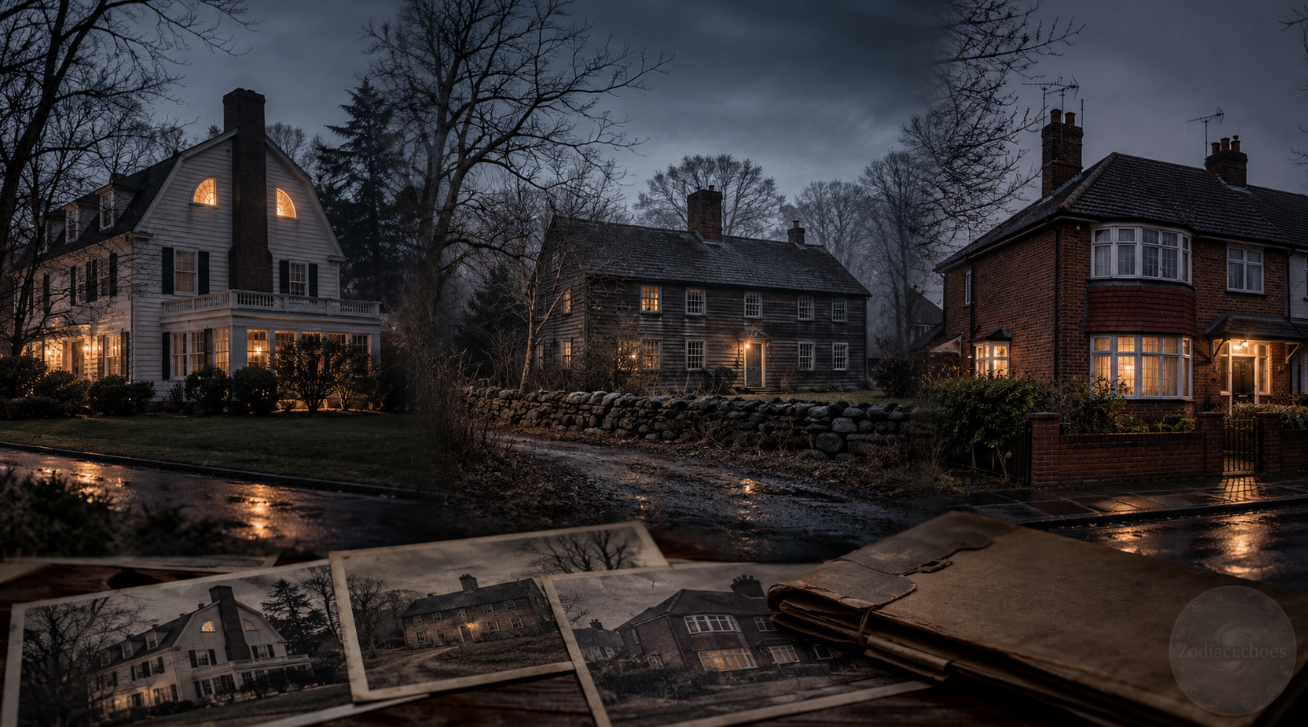
Amityville, the Perron farmhouse and the Enfield house each followed a different path. They are real places associated with the stories behind films, which is not necessarily the same thing as being the buildings shown on screen. Their histories are clearest when the crimes, family testimony and later publicity are kept in their proper sequence.
Amityville: A Crime Before a Haunting Story
On November 13, 1974, Ronald DeFeo Jr. killed his parents and four siblings inside their Long Island home. The six deaths are the documented crime at the centre of Amityville’s history. The supernatural narrative developed later, after George and Kathy Lutz moved into the property in 1975 and reported frightening experiences.
The Lutz family’s account became the basis for Jay Anson’s 1977 book and the 1979 film The Amityville Horror. The murders and the haunting claims have different evidential foundations. The Society for Psychical Research’s Psi Encyclopedia discusses serious problems with the haunting narrative, including allegations of fabrication and the role of lawyer William Weber in its development.
The property subsequently changed hands, while its appearance also changed. Its distinctive quarter-circle windows were replaced, making the building less immediately recognizable. Yet the association endured: the house’s name became inseparable from a film franchise, even though the real building continued its life as a residence.
The Conjuring Farmhouse: A Family Home Becomes an Attraction
The Rhode Island farmhouse associated with The Conjuring was home to the Perron family during the 1970s. In her own published account, Andrea Perron describes the family purchasing it in late 1970 and remaining until 1980. She maintains that their experiences there were paranormal, later recounting them in her House of Darkness: House of Light books.
That account provides something more specific than an anonymous haunted-house legend: a named former resident describing her family’s experiences. It remains testimony, however, rather than a property record proving every event depicted in the film. Reading the family’s account alongside the screen version also avoids assuming that a dramatic sequence happened exactly as it was filmed.
The house later became a business offering investigations and overnight stays. Its post-film history then involved the practical requirements of operating an attraction in a residential area. In November 2024, Burrillville’s council declined to renew its entertainment licence, citing problems with the renewal application and operation.
Police issued citations in December 2024 after the licence expired. Those events form a documented chapter in the property’s history, separate from its haunting reputation. They also mean that old travel features advertising overnight visits should not be treated as confirmation of current access.
Enfield: A London Home With a Recorded History
The Enfield case began in 1977, when Peggy Hodgson and her children reported disturbances in their London home. The reports included knocking, moving furniture and an unusual voice associated with daughter Janet. Maurice Grosse became a central investigator, while newspaper coverage brought the household wider attention.
The case differs from many haunted-house stories because it left extensive recordings and identifiable witnesses. Investigators also disagreed about what they were observing, and Janet later acknowledged that some incidents had been staged while maintaining that others were genuine. The surviving material therefore contains both extraordinary claims and challenges to them.
The Conjuring 2 brought the story to another audience, but it was not the final retelling. Apple’s 2023 documentary series returned to original audio recordings and included Janet and Margaret Hodgson as contributors. That gives viewers a way to encounter the family’s testimony beyond a fictionalized feature film.
These properties share cinematic fame, but their later histories are very different. Amityville continued through private ownership, the Perron farmhouse became a paranormal attraction, and Enfield’s recordings generated further documentaries. Following those histories reveals what happened after a frightening story became public property—even when the house itself did not.
FAQ
Is the Amityville house connected to a real murder?
Yes. Six members of the DeFeo family were killed there in 1974. The later haunting claims are a separate part of its history.
Did the Perron family really live in the house associated with The Conjuring?
Yes. Andrea Perron’s account describes the family’s ownership and residence during the 1970s, alongside her claims about their experiences.
Are there original recordings from the Enfield case?
Yes. Original audio recordings form a central part of the 2023 documentary The Enfield Poltergeist.
Sources
- HISTORY — The Amityville Murders
- Society for Psychical Research, Psi Encyclopedia — Amityville Hoax
- The Conjuring House — Andrea Perron’s Family Account
- NRI NOW — Council Denies Business Licences for Conjuring House and Mapleville Farm
- NRI NOW — Police Cite Conjuring House Business
- Radio Times — The Enfield Poltergeist: The Real Story
- People — The Enfield Case Behind the Conjuring 2
- Apple TV Press — The Enfield Poltergeist