- The ritual survives as Experiment No. 8 in the fifteenth-century Munich Manual of Demonic Magic (Clm 849).
- Its purpose was to obtain a supernatural ship capable of carrying the magician and his companions rapidly across the sea.
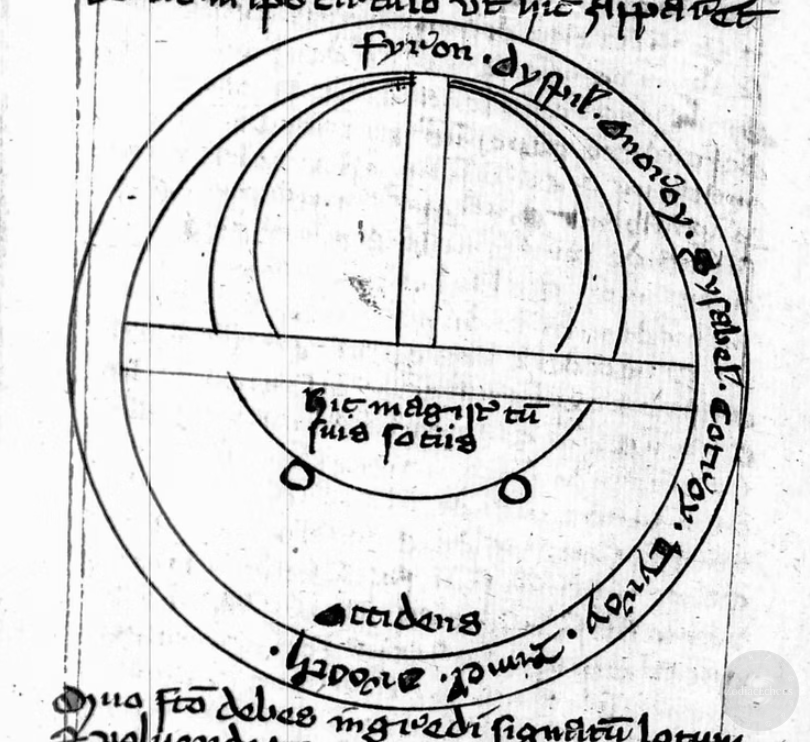
- The surviving manuscript contains an original diagram specifically associated with the ship ritual.
- The magical figure resembles an inverted medieval T–O world map with a crescent-like shape that Richard Kieckhefer suggests may represent the ship.
- The ceremony invokes eight spirits, who are supposed to appear in the form of eight sailors.
- The spirits swear obedience before transporting the magician and everyone inside the circle.
- The manuscript claims the travellers would experience the journey as though they were actually sailing across the open sea.
- Kieckhefer places the operation among the manuscript’s extraordinary illusionist experiments, alongside the Flying Throne ritual.
A flying throne was not the only impossible form of transportation preserved in the Munich Manual of Demonic Magic. Elsewhere in the same fifteenth-century manuscript is an even stranger proposal: summon eight spirits, make them appear as sailors, and order them to carry you across the world aboard a supernatural ship.
Known simply as “To Obtain a Ship,” Experiment No. 8 is unusually elaborate. The manuscript does not merely promise magical transportation. It supplies a special diagram, describes the appearance of the supernatural crew and explains what the magician and his companions should supposedly experience once the voyage begins.
The result reads like a piece of medieval supernatural fiction. Except it survives inside an actual handbook of ritual magic.
A Ship Hidden Inside a Magical Circle
The most important surviving object for us is IMAGE below: the original diagram associated with Spell 8. The Maniculum’s reproduction comes from a facsimile of the medieval manuscript and identifies the figure specifically as “Spell 8: To Obtain a Ship.”
The design is peculiar even by the standards of magical circles. Kieckhefer describes a circle crossed by horizontal and vertical bands, creating something resembling an inverted version of a medieval T–O world map. Superimposed over that structure is a crescent-shaped figure which may represent the ship itself. Two smaller circles appear underneath it, while another part of the diagram indicates the position intended for the magician and his companions.
Even the orientation is strange. “East” is marked toward the bottom of the design rather than where a modern viewer might intuitively expect it. Within the logic of the ritual, this is not simply a protective circle. It is described as the insignia of the spirits that are about to be called.
Eight Spirits Become Eight Sailors
The centerpiece of the operation is its supernatural crew. After the ritual space has been prepared, the magician calls eight spirits and orders them to appear without delay.
According to Kieckhefer’s translation and analysis, the response is remarkably specific. The magician does not see eight conventional demons. He sees eight sailors. They announce respectfully that they have been sent to carry out his command.
Before the journey can begin, however, the spirits must swear that they will obey. This oath establishes the relationship between magician and supernatural crew that appears repeatedly throughout medieval necromantic literature: the operator is not supposed to beg the spirits for assistance but to compel them to perform a service.
Only after their obedience has been secured does the magician tell them where he wants to go.
The Circle Itself Begins to Travel
What happens next is the strangest part of the text. The eight sailors are commanded to transport the circle and everyone standing within it to the chosen destination.Then the voyage apparently begins.
Kieckhefer’s account says that those inside the circle experience it as though they are sailing on the high seas. The journey is supposed to take only a short time, regardless of the destination. Once they arrive, the magician can conduct whatever business brought him there and subsequently command the same spirits to return the group to its starting point.
This makes the magical ship different from a simple vision of a distant location. The manuscript describes the experience as transportation. The magician can bring companions, reach another place and then order the spirits to carry everybody back.
There is no evidence that such journeys actually occurred, of course. But the level of detail shows precisely what kind of experience the medieval ritual was intended to produce.
Why Kieckhefer Calls It an Illusionist Experiment
Richard Kieckhefer groups the ship with several other extraordinary transportation rituals in the Munich Manual. These include magical horses and the even more spectacular Flying Throne, which promises transportation through the air.
Rather than treating these texts as evidence that medieval magicians believed they possessed functioning supernatural vehicles, Kieckhefer discusses them within the manuscript’s category of illusionist experiments. The ship ritual itself contains language suggesting an extraordinary perceived experience: the travellers are made to feel as though they are sailing across the sea.
That distinction makes the operation more interesting rather than less. The intended effect may have been an overwhelming supernatural experience in which the participants believed themselves to have travelled somewhere impossible. Medieval magical literature repeatedly blurs the boundary between physical transformation, vision, apparition and illusion. Spell 8 is an unusually vivid example.
The Eight Sailors Could Be Called Again
The first voyage does not necessarily have to be the last. The ritual provides a way of turning the eight spirits into something resembling a permanent supernatural transportation service.
During the initial operation, the magician can demand an oath that the spirits will return whenever summoned. On later occasions, the elaborate original preparation is no longer supposed to be necessary. A new circle can be traced with an ordinary object—or even with a finger—and the previous oath invoked. The eight sailors then supposedly appear again.
The magician and his companions enter the designated place, name their destination and are carried there aboard the supernatural ship. Kieckhefer’s translation states that the later journey is supposed to deliver them within an hour. The same crew can subsequently return them home.
It is an extraordinary concept for a fifteenth-century manuscript: bind eight spirits once and gain access to something resembling supernatural on-demand travel.
READ THE HISTORICAL RITUAL
Richard Kieckhefer reproduces and analyzes the ship experiment in Forbidden Rites: A Necromancer’s Manual of the Fifteenth Century.
The manuscript itself is Clm 849, generally dated to the fifteenth century and now preserved by the Bavarian State Library in Munich. The Maniculum also provides access to the digitized manuscript alongside its reproductions of the magical figures.
A Medieval World Map Turned Into a Ship
Original diagram for Spell 8 deserves another look because its construction may reveal something about how the anonymous compiler imagined magical travel.
The resemblance to a T–O map is significant. Medieval T–O maps represented the known world schematically as a circle divided into its principal geographical regions. In Spell 8, something resembling that familiar image has been inverted, modified and combined with what appears to be a vessel. The result is almost a magical map and vehicle at the same time.
Whether the compiler deliberately intended that symbolism cannot be established with certainty, and Kieckhefer is careful about identifying the crescent form as a ship. Yet the visual combination is striking: the world becomes part of the diagram used to escape ordinary geographical limits.
The magician stands inside it, summons his crew and tells them where on that world he wants to go.
The Ship Was Part of a Bigger Obsession
Experiment No. 8 becomes even more fascinating when placed beside the other transportation spells in the manuscript. The anonymous compiler was clearly interested in overcoming distance. Magical horses could carry a rider at impossible speed. The Flying Throne promised aerial travel. The supernatural ship offered the same freedom over water.
These rituals reveal something surprisingly human beneath all the demonology. Medieval people faced geographical limitations that are difficult to imagine today. Journeys could take weeks or months, seas were dangerous and distant places were genuinely inaccessible to most people.
The grimoire offered a fantasy solution. Do not spend months travelling.
- Draw a circle.
- Call eight spirits.
- Tell the sailors where you want to go.
- And according to the manuscript, the sea itself would cease to be an obstacle.
Eight Sailors Waiting Inside a Fifteenth-Century Book
There is no evidence that Experiment No. 8 ever transported anyone across an actual ocean. What survives instead is something arguably more valuable: a remarkably complete record of what a medieval magical author imagined supernatural transportation could look like.
We have the ritual. We have the scholarly translation. And most importantly, we still have the actual diagram associated with the operation in the manuscript. It does not show a magnificent wooden vessel cutting through enormous waves. It looks more like a distorted map of the world crossed with a magical seal. But according to the text, once the eight spirits arrived as sailors, that strange circle was all the ship the magician needed.
Cosmic Highlights

FAQ
Is “To Obtain a Ship” a genuine medieval ritual?
Yes. The operation survives as Experiment or Spell No. 8 in the fifteenth-century Munich Manual of Demonic Magic, Clm 849. A corresponding manuscript diagram also survives.
Why are there eight sailors?
The ritual summons eight spirits, which are supposed to manifest in the recognizable form of eight sailors. They then swear obedience and serve as the supernatural crew responsible for transporting the magician.
What does the original magical diagram represent?
Kieckhefer describes it as a circle divided in a way resembling an inverted medieval T–O world map, combined with a crescent-shaped form that may represent a ship. The magician and companions occupy a designated area within the figure.
Could the magician bring other people?
Yes. The text explicitly allows companions to enter the designated part of the circle and supposedly experience the journey together.
Could the eight spirits be summoned again?
According to the grimoire, yes. The magician could bind them by oath during the first operation and later invoke that oath to obtain another journey without recreating the entire original ceremony.
Did the magical ship actually exist?
There is no reliable evidence that supernatural transportation occurred. Kieckhefer places the ship among the manuscript’s illusionist transportation experiments, making the ritual historically significant rather than evidence of a functioning magical vehicle.