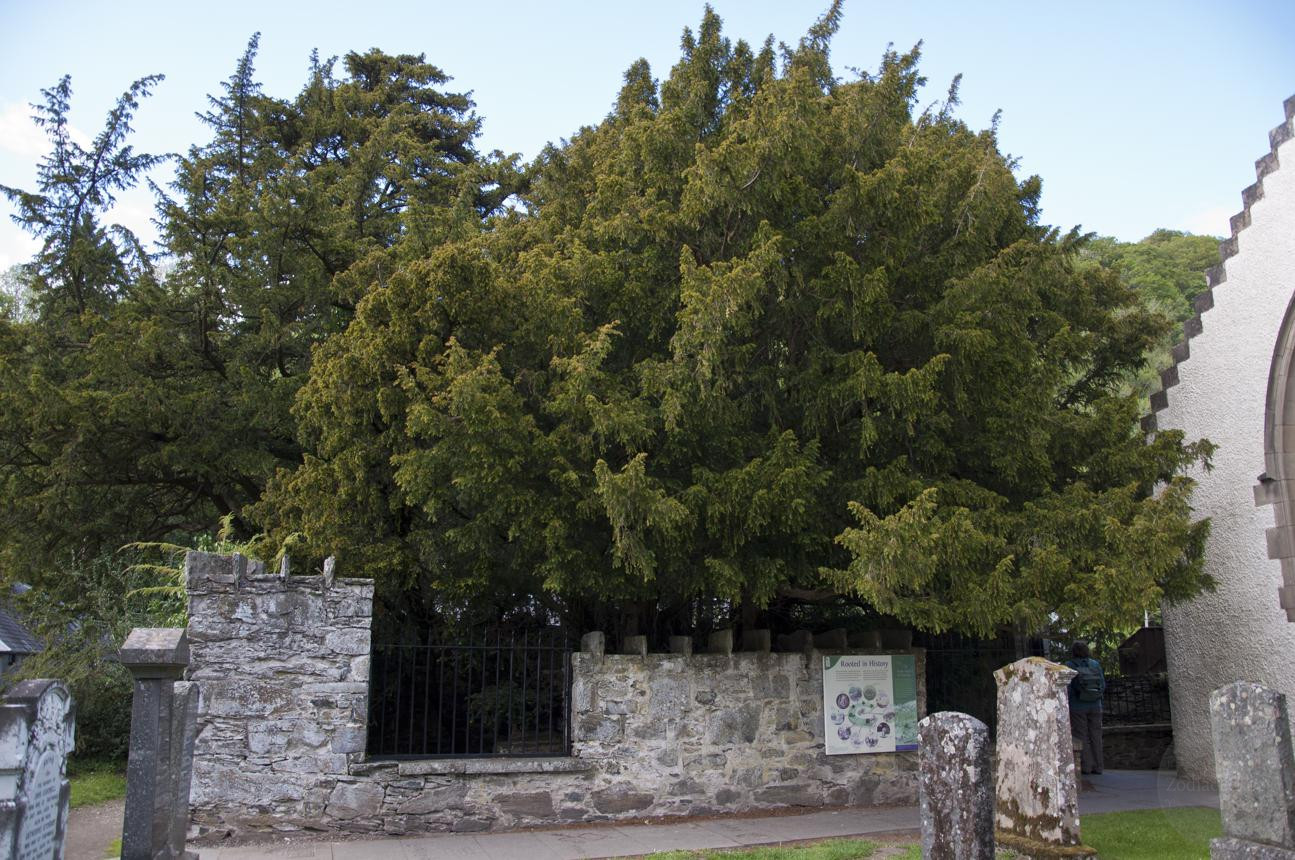
- Ancient guardians: Some British churchyard yews are older than the churches standing beside them.
- A poisonous tree: Yew needles, bark, and seeds contain dangerous toxins, reinforcing the tree’s sinister reputation.
- Death and immortality: The evergreen yew became associated with funerals, resurrection, and the boundary between life and death.
- Surviving mysteries: Ancient yews in Scotland and Wales remain surrounded by legends of spirits, sacred places, and supernatural events.
Walk through an old British churchyard on a misty morning, and you may encounter something more ancient than the gravestones, the church, or even the village itself. Standing among the dead is a dark evergreen tree with twisted branches, a hollow trunk, and a history stretching back hundreds or sometimes thousands of years.
It is the common yew (Taxus baccata), one of Britain’s longest-living native trees and a species deeply associated with death, mourning, and immortality. For centuries, people have regarded these trees as guardians of burial grounds. Their poisonous nature and extraordinary longevity helped create a reputation that survives in British folklore today.
Why Do Ancient Yew Trees Grow in Graveyards?
Yew trees are a familiar sight in churchyards throughout Britain. According to the Woodland Trust, more than 500 English churchyards contain yews older than the church buildings themselves. This remarkable fact raises an intriguing question: were some churches deliberately constructed beside trees that people already considered sacred?
In pre-Christian Britain, yews acquired associations with death, renewal, and the continuity of life. Their evergreen foliage remained green through winter, while their ability to survive for extraordinary periods made them natural symbols of endurance.
Some ancient trees may have stood at important gathering or sacred sites before Christianity became established. Later, Christian communities incorporated the yew into churchyard traditions. However, not every old churchyard yew predates Christianity. Many were planted during the establishment of medieval churches, and the reasons for their presence varied between communities.
The Poisonous Tree That Became a Symbol of Death
Unlike many trees associated with supernatural folklore, the yew possesses a very real danger. Its needles, bark, and seeds contain poisonous compounds capable of causing severe illness or death. The bright red fleshy covering surrounding each seed is an exception, but the seed itself remains toxic.
For earlier generations, this combination of beauty and danger was particularly striking. A tree that remained green throughout winter could also contain substances deadly to humans and livestock.
The Roman writer Julius Caesar recorded that Cativolcus, a leader of the Eburones, took poison from a yew rather than surrender to Roman forces. The yew therefore carried two seemingly contradictory meanings: it represented both the possibility of death and the promise of life continuing beyond it.
Why Were Yew Branches Placed in Coffins?
In British funerary traditions, yew branches were sometimes carried during processions or placed inside coffins. Their evergreen appearance symbolized endurance, remembrance, and hope for eternal life.
Christian communities also used yew branches during Palm Sunday celebrations, particularly where traditional palm leaves were unavailable. These practices strengthened the tree’s connection with religious ceremonies and burial grounds.
But the yew’s reputation was not entirely comforting. Its dark foliage, ancient appearance, and association with graves also made it a symbol of sorrow and approaching death. In his eighteenth-century poem The Grave, Scottish poet Robert Blair portrayed the yew as a gloomy companion of tombs and coffins.
The Fortingall Yew: A Tree Older Than Christianity in Scotland
One of Britain’s most extraordinary examples grows in the churchyard of Fortingall, Perthshire, Scotland. The Fortingall Yew is generally estimated to be between 2,000 and 3,000 years old, although some historical estimates have suggested considerably greater ages.
Its immense age has inspired numerous legends. One local story claims that Pontius Pilate was born beneath its branches, although this belongs to folklore rather than established history. Another tradition associates the tree with ancient seasonal ceremonies and the Celtic festival of Beltane.
Perhaps the most unsettling story concerns funeral processions. During the eighteenth century, when the tree’s trunk had already divided, coffins were reportedly carried through the opening between its enormous sections. The ancient yew became a symbolic passage between the world of the living and the resting place of the dead.
The Bleeding Yews of Wales
In the churchyard of St Brynach’s Church in Nevern, Pembrokeshire, several ancient yew trees are associated with an unusual local legend. Known as the Bleeding Yews of Nevern, these trees have been reported to produce reddish liquid from their trunks, creating the appearance of bleeding bark.
According to local folklore, the phenomenon has supernatural significance. One tradition connects the bleeding trees with the death of an innocent man, while another associates them with a prophecy concerning the church.
Although the reddish liquid has natural botanical explanations, the visual effect has helped preserve the trees’ mysterious reputation. For generations, visitors have encountered what appears to be blood emerging from the trunk of a tree growing among graves.
Why Are Yew Trees Still Associated With the Dead?
The connection between yews and burial grounds has never entirely disappeared. Ancient specimens remain protected features of churchyards, while younger yews continue to be planted in cemeteries and memorial gardens.
Their longevity gives them a remarkable relationship with human history. A single tree may survive countless generations of families, witnessing the construction of churches, the burial of villagers, and centuries of changing traditions. Some ancient yews were already mature when the oldest surviving gravestones around them had not yet been carved.
Unlike ordinary monuments, these living witnesses continue growing, renewing their foliage, and sometimes developing new trunks as their oldest wood decays. It is easy to understand why earlier generations imagined that such trees possessed a special relationship with time, death, and the unseen world.
Conclusion
The churchyard yew remains one of Britain’s most mysterious living symbols. Its poisonous nature, remarkable lifespan, and centuries of funerary associations have given it a reputation unlike that of almost any other native tree.
From the ancient Fortingall Yew to the Bleeding Yews of Nevern, these extraordinary trees preserve a mixture of history, folklore, and religious symbolism. And perhaps the most haunting detail is that some of these silent guardians were already standing long before the churches and graves surrounding them existed.
Cosmic Highlights

FAQ
Why are yew trees planted in British graveyards?
Yews became associated with churchyards through their symbolism of death, immortality, and resurrection. Practical reasons, including their poisonous nature and protection from grazing animals, may also have influenced the tradition.
Are churchyard yew trees poisonous?
Yes. Most parts of the common yew contain dangerous toxins, including the needles, bark, and seeds. The red fleshy covering around the seed is not poisonous, but the seed itself is.
What is the oldest yew tree in Britain?
The Fortingall Yew in Perthshire, Scotland, is among Britain’s oldest known trees. Its age is commonly estimated at approximately 2,000–3,000 years.
What are the Bleeding Yews of Nevern?
They are ancient yew trees in Pembrokeshire, Wales, associated with reddish liquid emerging from their trunks and local legends concerning death and supernatural events.
Do some yew trees predate the churches beside them?
Yes. Some ancient British churchyard yews are older than their surrounding churches, although not every old yew dates to pre-Christian times.
Sources and Further Reading
1. Woodland Trust – Yew (Taxus baccata)
History, poisonous properties, symbolism, and traditional associations with British churchyards.
https://www.woodlandtrust.org.uk/trees-woods-and-wildlife/british-trees/a-z-of-british-trees/yew/
2. Woodland Trust – Ancient Yew Trees
The extraordinary longevity of Britain’s ancient yews and their historical significance.
https://www.woodlandtrust.org.uk/blog/ancient-yew-trees/
3. Woodland Trust – The UK’s Spookiest Trees
British tree folklore, including legends associated with the ancient Fortingall Yew in Scotland.
https://www.woodlandtrust.org.uk/blog/uk-spookiest-trees/
4. Trees for Life – Yew
The mythology, cultural history, and traditional symbolism of yew trees, including their connections with death and immortality.
https://treesforlife.org.uk/into-the-forest/trees-plants-animals/trees/yew/