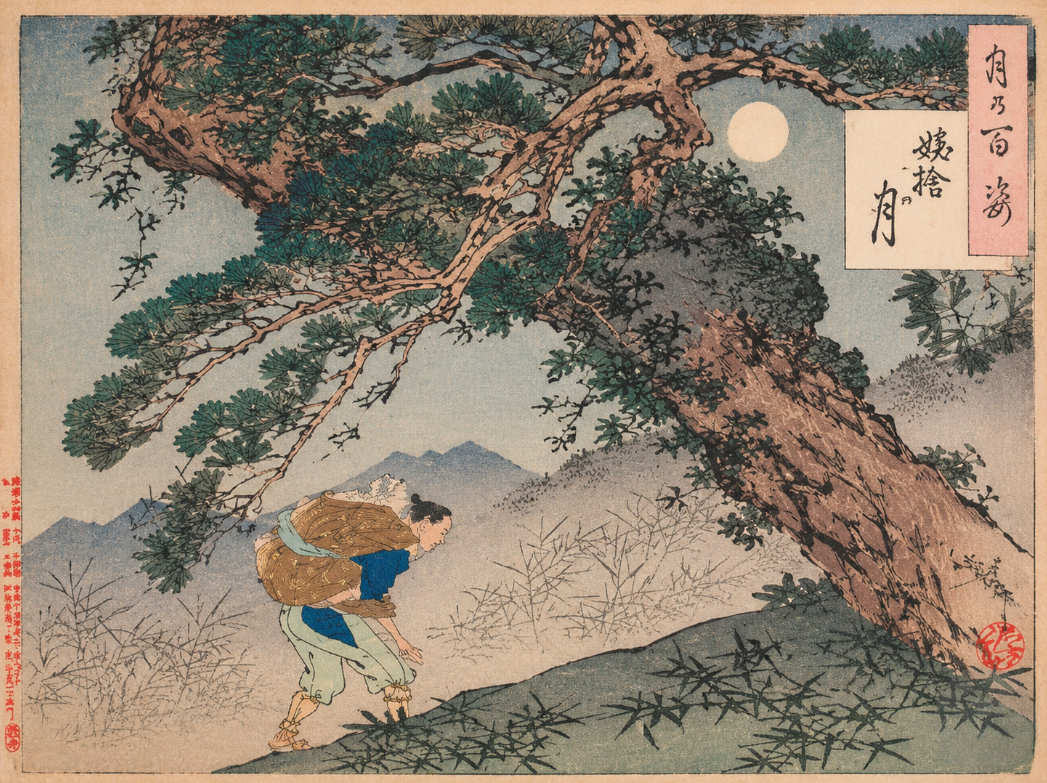
- Ubasute describes the abandonment of elderly relatives in remote mountains, where they faced starvation, exposure, and death.
- The legend appears in Japanese literature dating back to the Heian period, including the tenth-century Yamato Monogatari.
- Obasute Mountain in present-day Nagano Prefecture became associated with abandonment, sorrow, and haunting moonlit landscapes.
- Different versions of the legend explore cruelty, poverty, family loyalty, and the wisdom of older generations.
Imagine an elderly woman being carried up a steep mountain path by her own son. She knows where he is taking her. There will be no shelter, no food, and nobody to help her return home. Once he leaves, she will face the cold and darkness alone.
Yet as they climb, she quietly breaks small branches and drops them along the path. When her son asks why, her answer is devastating: she is marking the route so that he can find his way home safely after abandoning her.
This heartbreaking scene belongs to one of Japan’s most disturbing traditional narratives: Ubasute, also known as Obasute, the abandonment of elderly people in the mountains.
What Was Ubasute?
The Japanese term ubasute is commonly interpreted as the abandonment of an elderly woman, while related expressions refer more broadly to leaving aging parents behind.
In traditional stories, a family member carries an elderly relative into the mountains and leaves them in an isolated place. Without food or protection, the abandoned person is expected to die from hunger, exposure, or exhaustion.
The stories frequently place the decision within a world of extreme hardship. Food is scarce, survival depends on physical labor, and older people are treated as burdens once they can no longer contribute to the household. Other versions describe a cruel ruler ordering families to abandon their elderly relatives, forcing children to choose between obedience and loyalty.
The Ancient Story of Obasute Mountain
One of the oldest literary accounts appears in Yamato Monogatari, a tenth-century Japanese collection of tales. Its story concerns a man who has been raised by his elderly aunt. Although she cared for him like a mother, his wife grows increasingly hostile toward the older woman and pressures him to remove her from their household.
Eventually, the man carries his aunt into the mountains and abandons her. Later, he looks toward the mountain beneath the moonlight and becomes overwhelmed by grief and remorse. Unable to endure what he has done, he returns to bring her home.
The tale became associated with Obasute Mountain in the Sarashina region of present-day Nagano Prefecture. Its moonlit scenery also entered Japanese poetry, where beauty and sorrow became inseparable.
The Mother Who Left a Trail for Her Son
Another famous version introduces an even more painful detail. As a son carries his elderly mother into the mountains, she breaks branches and scatters them along the path. He initially assumes she is confused or frightened. But the mother explains that she wants him to find his way back safely after leaving her to die.
Her concern for her son, even in the face of abandonment, forces him to recognize the cruelty of his decision. In many retellings, he refuses to leave her and carries her home again. The story transforms an act of rejection into a lesson about unconditional love and filial responsibility.
The Village That Ordered Its Elderly to Die
A different group of Ubasute tales describes communities ruled by harsh laws requiring the elderly to be abandoned after reaching a certain age. One well-known narrative follows a son who secretly hides his mother rather than obey the order.
When the ruler later demands solutions to seemingly impossible problems, the hidden elderly woman provides the wisdom needed to solve them. Her intelligence eventually reveals the value of older generations, and the cruel policy is overturned.
These stories explore a striking contradiction: the people considered too old to be useful often possess knowledge that younger generations desperately need.
How Ubasute Became Part of Japanese Literature and Cinema
The legend continued to evolve through Japanese poetry, theatrical traditions, and modern storytelling. Obasute became the subject of a classical Noh play, while later writers explored the emotional and moral consequences of abandoning the elderly.
One particularly famous adaptation is The Ballad of Narayama, a story that portrays a mountain community where elderly people are expected to leave their families and die. Its cinematic adaptations, including Shohei Imamura’s acclaimed 1983 film, brought the disturbing tradition to international audiences.
Across these different interpretations, the central image remains unforgettable: an aging parent, a lonely mountain, and a family forced to confront the meaning of duty, survival, and compassion.
Conclusion
Ubasute is one of Japan’s most haunting traditional legends because its horror comes not from ghosts or supernatural creatures, but from human decisions.
The image of an elderly mother waiting alone on a mountainside captures the fear of becoming unwanted by the very people one has spent a lifetime protecting. Yet many versions end with rescue, remorse, or recognition of the wisdom that older generations possess.
The mountain becomes more than a place of abandonment. It becomes a symbol of the fragile boundary between cruelty and compassion.
Cosmic Highlights

FAQ
What does Ubasute mean in Japanese?
Ubasute refers to the abandonment of an elderly woman, traditionally in a remote mountain location. Related terms, including Obasute and Oyasute, appear in Japanese folklore about leaving aging relatives behind.
Where is Obasute Mountain located?
Obasute Mountain is traditionally associated with the Sarashina area of present-day Nagano Prefecture, Japan. Mount Kamuriki is closely connected with the legend and its literary history.
What is the oldest Japanese story about Ubasute?
One of the earliest detailed narratives appears in the tenth-century Yamato Monogatari. It tells of a man who abandons his elderly aunt in the mountains but later returns for her after experiencing overwhelming remorse.
What is the story of the mother who dropped branches?
In a famous Japanese folktale, an elderly mother marks the mountain path with broken branches so her son can return safely after abandoning her. Her selfless concern causes him to reconsider his actions and take her home.