- Most Oscar-winning performers: Leo, with 14 distinct winners.
- Highest winner share: Libra, with 45% of its nominated performers winning at least once.
- Strongest challengers: Scorpio at 38.5%, Leo at 36.8%, and Gemini at 34.4%.
- Standout Venus placement: Virgo, appearing among 14 Oscar-winning performers.
- Standout Mars placement: Gemini, also appearing among 14 winners.
Does Hollywood’s biggest acting award favor certain zodiac signs? An analysis of 540 Academy Award nominations spanning 27 years reveals an intriguing pattern: Leo has produced more Oscar-winning performers than any other Sun sign, but Libra has the highest proportion of winners among its nominees.
The research covers every nomination in the four acting categories between 2000 and 2026, bringing together 325 distinct performers and 108 winning nomination entries. After excluding three individuals with unresolved birth-date information, the study examined 322 natal profiles, including planetary placements and major aspects.
Unlike a simple celebrity zodiac ranking, this analysis distinguishes between the number of performers nominated, the number who actually won, and the percentage of winners within each sign. It also explores whether placements involving Venus, Mars, Jupiter, and Saturn reveal patterns that might otherwise remain hidden.
The results offer several surprises. Leo dominates the total winner count, Libra performs particularly strongly relative to its number of nominees, and some of the most interesting planetary concentrations appear in signs that do not lead the Sun-sign rankings.

27 Years of Oscars: What the Numbers Reveal
Between the 2000 and 2026 Academy Awards ceremonies, the four acting categories generated 540 nomination entries and 108 winning entries. Because successful actors often return to the Oscars multiple times, these entries represent a smaller group of 325 individual performers.
That distinction is fundamental to the research. Counting every nomination as a separate person would give disproportionate influence to repeatedly nominated stars. Instead, the primary astrological comparison counts each performer once and classifies them according to whether they won at least one acting Oscar during the study period.
Of the 322 performers with usable birth-date information, 97 received at least one acting Oscar, while 225 were nominated without winning during the period. This produces an overall winner share of approximately 30.1%.
The analysis therefore examines two different forms of Oscar recognition. The first is nomination, which represents recognition by Academy voters. The second is victory, which separates the performers who ultimately received the award from those who remained nominees. These two measures do not produce identical zodiac rankings.
Leo Dominates the Oscar Winner Count
Leo is the most represented Sun sign among Oscar-winning performers, with 14 individuals receiving at least one acting Academy Award between 2000 and 2026. No other sign reaches that total.
Gemini follows with 11 winners, while Aries and Scorpio each account for 10. Libra comes next with nine, despite having a considerably smaller pool of nominees than several competing signs.
Leo’s prominence is particularly striking from an astrological perspective. Traditionally ruled by the Sun, Leo is associated with personal expression, theatricality, creative confidence, and the desire to make a lasting impression. These qualities closely resemble the public image of a commanding screen performer.
Yet the figures reveal something more complicated than a simple Leo victory. The dataset also contains 24 Leo performers who were nominated without winning during the study period. That means Leo’s 14 winners emerged from a group of 38 nominated individuals.
Its resulting winner share is 36.8%—strong, but not the highest.
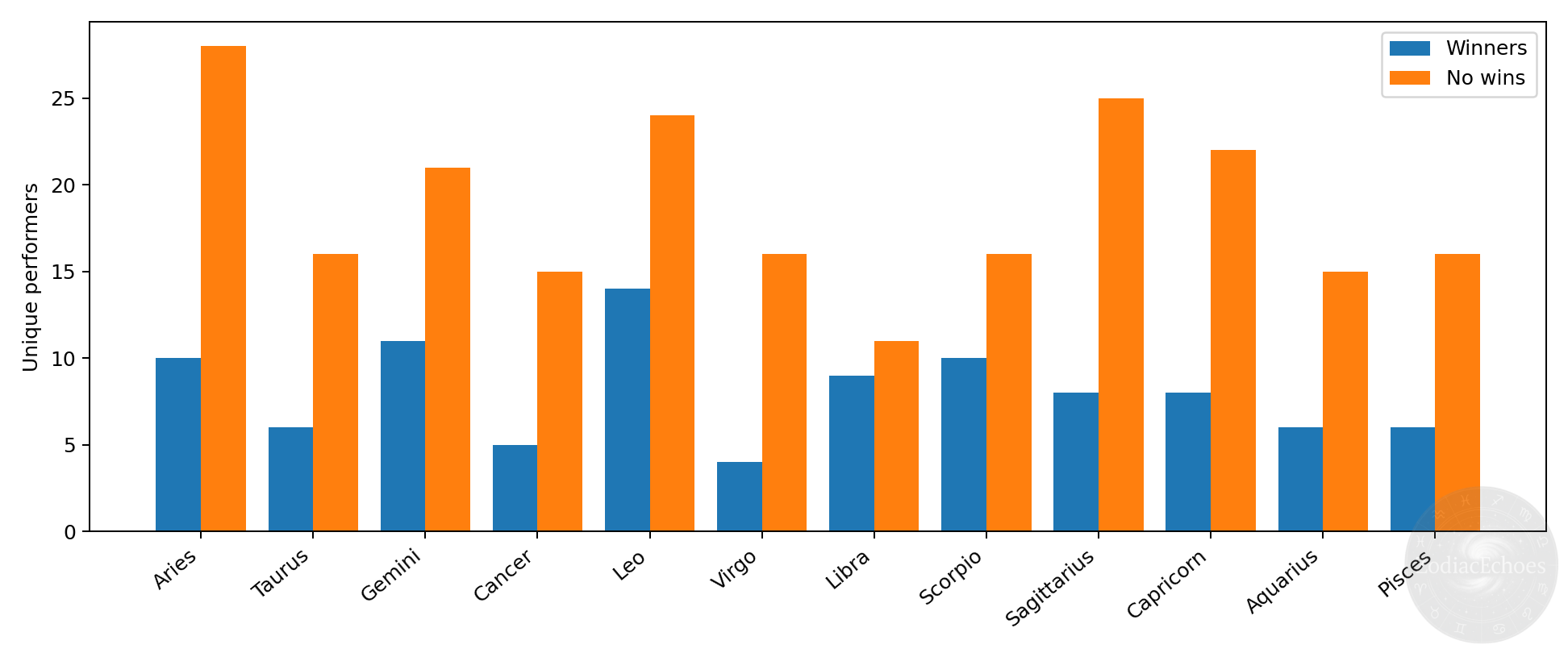
Number of distinct Oscar-winning and nonwinning performers by Sun sign, based on 322 eligible birth-date profiles from 2000–2026.
The chart illustrates why absolute totals can be misleading. A sign with many nominees has more opportunities to produce winners, while a smaller group can achieve a higher proportion of victories without leading the overall count. For Leo, the most distinctive result is its numerical dominance among winning performers. For other signs, the story changes when the number of nominees is taken into account.
Hollywood’s Most Successful Oscar Winners: Who Won More Than Once?
While the zodiac analysis reveals broader patterns, several performers stand out for repeatedly winning Hollywood’s most prestigious acting award. Across the 2000–2026 study period, Sean Penn leads with three acting Oscars, while nine other performers won twice.
The Most Successful Oscar Winners, 2000–2026
| Actor or Actress | Zodiac Sign | Oscar Wins | Winning Films |
|---|---|---|---|
| Sean Penn | Leo | 3 | Mystic River (2004), Milk (2009), One Battle after Another (2026) |
| Adrien Brody | Aries | 2 | The Pianist (2003), The Brutalist (2025) |
| Cate Blanchett | Taurus | 2 | The Aviator (2005), Blue Jasmine (2014) |
| Christoph Waltz | Libra | 2 | Inglourious Basterds (2010), Django Unchained (2013) |
| Daniel Day-Lewis | Taurus | 2 | There Will Be Blood (2008), Lincoln (2013) |
| Emma Stone | Scorpio | 2 | La La Land (2017), Poor Things (2024) |
| Frances McDormand | Cancer | 2 | Three Billboards Outside Ebbing, Missouri (2018), Nomadland (2021) |
| Hilary Swank | Leo | 2 | Boys Don’t Cry (2000), Million Dollar Baby (2005) |
| Mahershala Ali | Aquarius | 2 | Moonlight (2017), Green Book (2019) |
| Renée Zellweger | Taurus | 2 | Cold Mountain (2004), Judy (2020) |
The table counts acting Oscars awarded during the study period, not an individual’s entire career. Some performers also won acting Oscars before 2000.
Sean Penn: Three Oscars and a Remarkable Leo Record
Sean Penn is the only performer in the dataset with three acting victories, winning for Mystic River, Milk, and One Battle after Another. Born on August 17, 1960, Penn is a Leo, the sign that also leads the overall winner count.
His performances frequently explore morally complicated, emotionally intense characters. From the grieving father in Mystic River to the political activist Harvey Milk, Penn’s award-winning roles demonstrate an extraordinary capacity for transformation.
Cate Blanchett and Emma Stone: Two Different Paths to Oscar Success
Cate Blanchett, a Taurus, won twice during the study period, first for her supporting performance as Katharine Hepburn in The Aviator and later for her leading role in Blue Jasmine. Her victories illustrate the range between portraying a recognizable historical figure and creating a psychologically complex fictional character.
Emma Stone, a Scorpio, also earned two acting Oscars, for La La Land and Poor Things. Her performances moved from musical romantic drama to an unconventional exploration of identity and personal freedom, highlighting the versatility that has defined her career.
Daniel Day-Lewis, Hilary Swank, and the Art of Transformation
Daniel Day-Lewis, another Taurus, secured two victories within the study period for There Will Be Blood and Lincoln. His reputation for meticulous preparation makes him an interesting example when considering the relationship between acting discipline and the planetary placements explored in this research.
Meanwhile, Hilary Swank, a Leo, won twice within just six ceremonies, for Boys Don’t Cry and Million Dollar Baby. Both performances required demanding physical and emotional transformations, reinforcing Leo’s prominent representation among the dataset’s most successful performers.
Together, these repeat winners illustrate an important distinction: the strongest Oscar careers cannot be explained by Sun signs alone. Their achievements span several zodiac signs, while their natal planetary configurations provide an additional layer for the broader statistical analysis.
Libra’s Unexpected Advantage: The Highest Winner Share
Although Leo leads the winner count, Libra records the highest proportion of Oscar winners among nominated performers.
Of the 20 Libra individuals included in the analysis, nine won at least one acting Oscar during the period. That represents a winner share of 45%, substantially above the overall sample average of 30.1%.
Scorpio follows at 38.5%, with 10 winners among 26 nominees. Leo ranks third at 36.8%, while Gemini reaches 34.4%. This changes the interpretation of the original ranking. Leo produced more winners, but Libra’s smaller nominated group had the strongest proportion of performers who ultimately won.
Oscar Winner Share by Zodiac Sign
| Zodiac Sign | Winners | Nonwinners | Winner Share |
|---|---|---|---|
| Libra | 9 | 11 | 45.0% |
| Scorpio | 10 | 16 | 38.5% |
| Leo | 14 | 24 | 36.8% |
| Gemini | 11 | 21 | 34.4% |
| Aquarius | 6 | 15 | 28.6% |
| Taurus | 6 | 16 | 27.3% |
| Capricorn | 8 | 22 | 26.7% |
| Aries | 10 | 28 | 26.3% |
| Pisces | 6 | 16 | 27.3% |
| Cancer | 5 | 15 | 25.0% |
| Sagittarius | 8 | 25 | 24.2% |
| Virgo | 4 | 16 | 20.0% |
Winner share is the percentage of nominated performers within each sign who won at least once during 2000–2026.
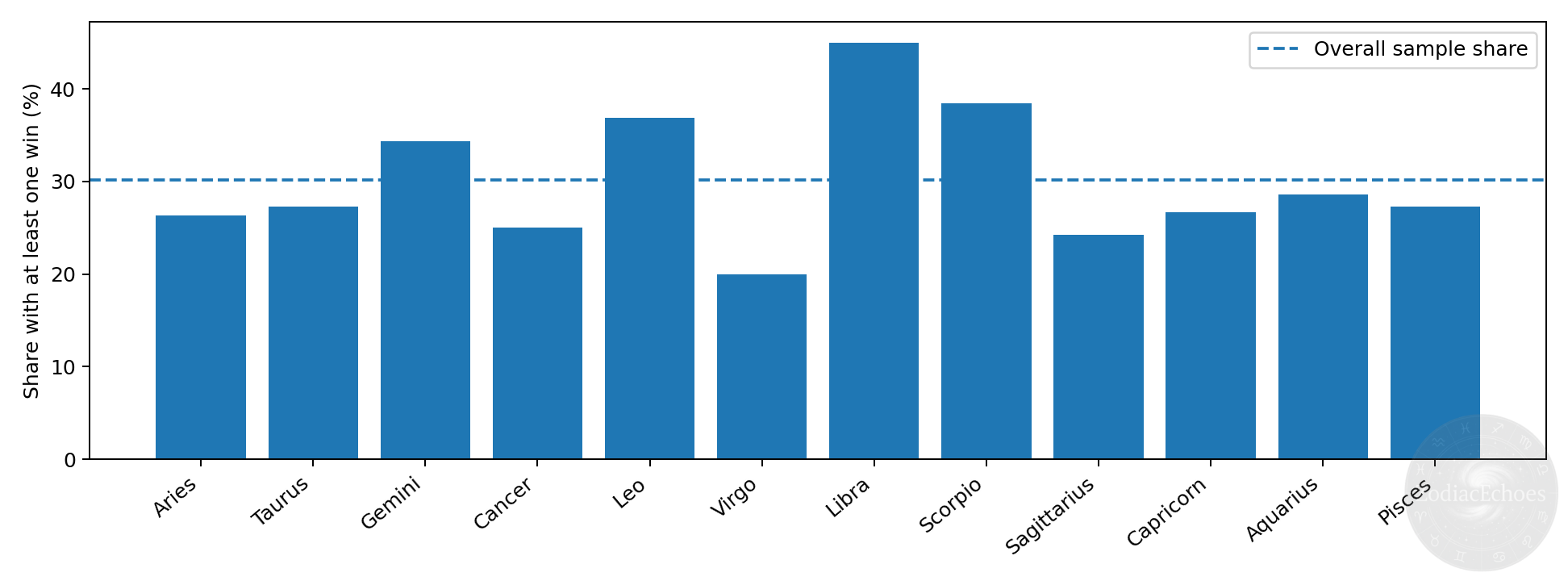
Percentage of nominated performers who won at least one acting Oscar, grouped by Sun sign. The dashed reference line represents the overall sample winner share.
Astrologically, Libra is traditionally associated with Venus, artistic sensitivity, harmony, and the ability to understand competing perspectives. In acting, those themes can be interpreted through emotional subtlety, character relationships, and the ability to portray contrasting motivations.
Scorpio presents a different symbolic profile. Its traditional associations include psychological intensity, emotional depth, transformation, and the exploration of hidden motivations. These qualities offer a natural interpretive connection to dramatic roles that demand vulnerability or profound character development.
The contrast between Libra and Scorpio is especially interesting: one sign is traditionally linked to balance and relational intelligence, while the other is associated with intensity and transformation. Both perform strongly in the winner-share comparison.
Which Zodiac Signs Have the Lowest Winner Share?
At the opposite end of the ranking, Virgo has the lowest winner share at 20%, with four winners among 20 nominated performers. Sagittarius follows at 24.2%, while Cancer reaches 25%. Aries, despite producing 10 winning performers, has a winner share of just 26.3% because its nominated population is relatively large.
These results reinforce the importance of distinguishing nomination frequency from winning frequency. A sign can produce numerous recognized actors without achieving an equally high proportion of victories.
Virgo’s position is particularly notable because its planetary symbolism appears elsewhere in the research. Although Virgo ranks last in the Sun-sign winner-share comparison, Venus in Virgo and Jupiter in Virgo are prominent among the winning performers. This suggests that examining Sun signs alone may overlook some of the more interesting distributions within the dataset.
Beyond Sun Signs: The Planetary Placements of Oscar Winners
A Sun-sign analysis captures only one component of a natal chart. To examine the wider astrological picture, the research also calculated planetary placements using the performers’ recorded birth dates.
The calculations include the Sun, Mercury, Venus, Mars, Jupiter, Saturn, Uranus, Neptune, and Pluto. The Moon, Ascendant, and houses were excluded because reliable birth times were unavailable. Three planetary distributions stand out among the winning performers: Venus in Virgo, Mars in Gemini, and Jupiter in Virgo.
Venus in Virgo: Precision Behind the Performance
Venus in Virgo appears among 14 of the 97 winning performers, making it the most frequent Venus sign in the winning group. Within the full eligible sample, 32 performers have Venus in Virgo, and 14 of them won. That produces a winner share of approximately 43.8% for this placement.
In traditional astrology, Venus represents artistic expression, aesthetic preferences, pleasure, and relationships. Virgo introduces themes of refinement, careful observation, technical discipline, and attention to detail.
Applied symbolically to acting, this combination evokes a performer who approaches creativity through preparation and precision rather than relying exclusively on spontaneous expression. The placement is especially intriguing because Virgo’s Sun-sign results are comparatively weak. Virgo appears more prominently as a Venus placement among winners than it does as a Sun sign.

Mars in Gemini: Adaptability and Expression
Mars in Gemini is the most frequent Mars placement among the winning performers, appearing 14 times. Of the 32 eligible performers with this placement, 14 won during the period, producing a winner share of approximately 43.8%.
Mars traditionally describes drive, action, determination, and the way an individual directs energy. Gemini is associated with communication, versatility, curiosity, and rapid adaptation. In the context of performance, Mars in Gemini can be interpreted through the ability to move between emotional registers, adopt contrasting personalities, and deliver dialogue with precision and energy.
Mars in Taurus also appears prominently, with 13 winners among 32 performers. Its symbolic emphasis differs considerably, favoring endurance, persistence, and sustained effort over Gemini’s flexibility. The presence of both placements among the leading Mars distributions suggests two contrasting astrological themes: adaptability and persistence.
Jupiter in Virgo: Recognition Through Mastery?
Jupiter in Virgo produces another noteworthy result. Thirteen of the 27 eligible performers with this placement won an acting Oscar, giving it a winner share of approximately 48.1%.
Jupiter is traditionally associated with growth, opportunity, recognition, and expansion. Virgo, meanwhile, emphasizes craftsmanship, analysis, and continuous improvement. From an astrological perspective, Jupiter in Virgo offers an interesting symbolic combination: success through technical mastery, dedication to a craft, and the gradual refinement of ability.
This is one of the stronger descriptive concentrations identified in the planetary analysis. However, its smaller subgroup means the percentage can change considerably with only a few additional performers.
Saturn and the Discipline of Award-Winning Performers
Saturn provides another perspective on the research because its traditional symbolism differs from the more expressive associations of Venus and Mars. Saturn represents structure, responsibility, persistence, and long-term development. In a profession where careers can unfold across decades, these themes have an obvious interpretive relevance.
Saturn in Capricorn appears among 17 winning performers, making it the most frequent Saturn placement within the winning group. Saturn in Aries follows with 13.
However, the most frequent placement is not necessarily the one with the highest winner share. Saturn in Gemini, for example, appears among seven winners and eight nonwinners, producing a winner share of approximately 46.7%.
Saturn in Cancer also records a relatively high share, with 10 winners among 23 eligible performers. These differences underline an important analytical principle: a planetary sign can lead in total winners without leading in the proportion of winners within its group.
Planetary Aspects: A Deeper Look at the Oscar Charts
Planetary signs describe where celestial bodies were positioned at birth, but aspects examine their angular relationships. The research calculated five traditional major aspects: conjunctions, sextiles, squares, trines, and oppositions. A maximum orb of five degrees was applied, alongside a birth-time sensitivity check.
Across the 322 eligible profiles, the dataset identifies 2,293 aspect occurrences that remained stable throughout the sampled sensitivity window.
Distribution of Stable Major Aspects
| Aspect | Recorded Occurrences |
|---|---|
| Sextile | 827 |
| Square | 446 |
| Trine | 423 |
| Conjunction | 399 |
| Opposition | 198 |
| Total | 2,293 |
Sextiles form the largest category, accounting for approximately 36.1% of the recorded aspects. Squares follow at 19.5%, trines at 18.4%, conjunctions at 17.4%, and oppositions at 8.6%.
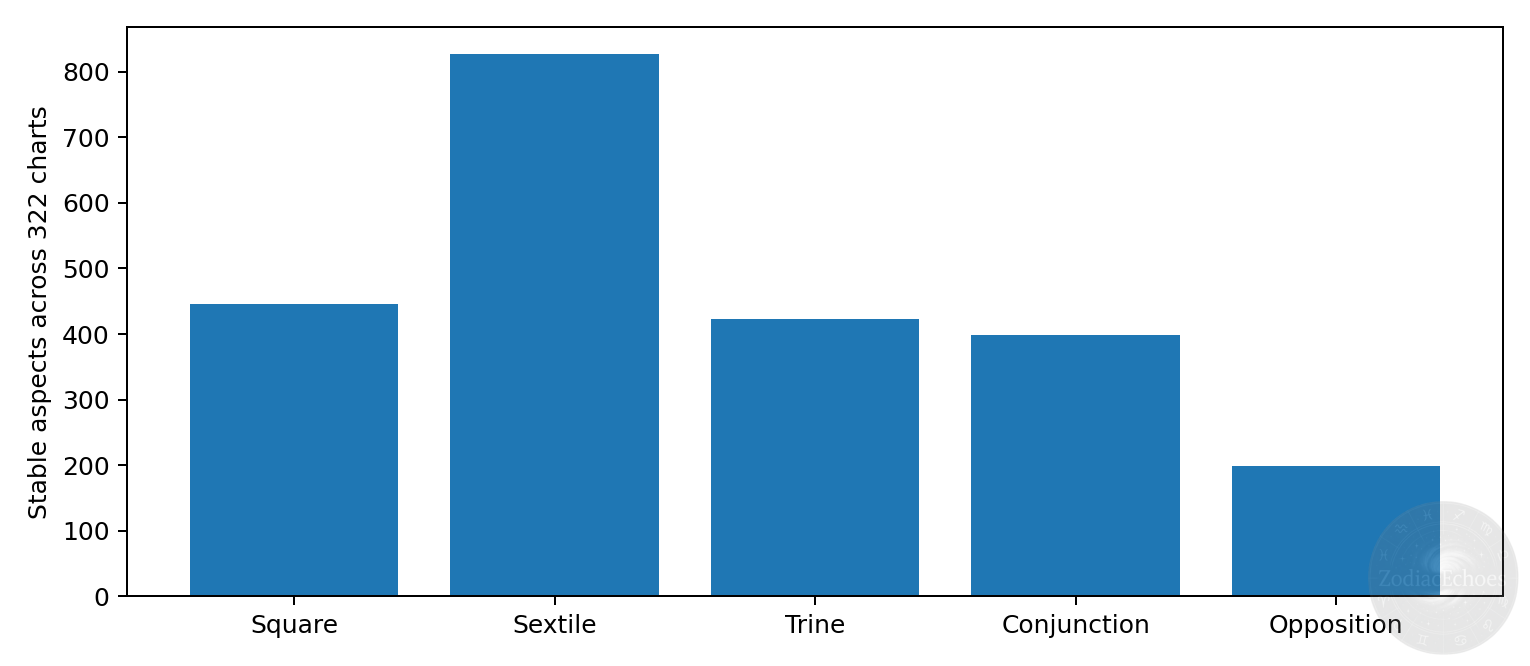
Distribution of stable major planetary aspect occurrences across 322 eligible natal profiles. Counts represent aspect occurrences, not distinct individuals.
In traditional astrology, sextiles and trines are generally associated with easier exchanges of planetary energy, while squares and oppositions describe tension, challenge, and the need for adjustment. Conjunctions concentrate planetary symbolism through close angular proximity.
Yet the chart should not be interpreted as evidence that sextiles make actors more successful. The totals combine winners and nonwinners, and the number of possible planetary relationships influences the distribution.
A more targeted analysis would compare the prevalence of specific aspects among winning and nonwinning performers, rather than treating the overall aspect count as a measure of success.
How We Conducted the Oscar Astrology Study
The study includes all four acting categories at the Academy Awards ceremonies held from 2000 through 2026: Actor in a Leading Role, Actress in a Leading Role, Actor in a Supporting Role, and Actress in a Supporting Role.
The original 540 nomination records were consolidated into 325 unique performers. Each person was then classified according to whether they won at least one acting Oscar during the selected period.
Birth-date information was reviewed against biographical sources. Three individuals—Marina de Tavira, Rosamund Pike, and Vanessa Kirby—were excluded from the primary astrological calculations because their recorded birth-date information required further verification.
Planetary positions were calculated using Swiss Ephemeris 2.10.03, applying tropical geocentric positions and a reference time of 12:00 UTC. The research also examined whether planetary placements and aspects remained consistent across a broader window of possible birth times.
The resulting dataset contains 322 usable astrological profiles, divided into 97 winning performers and 225 nominated nonwinners. The winner-share comparisons describe this nominated population, not the wider acting profession or the general population. They are descriptive findings and do not establish that any astrological placement causes an Academy Award victory.
Conclusion
Leo leads the absolute count of Oscar-winning performers, but Libra emerges as the strongest Sun sign when victories are measured relative to the number of nominees. Scorpio and Gemini also perform prominently, while the wider planetary analysis highlights Venus in Virgo, Mars in Gemini, Jupiter in Virgo, and Saturn in Capricorn.
The central finding is that the picture changes depending on what is measured. Nomination frequency, total winners, winner share, and planetary placements each reveal a different layer of the dataset.
Across 27 Academy Awards ceremonies, 540 nominations, and 322 usable natal profiles, the research provides a detailed foundation for examining the astrological patterns associated with Hollywood’s most recognized performers.
FAQ
Which zodiac sign has the most Oscar-winning actors?
Leo leads the 2000–2026 dataset with 14 distinct performers who won at least one acting Academy Award.
Which zodiac sign has the highest Oscar winner percentage?
Libra has the highest winner share among nominated performers, with nine winners out of 20 individuals, or 45%.
Which planetary placements stand out among Oscar winners?
Venus in Virgo and Mars in Gemini each appear among 14 winning performers. Jupiter in Virgo appears among 13 winners, while Saturn in Capricorn appears among 17.
How many Oscar nominations were included?
The study covers 540 acting nomination entries across 27 Academy Awards ceremonies, representing 325 distinct performers.
Were exact birth times used?
No. Planetary positions were calculated from recorded birth dates using a noon UTC reference time. The Moon, Ascendant, and astrological houses were excluded because verified birth times were unavailable.
Does this study prove that astrology determines Oscar success?
No. It identifies descriptive patterns within an already-nominated group of performers. The findings do not establish a causal relationship between natal placements and Academy Award victories.