- Ancient Mesopotamian astrologers believed certain eclipses could predict the death of a king.
- A substitute ruler could be placed on the throne to absorb the deadly omen.
- The real monarch temporarily abandoned his royal identity to escape the predicted catastrophe.
- Surviving Assyrian records describe substitute kings, including Damqi, whose reign ended in death.
Imagine waking up as an ordinary man and discovering that you have been chosen to become king. You receive royal clothing, ceremonial honors, and a place on the throne of one of the ancient world’s most powerful empires. But there is a horrifying secret. Your coronation is not a reward. It is a death sentence.
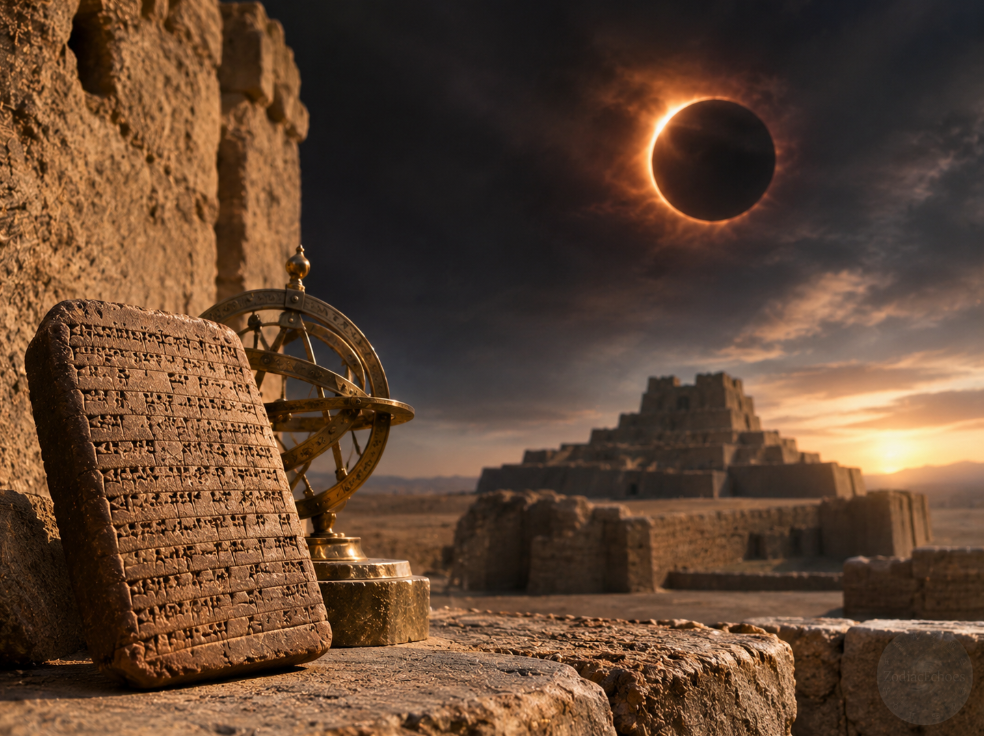
In ancient Mesopotamia, royal astrologers sometimes interpreted eclipses as warnings that a monarch was about to die. To prevent the prophecy from coming true, the court could appoint a substitute king whose purpose was to suffer the fate intended for the real ruler. This extraordinary practice was known as šar pūhi, the Substitute King ritual, and it is documented in surviving cuneiform records.
Why Did Ancient Astrologers Fear Eclipses?
For Babylonian and Assyrian astrologers, the heavens were not merely beautiful. They were a vast system of divine messages that could reveal the future of kingdoms, armies, and rulers.
Priests observed planetary movements, unusual celestial events, and especially eclipses. Their interpretations were recorded in extensive omen collections, including Enūma Anu Enlil. A lunar eclipse could be particularly threatening. Its timing, duration, and position in the sky helped astrologers determine which ruler or territory might be endangered.
When an eclipse was interpreted as predicting the king’s death, the warning could become a matter of national security.
The monarch’s survival was considered essential to the stability of the kingdom. Consequently, religious specialists developed an extraordinary way of attempting to redirect the predicted disaster.
The Man Who Was Crowned to Die
The solution was as ingenious as it was terrifying. Instead of allowing the real king to face the dangerous omen, priests selected another man to assume his royal identity. The substitute received the symbols of kingship and was ceremonially installed on the throne. In some cases, a woman was also appointed as his queen.
Meanwhile, the genuine monarch withdrew from public life. He temporarily abandoned his royal title and could be referred to symbolically as a farmer. For the duration of the ritual, the substitute was the king whom the predicted catastrophe was supposed to strike.
The arrangement reflected a fundamental belief of Mesopotamian divination: divine warnings revealed dangers that might sometimes be prevented through carefully performed rituals. When the threatening period had passed, the substitute’s reign ended. Some documented ceremonies concluded with the deaths of the substitute king and queen, followed by funerary rites.
Damqi: The Substitute King of 671 BCE
One of the most revealing examples occurred during the reign of the Assyrian king Esarhaddon, who ruled from 681 to 669 BCE. In 671 BCE, a young Babylonian man named Damqi was appointed as a substitute king following ominous celestial predictions.
Damqi was not simply an anonymous prisoner. Historical correspondence identifies him as the son of an important religious official. He was installed as the temporary ruler, and a woman served as his queen. Both eventually died, and the surviving records describe the ceremonies associated with their deaths.
The episode demonstrates that the Substitute King ritual was not merely a legend invented by later storytellers. It formed part of the religious and political machinery of the Assyrian royal court.
Could Ancient Astrologers Really Deceive the Gods?
The ritual presents a fascinating contradiction. If the gods controlled human destiny, how could replacing the king possibly change their decision? Mesopotamian scholars did not necessarily regard omens as unavoidable sentences. A celestial warning could indicate a danger that appropriate religious action might avert.
Through substitution, purification, and other protective ceremonies, priests attempted to redirect the consequences of threatening signs. The substitute king became the person upon whom the predicted misfortune would fall, leaving the legitimate ruler free to resume his duties.
Astrology was therefore not simply a method of predicting events. It was also part of an elaborate system intended to influence what happened next.
Conclusion
Ancient Mesopotamian astrology possessed a power almost unimaginable today. Its interpretations could influence military decisions, royal ceremonies, and the survival of entire dynasties. The Substitute King ritual reveals just how seriously rulers regarded celestial warnings. A single eclipse could trigger an extraordinary sequence of ceremonies designed to protect the throne.
And its darkest implication remains unforgettable: when the heavens appeared to demand the death of a king, another human being could be chosen to die in his place.
Cosmic Highlights

FAQ
Did ancient astrologers really sacrifice substitute kings?
Yes. Surviving Assyrian records document substitute rulers who died during rituals intended to protect reigning monarchs from dangerous celestial omens.
What was the Substitute King ritual called?
It was known in Akkadian as šar pūhi, meaning Substitute King.
Why were eclipses dangerous for Mesopotamian kings?
Astrologers believed certain eclipses predicted political disasters, military defeats, or the death of a ruler. Their interpretations depended on the eclipse’s characteristics.
Who was Damqi?
Damqi was a Babylonian man appointed as a substitute king in 671 BCE during the reign of Esarhaddon. Historical correspondence records his participation and death.