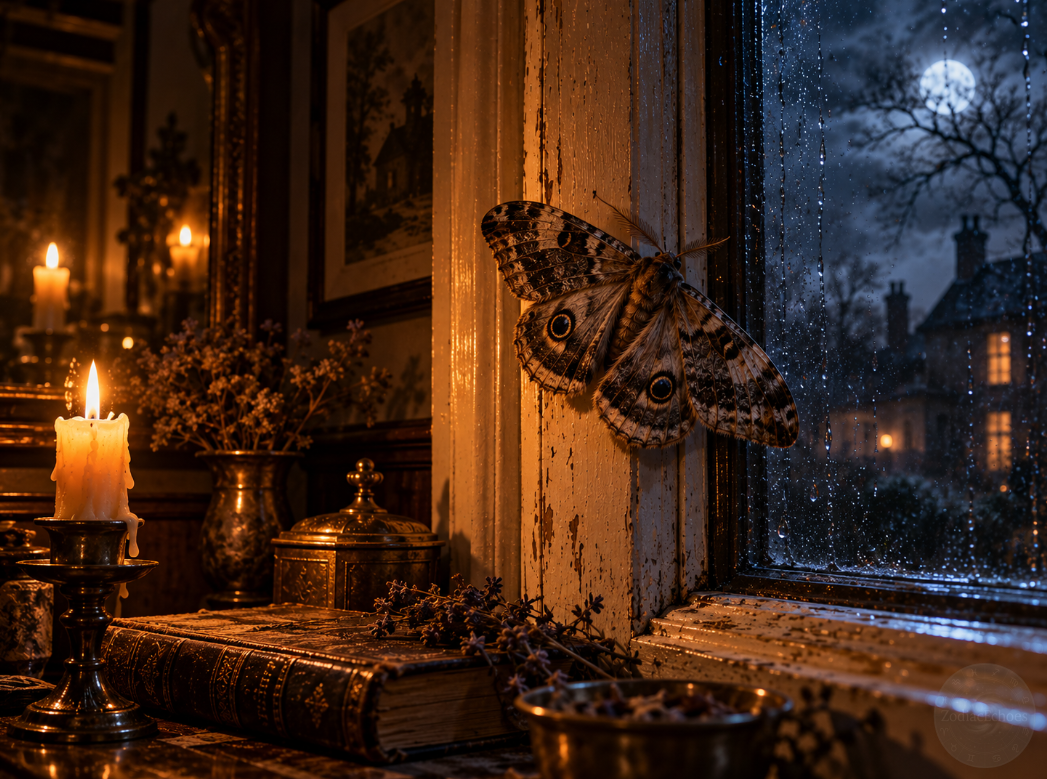
- Moths entering homes have been interpreted as omens of death or misfortune in some folklore traditions.
- The death’s-head hawkmoth became especially feared because of the skull-like marking on its thorax.
- Some traditions associate moths with departed souls, giving their appearance a spiritual meaning.
- Not all moth superstitions are negative; certain traditions connect them with visiting ancestors.
A large moth suddenly appears in your bedroom, circles the lamp, and settles silently on the wall. Most people would simply open a window and let it escape. But in some traditional beliefs, a moth entering the house was far more disturbing than an ordinary encounter with an insect. It could mean that death was approaching.
Moths have fascinated and frightened people for centuries. Their nocturnal habits, unpredictable movements, and attraction to light made them natural subjects for supernatural stories. In certain cultures, these mysterious insects became associated with departed souls, warnings from the spirit world, and approaching misfortune.
Why Were Moths Associated With Death?
Unlike butterflies, which are commonly associated with sunshine and transformation, moths are often active after dark. Their sudden appearance inside a home could seem particularly unsettling in an era when rooms were illuminated by candles or oil lamps.
A large, dark-colored moth was sometimes interpreted as a messenger of death. In certain regional traditions, its arrival suggested that someone in the household might soon die or that unfortunate news was approaching.
However, moth folklore was never entirely negative. In some traditions, moths were believed to represent the souls of deceased relatives returning to visit the living. Rather than being feared, these visitors could be treated with respect or allowed to leave undisturbed.
The meaning depended on the local belief, the insect’s appearance, and the circumstances of its arrival.
The Death’s-Head Hawkmoth: An Insect With a Skull on Its Back
Few insects have inspired as much supernatural fascination as the death’s-head hawkmoth, particularly the species Acherontia atropos.
This large moth has an extraordinary marking on its thorax that resembles a human skull. Combined with its impressive size and dark coloration, the pattern made it an especially powerful symbol of death in European folklore.
Its scientific name adds another unsettling detail. Atropos was one of the three Fates in Greek mythology, responsible for cutting the thread of human life. The genus name Acherontia refers to Acheron, a river associated with the ancient Greek underworld.
The moth also possesses an unusual ability: it can produce an audible squeaking sound when disturbed. For someone unfamiliar with the species, encountering a skull-marked insect that apparently squeaks could easily inspire frightening interpretations.
These characteristics helped establish the death’s-head hawkmoth as one of Europe’s most recognizable symbols of ominous folklore.
When a Moth Was Believed to Carry a Departed Soul
The relationship between moths and death was not always based on fear. Across different cultural traditions, winged insects have sometimes represented the soul leaving the body or returning temporarily to the world of the living.
Because moths are drawn toward artificial light, their appearance near candles, windows, or lamps could take on special significance during mourning or remembrance rituals.
Some people interpreted these encounters as signs that a deceased loved one remained nearby. Others believed the insects should not be harmed because they might carry a spiritual presence rather than an ordinary earthly identity.
These interpretations reveal how the same mysterious creature could represent either an approaching tragedy or a comforting connection with the dead.
Why Do Moths Really Enter Houses?
The ordinary explanation is much less frightening. Many moth species are attracted to artificial light, although the reasons for their behavior are more complex than simply seeking brightness.
Open windows, illuminated rooms, and suitable indoor environments can bring moths into human homes. Their arrival does not predict death, illness, or misfortune. Nevertheless, their strange appearance and nighttime activity have ensured that the old legends remain memorable.
Conclusion
The belief that a moth entering the house announces death reflects centuries of fascination with nocturnal creatures and the mysteries of the afterlife. From the skull-marked death’s-head hawkmoth to traditions describing moths as visiting souls, these insects acquired meanings far beyond their natural behavior. Although a moth flying through an open window is an ordinary occurrence, its place in supernatural folklore remains surprisingly powerful.
Cosmic Highlights
FAQ
Does a Moth Entering Your House Mean Someone Will Die?
In some traditional superstitions, a moth entering the house was interpreted as a warning of death or misfortune. The belief is part of folklore rather than a reliable prediction.
What Is a Death’s-Head Hawkmoth?
The death’s-head hawkmoth is a large moth famous for the skull-like marking on its thorax. Its appearance and unusual squeaking ability contributed to its ominous reputation.
Are Moths Believed to Represent Dead Relatives?
In some cultural traditions, moths and other winged insects are associated with departed souls, and their appearance may be interpreted as a symbolic visit from someone who has died.