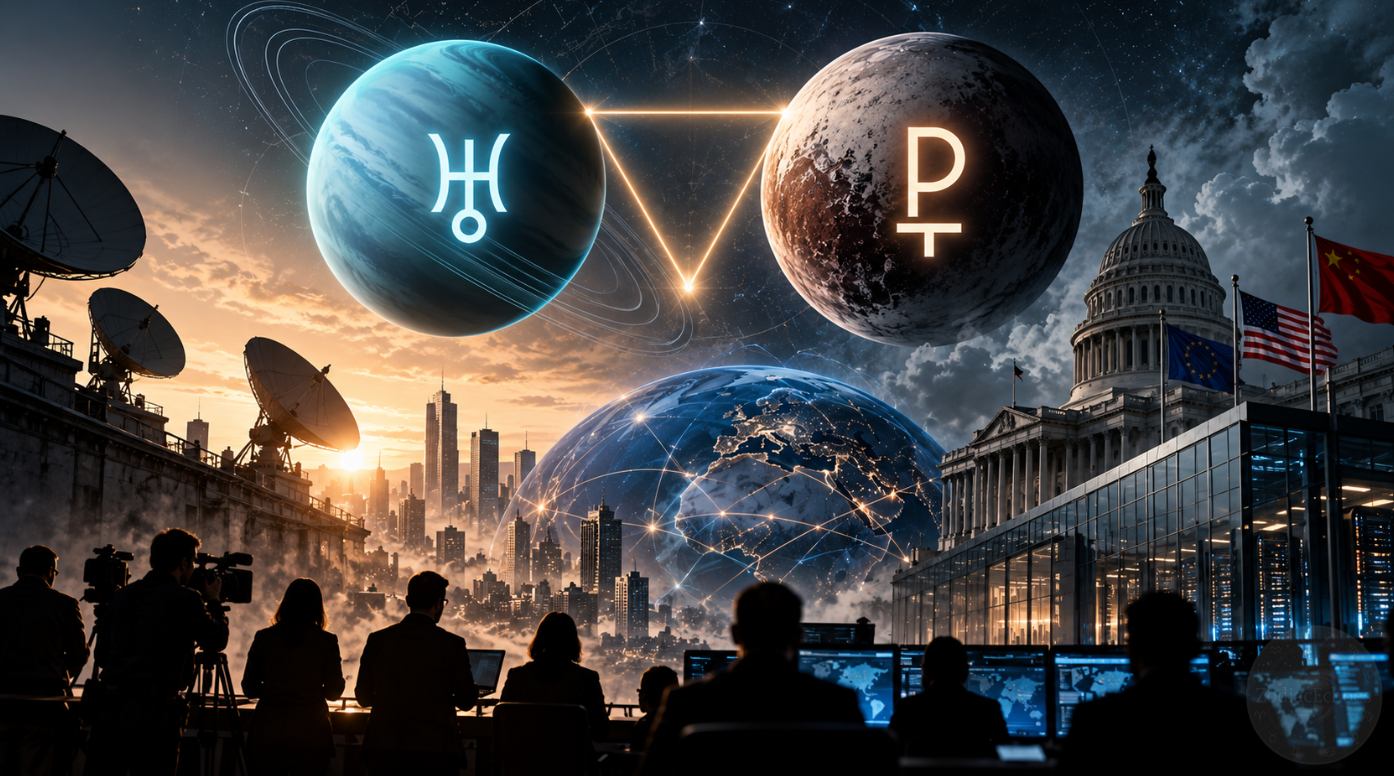
- Rare Alignment: Uranus and Pluto form an exact trine on November 29, 2026, at approximately 11:25 UTC.
- A Century-Old Pattern: The previous comparable series occurred in 1921–1922, during the early expansion of radio broadcasting.
- Five Exact Alignments: The current sequence runs from July 2026 to May 2028.
- Information and Power: Uranus in Gemini and Pluto in Aquarius bring communication technology, collective systems and institutional control into focus.
- The Central Question: Could the next technological revolution be defined by who controls information rather than who invents the technology?
November 29, 2026: A Rare Alignment Returns
A century ago, radio was beginning to transform the way governments, businesses and ordinary people communicated. For the first time, political speeches, breaking news and cultural events could reach enormous audiences without depending entirely on printed newspapers. A new struggle was emerging over who controlled the airwaves and who had the authority to speak to the public.
On November 29, 2026, Uranus and Pluto will form an exact trine for the second time in their current five-part series. The last comparable series occurred in 1921–1922, when radio broadcasting was developing into a powerful new medium.
Today, the world faces a different communications revolution. Artificial intelligence, algorithmic information systems, digital identities and vast networks of privately owned infrastructure are changing how information is created, distributed and interpreted.
In modern mundane astrology, Uranus represents technological breakthroughs and challenges to established systems, while Pluto symbolizes concentrated power, institutional transformation and the forces operating beneath visible structures. Their trine raises an intriguing question: Could the defining struggle of the next technological era concern control over information itself?
Uranus Trine Pluto 2026: The Exact Dates and Planetary Positions
The November alignment occurs at approximately 3°32′ Gemini for Uranus and 3°32′ Aquarius for Pluto in the tropical zodiac. The planets are separated by 120 degrees of ecliptic longitude, forming the aspect astrologers call a trine.
The current series contains five exact alignments:
| Date | Tropical zodiac positions |
|---|---|
| July 18, 2026 | 4°30′ Gemini and Aquarius |
| November 29, 2026 | 3°32′ Gemini and Aquarius |
| June 15, 2027 | 6°52′ Gemini and Aquarius |
| January 13, 2028 | 6°20′ Gemini and Aquarius |
| May 9–10, 2028 | 8°49′ Gemini and Aquarius |
The multiple alignments result from the apparent retrograde movements of the planets as viewed from Earth. Rather than occurring on a single day, the astrological configuration develops through several exact contacts over almost two years.
In the sidereal Lahiri zodiac, the November positions correspond to approximately 9°18′ Taurus for Uranus and 9°18′ Capricorn for Pluto. This provides an alternative symbolic perspective involving material resources and established hierarchies. However, the Uranus–Pluto trine is primarily a modern Western astrological interpretation, since neither planet belongs to the nine classical grahas of traditional Jyotisha.
What Happened During the Previous Uranus–Pluto Trines in 1921–1922?
The previous comparable series consisted of five exact trines between March 1921 and December 1922. It coincided with an extraordinary period in the development of mass communication.
In the United States, Pittsburgh station KDKA began regular broadcasting in November 1920. Radio stations multiplied during the following years as broadcasting moved beyond experimental technology toward commercial and public communication.
Britain experienced a similar transformation. The British Broadcasting Company was established in October 1922, and its regular London transmissions began on November 14, 1922. These developments created something historically significant: information could reach large audiences almost simultaneously, without passing through the traditional newspaper distribution system.
Radio also introduced new questions about regulation, ownership and political influence. Governments needed to decide how broadcasting frequencies would be allocated, while companies explored the commercial potential of reaching listeners directly.
The parallel with the present is particularly striking. A century ago, the challenge was controlling radio frequencies and broadcasting institutions. Today, the equivalent questions concern digital platforms, artificial intelligence, computing infrastructure and access to information. The technologies are entirely different, but the historical debate over who owns the channels through which society communicates remains remarkably familiar.
Uranus in Gemini: The Revolution in Communication
In Western astrology, Gemini governs communication, information exchange, language, trade and the connections that allow societies to function. Uranus, associated with invention, disruption and technological breakthroughs, introduces the possibility of profound changes to those systems.
Together, Uranus in Gemini can symbolize a period when the infrastructure of communication undergoes fundamental transformation.
Artificial intelligence provides an especially relevant modern example. AI systems increasingly participate in writing, translation, research, software development and information retrieval. These technologies are changing the relationship between people and the information they encounter.
The deeper question is not simply whether AI will become more capable. It is whether a relatively small number of organizations will control the systems through which millions of people obtain knowledge.
In mundane astrology, Uranus in Gemini invites attention to emerging communication networks, alternative information platforms and technologies that challenge established methods of distributing knowledge.
Pluto in Aquarius: Who Controls the Digital World?
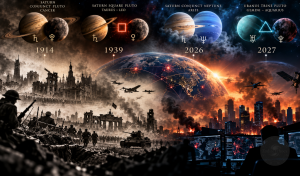
Pluto’s position in Aquarius adds a distinctly political dimension to the alignment. Aquarius is associated with collective organization, social networks, technological systems and the relationship between individuals and larger communities. Pluto represents power, control, institutional restructuring and the concentration of influence.
Their combination creates a compelling symbol for the growing importance of digital infrastructure as a source of political and economic power.
Modern societies depend on enormous technological networks. Cloud computing, data centers, telecommunications infrastructure and digital payment systems have become essential to businesses, governments and ordinary citizens.
The International Telecommunication Union estimated that approximately six billion people were using the internet in 2025, representing nearly three-quarters of the global population.
This dependence creates a new form of strategic importance. Control over critical infrastructure can influence how information travels, which services remain accessible and how digital economies operate.
Astrologically, Pluto in Aquarius can be interpreted as a long-term transformation of the institutions responsible for managing collective technological systems.
The central struggle may no longer be limited to controlling territory or natural resources. It may increasingly involve controlling the networks on which modern societies depend.
Governments, Technology Companies and Decentralized Networks
Governments and Digital Sovereignty
Governments have an interest in maintaining secure communications, protecting sensitive information and ensuring that essential digital services remain available. As technological infrastructure becomes more important to national security and economic activity, questions of regulation, jurisdiction and digital sovereignty become increasingly significant.
Within the symbolism of the Uranus–Pluto trine, this represents a potential meeting point between technological innovation and the institutional desire for control.
Technology Companies and Concentrated Power
Large technology companies operate platforms, computing systems and data infrastructure used across national borders. Their position raises questions about market concentration, access to advanced AI systems and the influence that privately operated networks can exercise over public communication.
Pluto’s symbolism is particularly relevant here because the planet is associated with power that operates through underlying structures rather than through visible political leadership alone.
Decentralized Systems and Alternative Models
Decentralized networks offer another possible direction. Their underlying principle is to distribute certain functions across multiple participants rather than placing all authority in a single organization. In astrological terms, Uranus represents experimentation and alternatives to established systems, while Aquarius emphasizes collective networks.
The trine could therefore be interpreted as a period in which centralized and decentralized models of technological power develop alongside one another, creating new debates about trust, ownership and independence.
From the 1960s to 2028: The Larger Uranus–Pluto Cycle
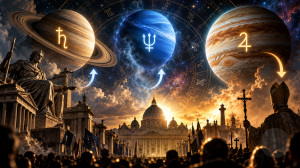
The current trine also belongs to a longer planetary cycle that began with the Uranus–Pluto conjunctions of 1965–1966. Those years were associated with major social movements, political protests, cultural transformation and the early development of technologies that would later reshape everyday life.
In the following decades, computing became increasingly accessible, telecommunications expanded and the internet emerged as a global communications network. Another important phase arrived between 2012 and 2015, when Uranus and Pluto formed seven exact squares. In mundane astrology, squares are traditionally interpreted as periods of tension, confrontation and pressure for change.
The approaching trines introduce a different symbolism. A trine represents cooperation, integration and the possibility of change developing through existing structures rather than through direct confrontation.
For this reason, the 2026–2028 sequence may be particularly interesting when examining how governments, corporations and emerging technologies adapt to one another. Rather than symbolizing technological disruption alone, the alignment may suggest a period when earlier innovations become embedded within the institutions that govern modern society.
Three Developments Astrologers May Watch Through 2028
1. A New Struggle Over Artificial Intelligence Infrastructure
As AI becomes integrated into business, education, research and public services, the ownership of computing resources and access to advanced systems may become increasingly important. The Uranus–Pluto symbolism highlights the relationship between technological breakthroughs and concentrated institutional power.
2. Changes in the Control of Information
The historical parallel with radio broadcasting raises questions about the future of news distribution, digital platforms and information verification. Astrologers may interpret this period through debates over who determines which information reaches the public and how its reliability is established.
3. The Restructuring of Digital Authority
The relationship between governments, multinational technology companies and decentralized networks may become a defining subject of the broader cycle. Questions involving digital identity, cross-border data systems and technological sovereignty fit the symbolism of Pluto in Aquarius and Uranus in Gemini.
Conclusion
The Uranus–Pluto trine of November 29, 2026, connects a rare planetary alignment with one of the most important questions of the modern era: who will control the world’s information? A century after radio broadcasting began transforming public communication, artificial intelligence and digital infrastructure are creating new relationships between technology, political authority and economic power.
With three further exact trines approaching through May 2028, the configuration offers mundane astrologers a compelling framework for examining whether the next great revolution will be defined not simply by technological invention, but by the struggle to determine who controls its reach and influence.
FAQ
When is the Uranus–Pluto trine in November 2026?
The exact trine occurs on November 29, 2026, at approximately 11:25 UTC, with Uranus at 3°32′ Gemini and Pluto at 3°32′ Aquarius in the tropical zodiac.
Why is the Uranus–Pluto trine considered rare?
The previous comparable series of five exact trines occurred in 1921–1922. The current series runs from July 2026 through May 2028, making it the first such sequence in more than a century.
What does Uranus trine Pluto mean in mundane astrology?
Uranus represents innovation, disruption and technological change, while Pluto symbolizes concentrated power and institutional transformation. Their trine is traditionally interpreted as an opportunity for these forces to interact through significant structural changes.
What happened during the previous Uranus–Pluto trines?
The 1921–1922 series coincided with the early expansion of commercial radio broadcasting, including the establishment of the British Broadcasting Company and the development of new mass communication systems.
Could Uranus trine Pluto influence artificial intelligence?
Modern astrologers may interpret the alignment through themes involving AI, information networks, technological ownership and institutional power. These are symbolic interpretations rather than established predictions of specific technological developments.
Is the Uranus–Pluto trine important in Vedic astrology?
Uranus and Pluto are not among the nine classical grahas used in traditional Jyotisha. Some modern astrologers incorporate outer planets, but the trine is primarily interpreted through Western astrology.
Sources
- Starzology – Uranus Trine Pluto — The five exact trines and the larger Uranus–Pluto cycle.
- Cafe Astrology – Uranus Trine Pluto — Historical and upcoming aspect dates.
- Swiss Ephemeris – Astrodienst — Planetary positions and astronomical calculation methods.
- BBC – History of the 1920s — The founding of the BBC and the beginning of regular broadcasts.
- Science and Media Museum – The BBC’s First Daily Transmissions — Historical broadcasting records.
- International Telecommunication Union – Facts and Figures 2025 — Global internet usage and digital connectivity.