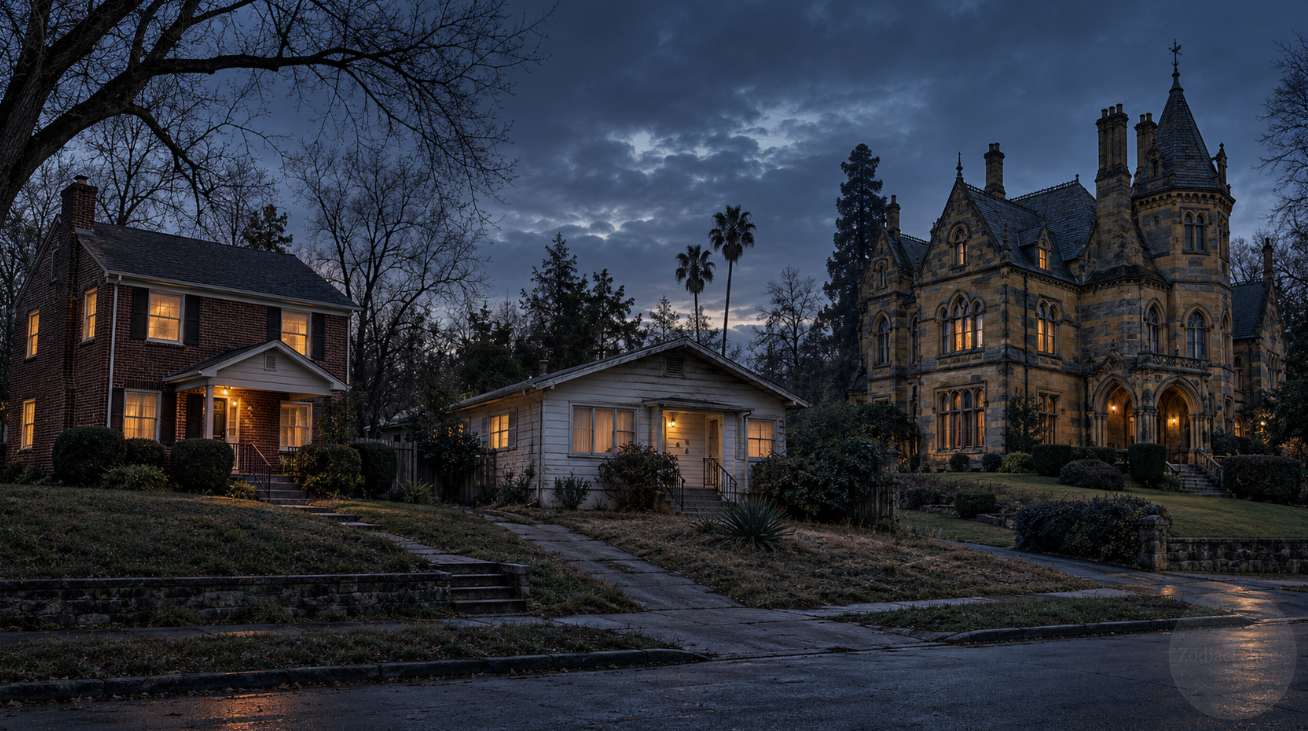
- A house in Bel-Nor, Missouri, was one of several locations involved in the 1949 case that inspired The Exorcist.
- The Entity grew from Doris Bither’s reports of disturbing experiences in a Culver City home, investigated in 1974.
- Ettington Park supplied the exterior of Hill House in The Haunting (1963) and later underwent extensive restoration.
- These buildings have different connections to cinema: two belong to the histories behind fictional stories, while the third became a fictional house on screen.
A modest suburban house can conceal its connection to a famous horror story almost completely. A Gothic mansion has the opposite problem: even without knowing its history, a visitor might recognize the silhouette of a haunted house.
The buildings connected with The Exorcist, The Entity and The Haunting reveal three different ways a real place becomes part of horror history. In Missouri and California, accounts of frightening experiences supplied material for fiction. In Warwickshire, filmmakers found architecture capable of giving a fictional nightmare a physical presence.
The Exorcist: The Suburban House Behind the Story
The real-life case associated with The Exorcist centred on a teenage boy in 1949. His family lived near Washington, D.C., but later travelled to Missouri, where they stayed with relatives in Bel-Nor, a suburb of St. Louis. That house became one of the locations where priests attended him.
Saint Louis University’s account draws on the diary of Jesuit priest Raymond Bishop and the history of the clergy involved. It describes Bishop visiting the family in March 1949, followed by William Bowdern, who led the authorized exorcism. The disturbing phenomena recorded in that narrative—including shaking furniture and marks on the boy’s body—remain the observations and interpretations of the participants. The surviving record documents an exorcism case; it does not make every supernatural explanation an established fact.
The house’s role is sometimes enlarged in popular retellings. The proceedings did not remain within a single bedroom throughout. They moved between the relatives’ home, Alexian Brothers Hospital and other locations. According to the university’s historical account, the final episode took place at the hospital in April 1949.
The Bel-Nor house consequently represents one chapter in a geographically scattered story. It is not the Georgetown home occupied by the fictional MacNeil family, nor should the film’s bedroom be treated as a reconstruction of its interior.
Its later significance also owes something to what disappeared elsewhere. Saint Louis University records that the hospital building was demolished in 1978 and the old College Church rectory in 1966. The Bel-Nor residence survived as a recognizable connection to a case whose other important settings were lost. Behind the cinematic image of a monumental confrontation lies a much less theatrical landscape of family accommodation, religious institutions and buildings that changed or vanished.
The Entity: A California Home at the Centre of an Investigation
The house behind The Entity was an ordinary residence in Culver City, California. Its connection to horror began in August 1974, when Doris Bither approached investigators Barry Taff and Kerry Gaynor, reporting that unseen entities were attacking her at home. The researchers were associated with Thelma Moss’s parapsychology laboratory at UCLA.
In a University of California retrospective published fifty years later, Taff recalled arriving with a questionnaire and initially questioning whether the investigators should continue. He described an incident involving a frying pan leaving a cupboard, followed by weeks of reported moving objects, cold spots and unusual lights. Those descriptions are the investigator’s recollections of what he believed happened, rather than a university finding that the house was haunted.
The case subsequently reached novelist Frank De Felitta. His 1978 novel became the basis for The Entity, starring Barbara Hershey, with a fictional woman at its centre. The connection is therefore a sequence of adaptation: Bither’s reported experiences, a novel inspired by them, and a screenplay that transformed the material into a sustained supernatural assault.
The house’s place in the story becomes more complicated after Bither left. Gaynor later said he believed the activity followed her, leading him to associate its supposed source with Bither rather than the building. That interpretation remained paranormal, but it challenged the familiar idea of a dangerous address waiting for its next occupant.
The strongest documented continuation is the investigation’s afterlife in testimony and cinema. Decades later, the researchers were still discussing the case, while the film continued to introduce viewers to a fictional version of its central events. Their accounts do not establish a continuous history of later residents experiencing the same disturbances at the property.
The Haunting: When Ettington Park Became Hill House
Ettington Park has a different relationship with its film. The Warwickshire mansion supplied the exterior of Hill House in Robert Wise’s The Haunting (1963). It was chosen to embody the fictional building from Shirley Jackson’s novel, rather than serving as the site of the novel’s events.
Its architecture gave the filmmakers substantial material to work with. Historic England identifies the Grade I-listed country house as an earlier building remodelled between 1858 and 1862, with striking stonework, towers, elaborate windows and richly detailed interiors. The house had accumulated its own history long before a camera turned its façade into a threat.
The building’s post-film history included a serious interruption. According to the hotel’s published heritage account, a fire in 1979 caused extensive damage, after which the closed building deteriorated. In 1983, it was leased to a hotel company and became the subject of a restoration programme costing millions of pounds.
That recovery gave the mansion a working future beyond its screen identity. Ettington Park now operates as a hotel, offering bedrooms, dining and events within the former country-house setting. The building audiences knew as Hill House became somewhere people could stay for celebrations and holidays.
Its ghost stories also persist. The hotel’s own history recounts alleged sightings of a Victorian woman and a man accompanied by a dog. These belong to the property’s reported folklore, while its restoration and continued use form a separate, tangible history. Ettington’s survival is especially striking because its most famous cinematic role depends on making the house feel impossible to escape; outside the film, its doors welcome arriving guests.
Cosmic Highlights

FAQ
Did the real exorcism happen entirely in the Bel-Nor house?
No. The 1949 proceedings involved several locations, including Alexian Brothers Hospital, where the final episode was reported.
Was Doris Bither’s house the source of The Entity?
Her reported experiences there inspired the novel behind the film. The screen story fictionalized the people and events.
Is Ettington Park the real Hill House?
It provided the exterior seen in The Haunting (1963). Hill House itself is fictional.
Does Ettington Park still operate as a hotel?
Yes. Its official website lists accommodation, dining and events at the property.
Sources
- Saint Louis University — The 1949 St. Louis Exorcism
- Saint Louis University — Exorcism Exposé
- University of California — Paranormal Activity: A UCLA Haunting Story
- The Criterion Collection — The Unspeakable Truth of The Entity
- DiCamillo — Ettington Park
- Historic England — Ettington Park Hotel
- Hand Picked Hotels — History of Ettington Park
- Ettington Park Hotel — Official Website