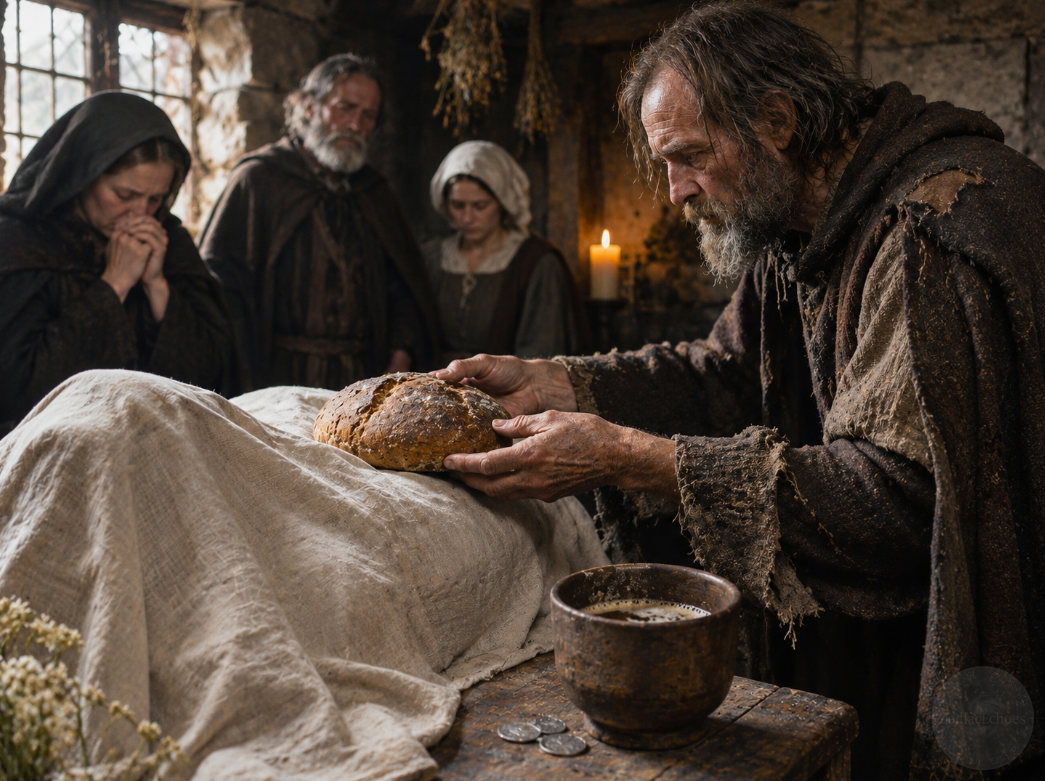
- Sin-eaters appeared in historical accounts from Wales and the English borderlands, where they performed unusual rituals for the deceased.
- Bread was placed on or near a dead person’s body before being eaten by someone believed to take on the deceased’s sins.
- Sin-eaters sometimes received money or drink in exchange for performing the ceremony.
- The ritual reflected deep fears about dying with unconfessed sins and the fate of the soul after death.
Imagine entering a dark cottage where a dead man lies beneath a white sheet. His family stands silently around the body. On a small table rests a piece of bread, and beside it, a cup of ale. Everyone is waiting for one particular visitor. He is not a priest, a doctor, or a relative. He has come to perform a task that others fear: to eat the sins of the dead.
For centuries, accounts from Wales and the English border counties described individuals known as sin-eaters. Their role was extraordinary. By consuming food associated with a corpse, they were believed to take upon themselves the spiritual burden of another person’s wrongdoing.
The Terrifying Ritual of Eating Another Person’s Sins
One of the earliest widely cited descriptions appeared in the seventeenth-century writings of John Aubrey, the English antiquarian who collected observations about local customs and supernatural beliefs.
Aubrey described a funeral practice in Herefordshire in which bread was placed upon the body of the deceased. A designated person then consumed it, accompanied by a drink and a small payment.
The act symbolically transferred the dead person’s sins to the individual eating the bread. By accepting this burden, the sin-eater was thought to help the deceased find peace in the afterlife.
The ceremony could be performed in a modest household, with little more than bread, drink, and the presence of grieving relatives. Yet its spiritual implications were enormous. According to the underlying belief, a living person could voluntarily carry the moral weight of someone who could no longer confess or repent.
Why Would Anyone Agree to Become a Sin-Eater?
Historical descriptions suggest that the person performing the ritual could receive a small payment, food, or drink. In communities where poverty was widespread, such compensation may have provided an incentive to undertake an unpopular task.
Sin-eaters have frequently been portrayed as isolated figures, feared or avoided because of the spiritual contamination supposedly accumulated through their work. Every funeral could add another person’s sins to the burden they already carried. In popular retellings, the sin-eater became someone whose own salvation was endangered by helping others.
However, surviving accounts do not establish that all sin-eaters lived as permanent outcasts. Much of the familiar image of a solitary, cursed individual comes from later folklore and literary portrayals.
Wales, Herefordshire, and the Fear of an Unquiet Soul
The tradition is particularly associated with the Welsh borderlands, including Herefordshire and neighboring areas. Later writers also connected sin-eating with Welsh communities and rural funeral customs.
These regions preserved numerous traditions concerning death, burial, and the relationship between the living and the deceased. In Christian belief, sin and repentance were closely connected to the fate of the soul. The prospect of dying without resolving serious wrongdoing could therefore be deeply troubling.
Sin-eating offered a symbolic solution to an otherwise irreversible problem: the deceased could no longer seek forgiveness through ordinary human actions, but someone living might accept the burden on their behalf. The custom existed outside conventional church teaching, making it an especially striking example of how local folk beliefs could develop alongside formal religion.
The Sin-Eater Who Became Part of Welsh Folklore
One name frequently associated with the tradition is Richard Munslow of Ratlinghope, Shropshire, who died in 1906 and has been described in modern historical accounts as one of the last known English sin-eaters. His association with the practice illustrates how memories of sin-eating survived long after the earliest written descriptions.
Yet the historical evidence remains uneven. Much of what is known comes from antiquarian observations, later recollections, and accounts recorded outside the communities themselves. The documented tradition is fascinating precisely because it occupies the boundary between recorded custom, religious anxiety, and enduring folklore.
Why the Legend Remains So Disturbing
Sin-eating reverses the ordinary meaning of a funeral meal. Instead of gathering to remember the dead, one person consumes food that supposedly carries their moral failures.
The bread becomes more than nourishment. It represents guilt, judgment, forgiveness, and the terrifying possibility that one person’s sins can become another person’s burden. That symbolism explains why sin-eaters continue to appear in horror fiction and supernatural storytelling.
Conclusion
The sin-eaters of the Welsh borderlands represent one of Britain’s most unsettling historical funeral traditions. Through a simple piece of bread, grieving families hoped that the spiritual burdens of the dead could be transferred to someone still living.
Whether remembered as compassionate helpers, desperate laborers, or feared outsiders, sin-eaters reveal how profoundly earlier generations worried about what happened to the soul after death.
Cosmic Highlights

FAQ
What was a sin-eater?
A sin-eater was a person described in historical British accounts who consumed bread or other food associated with a deceased person, supposedly taking on that person’s sins and helping their soul find peace.
Where did sin-eating take place?
Historical accounts particularly associate the custom with Herefordshire, the Welsh borderlands, and neighboring rural communities.
Were sin-eaters paid for their services?
Yes. Some historical descriptions mention small payments, bread, and alcoholic drinks given to the person performing the ritual.
Who was the last known sin-eater?
Richard Munslow of Ratlinghope, Shropshire, who died in 1906, is frequently described as one of the last known English sin-eaters.