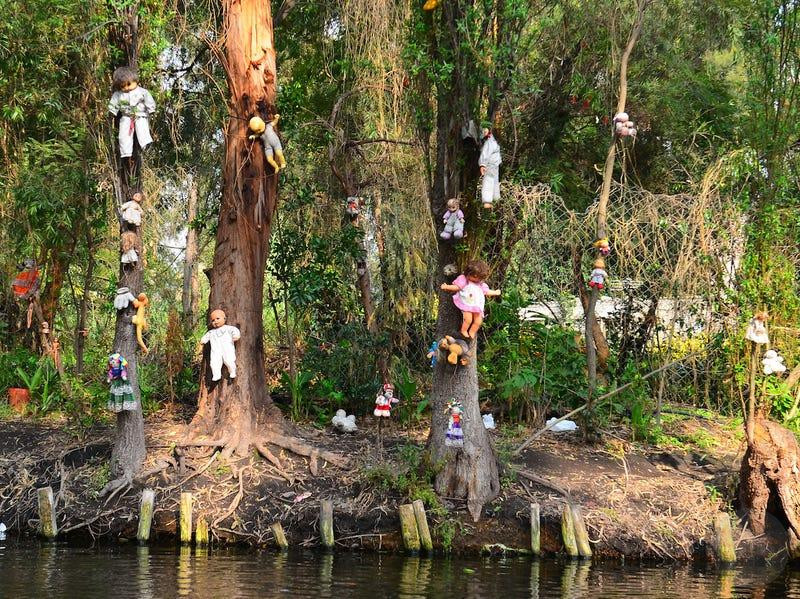
- Mexico’s Island of the Dolls is covered with hundreds of deteriorating dolls hanging from trees, fences, and buildings.
- Its former inhabitant, Julián Santana Barrera, reportedly collected dolls to protect himself from the restless spirit of a drowned girl.
- In 2001, Santana was found dead near the waters surrounding the island, adding another disturbing chapter to its legend.
- Visitors and caretakers continue to report mysterious whispers, unexplained movements, and strange sounds after dark.
Deep within the canals of Xochimilco, south of central Mexico City, lies a small island where childhood toys have become the stuff of nightmares.
Broken dolls hang from branches. Discolored faces emerge from the vegetation, while empty eye sockets stare at passing visitors. Some dolls are missing their heads, while others appear to be slowly disappearing into the trees themselves.
Known as La Isla de las Muñecas, or the Island of the Dolls, this extraordinary place owes its disturbing appearance to one man’s apparent obsession with protecting himself from the supernatural.
The Legend of the Drowned Girl
The island was once home to Julián Santana Barrera, a man who lived in relative isolation among the waterways of Xochimilco, cultivating vegetables and tending his land. According to local folklore, Santana discovered the body of a young girl who had drowned nearby. Other versions suggest that he had unsuccessfully attempted to rescue her.
When a doll subsequently appeared in the water, Santana reportedly believed it had belonged to the deceased child. He suspended it from a tree as an offering to her spirit. But the first doll was apparently not enough. Santana allegedly continued to hear disturbing cries and experience an unsettling presence around his home.
When Childhood Toys Became Protective Talismans
Over several decades, Santana transformed his surroundings into an enormous collection of abandoned toys. He retrieved dolls from rubbish heaps and waterways, sometimes exchanging vegetables for additional specimens.
Their physical condition did not concern him. Broken limbs, damaged faces, and missing eyes were no reason to discard them.
In his apparent understanding of the supernatural, the dolls served as protective objects rather than decorations. They were intended to appease or repel whatever presence he believed inhabited the island.
This practice resembles the broader folkloric concept of apotropaic magic, in which physical objects are used to ward off harmful supernatural influences. However, Santana’s collection was his own unusual creation rather than an established Mexican religious ritual.
The Mysterious Death of Julián Santana
On April 17, 2001, the story took its most disturbing turn when Santana died near his island. According to accounts attributed to his nephew, Santana had been fishing and claimed that supernatural beings in the water were calling to him.
His body was subsequently discovered in the canal. Popular versions of the legend insist that he died in the same location where the mysterious girl had supposedly drowned decades earlier.
Accounts differ over whether Santana drowned or suffered a heart attack. The precise circumstances remain uncertain, but his death permanently connected the island with its frightening origin story.
Do the Dolls Come Alive After Dark?
Following Santana’s death, the island attracted increasing numbers of curious visitors, paranormal investigators, and enthusiasts of haunted places. Some claim that the dolls move their heads, whisper to one another, or produce strange whistling sounds.
There are also stories of mysterious crying heard after sunset, when the surrounding waterways become quiet and the island’s deteriorating inhabitants disappear into darkness.
Some visitors bring additional dolls as offerings, continuing the practice that Santana began decades earlier. The collection has consequently become both a tourist attraction and a living supernatural legend.
The World’s Largest Collection of Haunted Dolls
In 2022, Guinness World Records recognized the island for its extraordinary collection of allegedly haunted dolls, while acknowledging that their supernatural properties could not be established.
The island’s unsettling atmosphere may also be connected to pediophobia, the fear of dolls. Their resemblance to living people, combined with unnatural expressions and physical deterioration, can provoke intense discomfort.
On the Island of the Dolls, that sensation is multiplied by hundreds of silent faces watching from every direction.
Conclusion
Whether the drowned girl ever existed remains uncertain. What is undeniable is that one man’s collection became an extraordinary monument to supernatural belief, isolation, and fear. More than two decades after Santana’s death, the dolls remain suspended above the island’s pathways.
Whatever he believed was watching him from the darkness, the objects he collected to protect himself have become the very reason people fear the island today.
Cosmic Highlights
FAQ
Where is the Island of the Dolls located?
The Island of the Dolls is located within the canals of Xochimilco, in southern Mexico City, Mexico.
Why are dolls hanging from trees on the island?
According to local legend, Julián Santana Barrera collected and displayed dolls to appease the restless spirit of a drowned girl and protect himself from supernatural influences.
Did the drowned girl really exist?
No official record confirming the girl’s drowning has been identified. Her story remains part of the island’s folklore.
How did Julián Santana Barrera die?
Santana died on April 17, 2001. Accounts differ regarding whether he drowned or suffered a heart attack near the island.
Can people visit the Island of the Dolls today?
Yes. The island is a tourist attraction accessible by traditional boats known as trajineras through the canals of Xochimilco.
Are the dolls on the island really haunted?
Although visitors and local caretakers have reported strange experiences, no reliable evidence has established that the dolls are possessed or haunted.
Sources