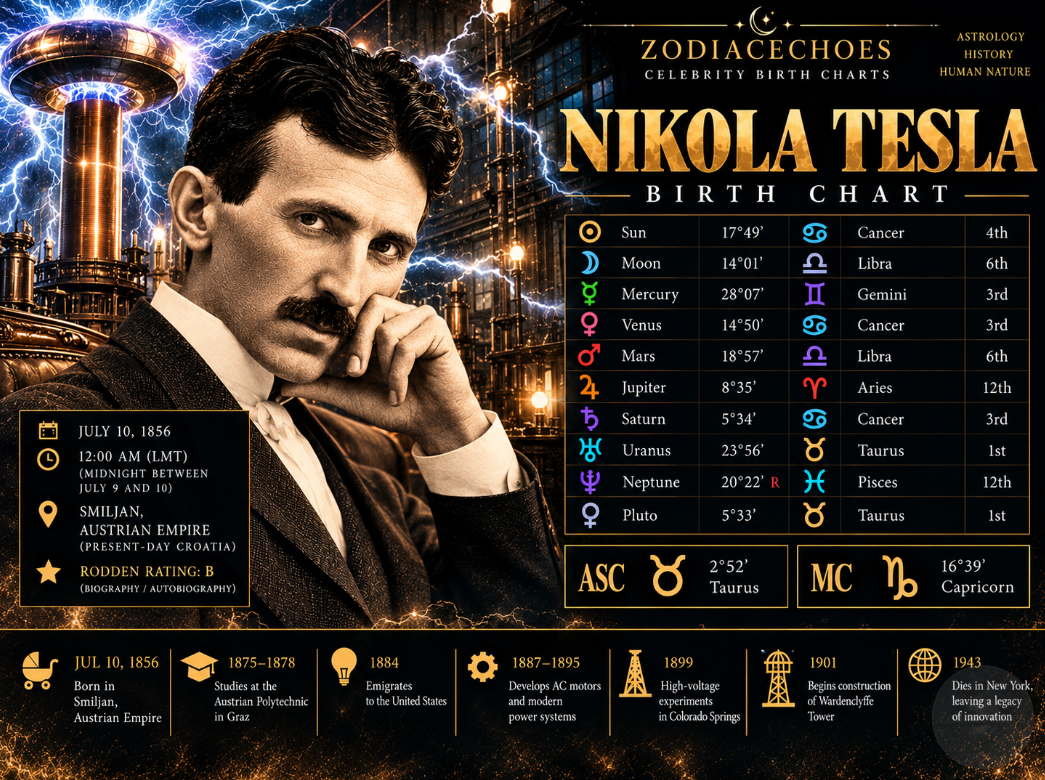
- Nikola Tesla was born on July 10, 1856, in Smiljan, then part of the Austrian Empire and now located in Croatia.
- His reported birth time of midnight between July 9 and 10 gives him a Cancer Sun, Libra Moon, and Taurus Ascendant.
- Mercury in Gemini in the 3rd House provides a compelling astrological symbol for his technical imagination, communication, and inventive thinking.
- Uranus in Taurus in the 1st House offers an intriguing parallel with his work on electrical systems that transformed everyday life.
- The Sun square Mars reflects a symbolic tension between personal vision and relentless action, a recurring theme in his professional life.
- His birth time carries a Rodden Rating B, meaning the reported time comes from biographical material rather than a directly verified birth record.
Nikola Tesla helped shape the electrical world we live in, yet much of his own life was spent chasing ideas that other people struggled to understand. He could describe complex machines before building them, imagine technologies decades ahead of their practical application, and work with an intensity that sometimes left little room for anything else.
By the time he died in a New York hotel in 1943, he had experienced international recognition, bitter professional disappointments, financial difficulties, and the collapse of some of his most ambitious dreams.
What makes Tesla’s story so fascinating is the contrast between the extraordinary reach of his imagination and the very human limitations of his circumstances. He was not simply a misunderstood genius, nor was every invention attributed to him a success. His achievements emerged from years of technical work, collaboration, experimentation, and sometimes costly mistakes.
His birth chart offers an unusual way to explore those contradictions. With a Cancer Sun, Libra Moon, Taurus Rising, and Mercury in Gemini, Tesla’s horoscope brings together symbolism associated with memory, imagination, intellectual curiosity, practical construction, and the tension between cooperation and independence.
Astrology cannot explain how Tesla invented an induction motor or why his projects succeeded or failed. But when the chart is placed alongside his documented biography, it offers a compelling symbolic portrait of a man who spent much of his life trying to turn invisible forces into something the world could use.
Nikola Tesla’s Birth Data and Astrological Chart
Tesla was born on July 10, 1856, in the village of Smiljan, in the Austrian Empire. His birth date is supported by historical documentation, including a baptismal record preserved by the Nikola Tesla Museum.
His commonly cited birth time comes from John J. O’Neill’s biography Prodigal Genius: The Life of Nikola Tesla, which describes his birth as occurring at midnight between July 9 and July 10. Astro-Databank assigns this information a Rodden Rating B, indicating a biographical source rather than an independently verified birth-time record.
The following positions use the tropical zodiac and Placidus house system, calculated for the reported midnight birth time in local mean time. The signs and planetary positions are more secure than the house placements and angles, which depend on the accuracy of that time.
| Planet | Zodiac Position | House |
|---|---|---|
| Sun | Cancer 17°49′ | 4th |
| Moon | Libra 14°01′ | 6th |
| Mercury | Gemini 28°07′ | 3rd |
| Venus | Cancer 14°50′ | 3rd |
| Mars | Libra 18°57′ | 6th |
| Jupiter | Aries 8°35′ | 12th |
| Saturn | Cancer 5°34′ | 3rd |
| Uranus | Taurus 23°56′ | 1st |
| Neptune | Pisces 20°22′ Retrograde | 12th |
| Pluto | Taurus 5°33′ | 1st |
- Ascendant: Taurus 2°52′
- Midheaven (MC): Capricorn 16°39′
- Birth Time: 12:00 AM, Local Mean Time
- Birthplace: Smiljan, Austrian Empire (present-day Croatia)
- Rodden Rating: B
Cancer Sun: The Inventor Who Never Completely Left His Childhood Behind
Cancer is traditionally associated with memory, emotional attachment, imagination, and the influence of family. These themes offer an interesting starting point for understanding Tesla because his childhood experiences remained important to the way he described his own mind.
Tesla grew up in a Serbian Orthodox family. His father, Milutin Tesla, was a priest, while his mother, Georgina Đuka Mandić, was known for her practical ingenuity and ability to make household tools and devices. Tesla later credited his mother with influencing his inventive abilities.
This family connection matters because the popular image of Tesla often begins with an isolated genius working among electrical machines. In reality, his intellectual development began in a household where language, observation, craftsmanship, and practical problem-solving were part of everyday life.
In astrology, the Sun in Cancer in the 4th House emphasizes themes of home, family foundations, and the private world. Tesla eventually lived far from Smiljan, spending much of his adult life in the United States, but his descriptions of childhood reveal how deeply early impressions shaped his sense of identity.
He also described unusually vivid mental imagery. According to his own autobiographical writings, he could visualize devices in considerable detail and mentally test their operation before constructing physical models.
That ability was not a supernatural gift demonstrated by his horoscope. It was a distinctive cognitive method that Tesla himself described. Still, the traditional symbolism of Cancer — memory, internal experience, and a rich imaginative life — creates an interesting connection with the inventor’s accounts of how his ideas developed.
Mercury in Gemini: A Mind That Could Build Machines Before They Existed
If one placement deserves particular attention in Tesla’s birth chart, it is Mercury at 28°07′ Gemini in the 3rd House. Mercury is associated with reasoning, communication, learning, and technical understanding. Gemini, one of the signs traditionally ruled by Mercury, emphasizes curiosity, adaptability, and the ability to connect different pieces of information.
Tesla’s intellectual strengths were not limited to having unusual ideas. He possessed the mathematical and engineering knowledge required to develop and test many of them.
During his education in Graz, he became interested in electrical machinery and the problems associated with direct-current motors. His later work on rotating magnetic fields and polyphase alternating-current systems helped establish practical methods for generating, transmitting, and using electrical power.
In 1888, Tesla presented his work on alternating-current motors and systems to the American Institute of Electrical Engineers. His inventions attracted the attention of George Westinghouse, whose company became instrumental in bringing polyphase AC technology into commercial use.
Mercury in Gemini in the 3rd House symbolically combines intellectual exploration with the communication of complex ideas. That is particularly relevant to Tesla because his career required more than invention. He had to explain his designs, demonstrate their operation, secure patents, and persuade industrial partners that the technology was worth developing.
His public lectures often combined technical explanations with dramatic electrical demonstrations. Audiences could see lamps illuminate, witness high-frequency effects, and encounter technologies that seemed almost impossible.
Tesla’s communication style was therefore part of his scientific and commercial identity. He was not merely creating devices; he was inviting the public to imagine a technological future that had not yet arrived.
Taurus Rising: The Practical Side of an Extraordinary Imagination
Tesla’s reported birth time places his Ascendant at 2°52′ Taurus. Taurus is a fixed earth sign associated with material reality, persistence, physical construction, and the desire to create something lasting. For a man whose reputation is often built around futuristic ideas, this placement offers a useful counterpoint.
Tesla was not simply a dreamer. His most important contributions involved turning theoretical electrical principles into functioning machines and systems.
His work on induction motors illustrates this distinction. The rotating magnetic field was an elegant concept, but its significance came from its practical application. Polyphase alternating-current systems made it possible to transmit electrical power efficiently over long distances and operate motors without the commutators used in many direct-current designs.
The commercial development of these systems depended on engineers, manufacturers, investors, and infrastructure. Tesla’s contributions were essential, but they formed part of a broader technological transformation. Taurus Rising provides a symbolic way to describe this relationship between vision and material results. An idea mattered most when it could become a working machine.
However, the Ascendant is among the chart’s most birth-time-sensitive features. Because Tesla’s midnight birth time is biographical rather than independently documented, this interpretation should be understood as conditional.
Uranus in Taurus: Revolutionizing the Physical World
Uranus is often called the planet of innovation, disruption, electricity, and unconventional thinking in modern astrology. Its placement in Taurus at 23°56′ in the 1st House makes it an especially tempting symbol in Tesla’s chart.
There is an obvious connection between the imagery of Uranus and Tesla’s electrical work. But it would be misleading to suggest that this planet made him an inventor. Uranus moves slowly, and many people born during the same period shared its position in Taurus without developing revolutionary electrical technologies.
The more interesting interpretation concerns the combination of Uranus, associated with change, and Taurus, associated with the physical world. Tesla’s work helped transform electricity from a developing scientific and industrial technology into something that could be distributed on a much larger scale.
The 1893 World’s Columbian Exposition in Chicago became an important showcase for alternating-current power. Westinghouse’s electrical system illuminated the fair, demonstrating the possibilities of AC technology to a vast audience.
The Niagara Falls power project offered another major milestone. In the 1890s, Tesla’s polyphase system played a significant role in the development of electrical generation and transmission associated with the falls.
These achievements did not occur because Tesla worked alone. They required substantial engineering, financing, construction, and cooperation among multiple people and organizations. Yet they capture the central theme of Uranus in Taurus: a disruptive idea becoming part of the material infrastructure of ordinary life.
Libra Moon and Mars: Collaboration, Rivalry, and Relentless Work
Tesla’s Moon at 14°01′ Libra sits in the same sign as Mars at 18°57′ Libra, creating a conjunction with an orb of approximately 4°56′. The Moon represents emotional needs and instinctive responses, while Mars symbolizes energy, action, and conflict. Libra introduces themes of partnership, negotiation, balance, and interpersonal tension.
Both planets occupy the 6th House, traditionally associated with work, routine, service, and daily responsibilities. This configuration provides an interesting framework for examining Tesla’s complicated professional relationships.
When Tesla arrived in New York in 1884, he began working for Thomas Edison’s business. The relationship did not last. Their approaches to electrical technology and business differed, and Tesla soon moved on to pursue his own opportunities.
The popular story of Tesla versus Edison is often exaggerated into a simple battle between two solitary geniuses. In reality, the development of electrical power involved competing companies, patents, engineers, investors, and technical systems.
Tesla’s later relationship with George Westinghouse demonstrates the other side of the Libra symbolism. Westinghouse recognized the commercial potential of Tesla’s AC inventions, and their cooperation helped move the technology beyond laboratory demonstrations.
The Moon–Mars conjunction in Libra can be read symbolically as tension between the need to work with others and the determination to pursue an independent vision. Tesla needed partners, but he also wanted control over his inventions and the direction of his work. That tension became increasingly visible as his projects grew more ambitious and expensive.
Sun Square Mars: The Cost of Never Slowing Down
Tesla’s Sun at 17°49′ Cancer forms a close square to Mars at 18°57′ Libra, with an orb of approximately 1°08′. In astrology, a square is traditionally associated with tension, friction, and the effort required to reconcile competing drives. The Sun symbolizes identity and purpose. Mars represents action, urgency, and the desire to overcome obstacles.
Tesla’s career offers many examples of intense dedication. He described long working hours, demanding routines, and periods when he devoted himself almost entirely to solving technical problems.
His willingness to pursue difficult ideas helped produce important achievements. But determination did not guarantee commercial success. Some of his later projects required resources far beyond what he could personally provide. When investors lost confidence or funding disappeared, Tesla’s technical ambitions could not always be sustained.
The Sun–Mars square offers a symbolic way to explore the conflict between a powerful personal vision and the practical limits imposed by time, money, and circumstances. This does not mean the aspect caused his work habits. Rather, it provides a narrative thread connecting his extraordinary persistence with the frustrations that accompanied his career.
Venus in Cancer: The Private Life Behind the Public Inventor
Tesla’s Venus at 14°50′ Cancer lies close to his Sun, forming a conjunction of approximately 2°59′. Venus is traditionally associated with relationships, affection, beauty, values, and personal attachments. In Cancer, it is often interpreted through emotional memory, protectiveness, and private loyalties.
Tesla never married, and he spoke publicly about the relationship between his personal life and his dedication to invention. His views on marriage and celibacy changed in emphasis over time, but he repeatedly presented his work as central to his existence.
It would be simplistic to use Venus in Cancer to explain his decision not to marry. Personal relationships cannot be reconstructed from a planetary placement, and historical evidence about Tesla’s private feelings remains incomplete.
Nevertheless, his biography reveals attachments that do not fit the stereotype of a man interested only in machines. In later life, Tesla developed a particularly strong affection for pigeons, feeding and caring for them in New York. His attachment to one white pigeon became a well-known part of his final years, described in accounts of his life.
The symbolism of Venus in Cancer offers a more human dimension to his chart: a man capable of intense personal attachment, even while living an increasingly solitary existence.
Saturn in Cancer: The Discipline Behind the Imagination
Saturn occupied 5°34′ Cancer in Tesla’s 3rd House, the same house as Mercury and Venus. Saturn represents structure, discipline, obstacles, and sustained effort. Its placement in a house associated with learning and communication offers a symbolic reminder that Tesla’s achievements required more than sudden flashes of inspiration.
Although he is frequently celebrated for his imagination, Tesla also devoted years to studying engineering principles, experimenting with electrical apparatus, and refining his designs.
His education was not without difficulties. He attended the Austrian Polytechnic in Graz but did not complete a degree there. Later accounts of his student years describe both intense academic engagement and personal setbacks. These experiences complicate the popular narrative of effortless genius.
Saturn in the 3rd House symbolizes the demanding side of intellectual development: repeated study, technical discipline, and the frustration of problems that cannot be solved immediately. Tesla’s ability to imagine machinery was remarkable, but his most influential inventions emerged when imagination was supported by engineering knowledge and practical experimentation.
Jupiter in Aries: Ambition Beyond Conventional Limits
Tesla’s Jupiter at 8°35′ Aries in the 12th House introduces another layer to his astrological profile. Jupiter represents expansion, belief, confidence, and the pursuit of larger possibilities. Aries is associated with initiative, independence, and the willingness to begin something new.
Tesla’s ambitions extended far beyond improving existing electrical equipment. He imagined new systems for wireless communication, experimented with high-frequency currents, explored remote control, and proposed technologies that attracted both serious interest and considerable skepticism.
In 1898, he demonstrated a radio-controlled boat at Madison Square Garden, an achievement that anticipated later developments in remote-control technology. His work also encouraged him to think about transmitting information and energy without conventional wires. The Jupiter-in-Aries symbolism fits the scale of these ambitions: an inventor repeatedly attempting to move beyond established technological boundaries.
The 12th House is traditionally linked with solitude, retreat, and work conducted away from ordinary public life. In Tesla’s case, it provides an interesting contrast between grand technological visions and the increasingly isolated circumstances in which he pursued some of them.
Neptune in Pisces: The Dream of a Wireless World
Tesla’s Neptune at 20°22′ Pisces, retrograde in the 12th House, is one of the most evocative placements in his chart. In modern astrology, Neptune is associated with imagination, idealism, inspiration, uncertainty, and the boundary between vision and illusion. Pisces reinforces many of those symbolic themes.
Tesla’s Wardenclyffe project illustrates the tension between visionary ambition and practical feasibility. Beginning in 1901, Tesla pursued construction of a large facility on Long Island intended for wireless communication and, in his broader plans, the transmission of electrical energy.
The project attracted financial support, including investment from J. P. Morgan. But technical uncertainty, escalating costs, changing commercial circumstances, and inadequate funding prevented Tesla from completing his larger ambitions. Wardenclyffe never became the global wireless system Tesla envisioned.
This episode is sometimes portrayed as proof that the world deliberately suppressed an invention that would have provided limitless free energy. That claim goes beyond the historical and technical evidence. Wireless power transmission is a real field of engineering, but Tesla’s proposed worldwide system was never demonstrated at the scale he imagined. Neptune in Pisces offers a symbolic language for this distinction.
Tesla could envision possibilities that inspired generations, but not every possibility could be realized with the technology, resources, or scientific understanding available to him. His greatest strength — the ability to imagine a radically different future — could also draw him toward projects whose practical foundations remained uncertain.
Pluto in Taurus Near the Ascendant: Reinvention and the Price of Persistence
Pluto stood at 5°33′ Taurus, approximately 2°40′ from Tesla’s reported Ascendant. In modern astrology, Pluto is associated with transformation, intensity, power, and profound change. Its close conjunction with the Ascendant is often interpreted as emphasizing a forceful personal presence or a life marked by repeated reinvention.
Tesla’s career contained several dramatic changes of direction. He left Europe for the United States, moved from employment into independent invention, gained international attention through alternating-current technology, and later redirected his ambitions toward wireless communication and other experimental projects.
His professional identity was closely tied to his inventions. As some projects failed to secure funding, his financial position and public standing became increasingly difficult to sustain. The Pluto–Ascendant conjunction offers a symbolic way to explore the intensity with which Tesla pursued his ideas, even when the world around him changed.
Because Pluto is a slow-moving planet and the Ascendant depends on an uncertain birth time, this interpretation deserves particular caution. It is a compelling symbolic detail, not an established explanation of Tesla’s personality.
Tesla’s Final Years: A Visionary in a Changing World
By the 1930s, Tesla was no longer at the center of the electrical industry he had helped transform. He continued to discuss new inventions and technological possibilities, but many of his later proposals remained unbuilt or unverified.
He lived in New York hotels, received support from admirers and business associates, and became increasingly removed from the large industrial organizations that dominated modern electrical engineering. He died on January 7, 1943, at the Hotel New Yorker, aged 86.
His reputation has changed significantly since his death. Tesla is now widely celebrated for his contributions to alternating-current systems, induction motors, high-frequency electrical research, and remote-control technology. Yet his legacy is also surrounded by myths that sometimes obscure the real engineering achievements.
The historical Tesla is more interesting than the legendary one. He was brilliant but not infallible, visionary but sometimes commercially unsuccessful, capable of major technological breakthroughs yet dependent on the same financial and institutional realities that shaped every other inventor of his era.
His birth chart reflects that complexity symbolically. Cancer emphasizes memory and imagination; Gemini highlights intellectual curiosity; Taurus suggests practical construction; Libra introduces cooperation and tension; and the outer planets evoke transformation and visionary ambition. Together, these placements provide a framework for discussing a life that was neither an uninterrupted triumph nor a simple tragedy.
Conclusion
Nikola Tesla’s birth chart offers a fascinating symbolic portrait of an inventor whose imagination repeatedly challenged the limits of his time. Mercury in Gemini, Uranus in Taurus, the Sun–Mars square, and Neptune in Pisces connect naturally with themes found throughout his biography: intellectual curiosity, practical innovation, relentless work, and ambitions that sometimes exceeded what he could achieve.
His legacy rests not on astrology, but on the electrical technologies he helped develop and the ideas he left behind. The chart adds another way to explore the remarkable human story behind those achievements.
FAQ
What was Nikola Tesla’s zodiac sign?
Nikola Tesla was a Cancer, born on July 10, 1856. His Sun was positioned at approximately 17°49′ Cancer in the tropical zodiac.
What was Nikola Tesla’s Moon sign?
His Moon was in Libra at approximately 14°01′. Based on the commonly cited midnight birth time, it occupied the 6th House.
What was Nikola Tesla’s Rising sign?
Using the reported birth time of midnight, Tesla’s Ascendant was Taurus at approximately 2°52′. This depends on the accuracy of the biographical birth-time report.
Is Nikola Tesla’s birth time verified?
His birth time has a Rodden Rating B in Astro-Databank. The midnight time is attributed to biographical material, not a directly verified official birth-time record.
What was Nikola Tesla’s Mercury sign?
Tesla’s Mercury was in Gemini at approximately 28°07′, in the 3rd House using the reported birth time. In astrology, Mercury in Gemini is associated with curiosity, communication, and intellectual flexibility.
Did Nikola Tesla have Uranus in Taurus?
Yes. Uranus was at approximately 23°56′ Taurus when Tesla was born. The reported birth time places it in his 1st House.
Can astrology explain Tesla’s genius?
No scientific evidence establishes that planetary positions determine intelligence or inventive ability. Astrology can be used as a symbolic framework for examining Tesla’s biography, but his achievements resulted from his abilities, education, experimentation, and the technological environment in which he worked.
Sources
- Astro-Databank – Nikola Tesla — birth data, source classification, and Rodden Rating.
- Nikola Tesla Museum – Birth — birth date and baptismal documentation.
- Nikola Tesla Memorial Centre, Smiljan — biographical background and historical context.
- Encyclopaedia Britannica – Nikola Tesla — education, inventions, career, and later life.
- Smithsonian Institution – Nikola Tesla — historical context and technological contributions.
- IEEE History Center – Nikola Tesla — engineering achievements and historical developments.
- Nikola Tesla, My Inventions (1919) — Tesla’s autobiographical account of his childhood, imagination, and inventive methods.