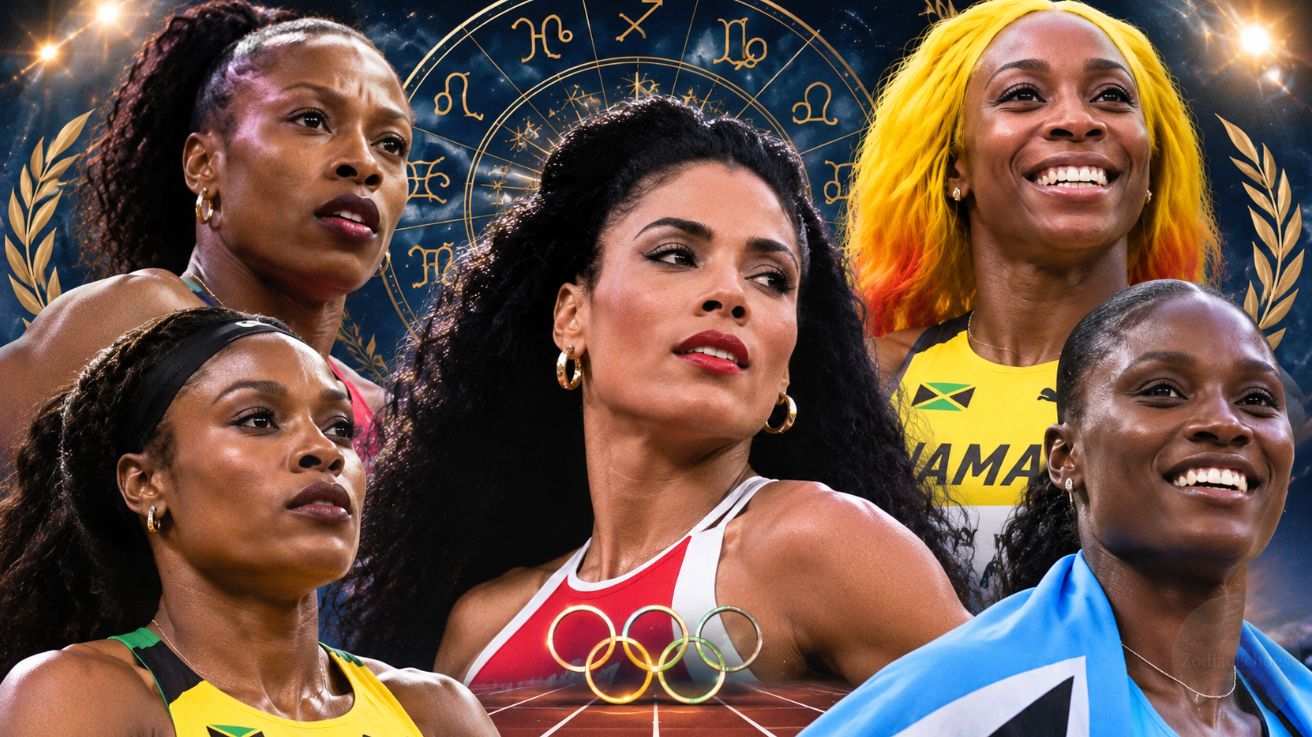
An original ZodiacEchoes investigation into the planetary patterns of women’s Olympic 100-meter medalists from Seoul 1988 to Paris 2024.
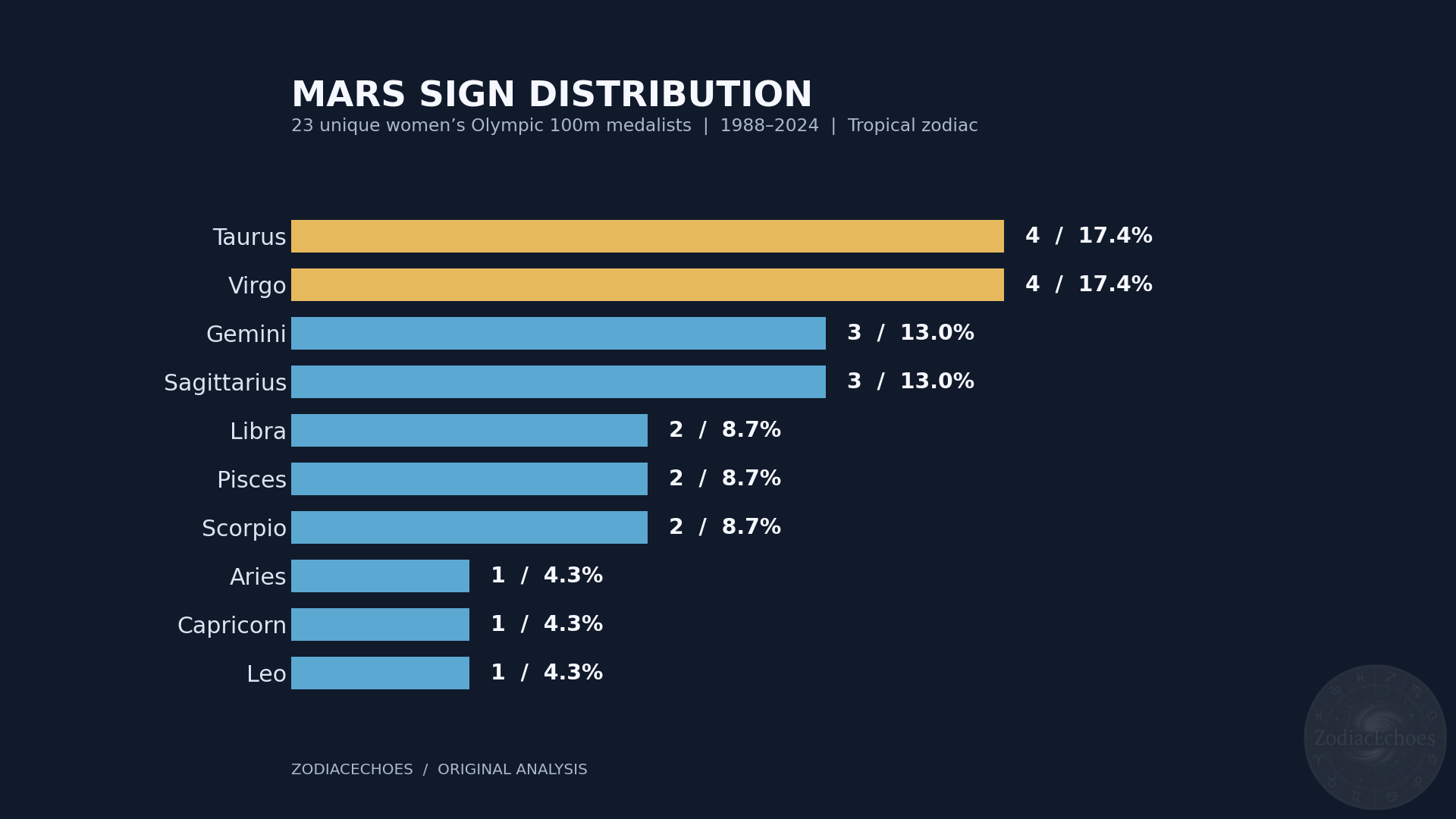
- Mars in Taurus and Virgo leads the dataset, with four athletes in each sign (17.4% apiece).
- Saturn in Pisces is the most frequent Saturn placement, appearing in five birth charts (21.7%).
- Aries and Sagittarius share the lead among Sun signs, with four sprinters each.
- Venus in Aries and Scorpio appears four times each, while Mercury in Taurus leads its distribution.
What separates a good sprinter from an Olympic champion? Explosive acceleration, extraordinary coordination, relentless preparation and the ability to deliver under pressure all play their part. But when we examine the birth charts of the fastest women in Olympic history, an additional question emerges: Do certain planetary placements appear more frequently among elite sprint medalists?
For this original ZodiacEchoes investigation, we examined 23 unique women who earned 30 Olympic 100-meter medal placements between 1988 and 2024. Our dataset includes some of athletics’ most recognizable names, from Florence Griffith-Joyner and Gail Devers to Shelly-Ann Fraser-Pryce, Elaine Thompson-Herah and Julien Alfred.
We analyzed their natal Sun, Mercury, Venus, Mars, Jupiter and Saturn signs, with special attention to Mars, the planet traditionally associated with physical drive, competitive instinct, acceleration and the desire to win.
The results were not quite what conventional astrological expectations might suggest.
Why Mars Matters in the Astrology of Sprinting
In traditional and modern astrology, Mars represents action, muscular effort, courage, urgency and the capacity to confront competition directly. If any planet seems naturally suited to the 100-meter sprint, Mars would be an obvious candidate.
The event is decided in seconds. A fractionally delayed reaction, an imperfect transition into maximum velocity or a slight loss of composure can change the medal order. Sprinters must combine explosive power with precise execution, and those qualities offer several possible expressions of Mars.
One might expect Mars in Aries, its traditional domicile, to dominate a group of Olympic sprint champions. Mars in Leo might also seem plausible because of its associations with confidence, visibility and performance under pressure. Yet neither Aries nor Leo leads our women’s dataset. Instead, two Earth signs occupy the top positions.
Mars in Taurus and Virgo: The Unexpected Leaders
Among the 23 unique medalists, Mars in Taurus and Mars in Virgo each appears four times, representing 17.4% of the sample per sign. Together, these placements account for eight athletes, or approximately 34.8% of the entire group.
Gemini and Sagittarius follow with three athletes each. Pisces, Libra and Scorpio appear twice each, while Aries, Capricorn and Leo appear once apiece. Cancer and Aquarius do not appear in the recorded Mars distribution.
Mars in Taurus offers a particularly interesting interpretation. Taurus is a fixed Earth sign associated with physical persistence, stability and the capacity to maintain effort. In sprinting, strength must be converted into controlled forward motion, and consistency through an extremely short race is essential.
Among the athletes with this placement are Elaine Thompson-Herah, the Olympic 100-meter champion in both 2016 and 2020, and Sha’Carri Richardson, silver medalist at Paris 2024. Their careers differ considerably, but both belong to a group in which Taurus is one of the two most common Mars signs.
Mars in Virgo, meanwhile, suggests a different expression of competitive energy: technical refinement, disciplined repetition and attention to detail. The placement appears in the charts of Gail Devers, the 1992 and 1996 Olympic champion, alongside Heike Drechsler, Gwen Torrence and Carmelita Jeter.
The contrast is compelling. Taurus emphasizes sustained physical determination, while Virgo emphasizes precision and optimization. Both can be read astrologically as qualities relevant to a race in which power and technique must work together almost perfectly.
Does Mars Change When We Examine Gold, Silver and Bronze?
Counting each athlete once gives us a picture of the overall birth-chart distribution. But Olympic history also contains repeat medalists, and their achievements deserve a separate perspective.
Our second Mars analysis counts individual medal finishes rather than unique athletes. This means Gail Devers contributes two gold-medal results, Elaine Thompson-Herah contributes two golds, and Shelly-Ann Fraser-Pryce contributes four medal finishes across four Olympic Games.
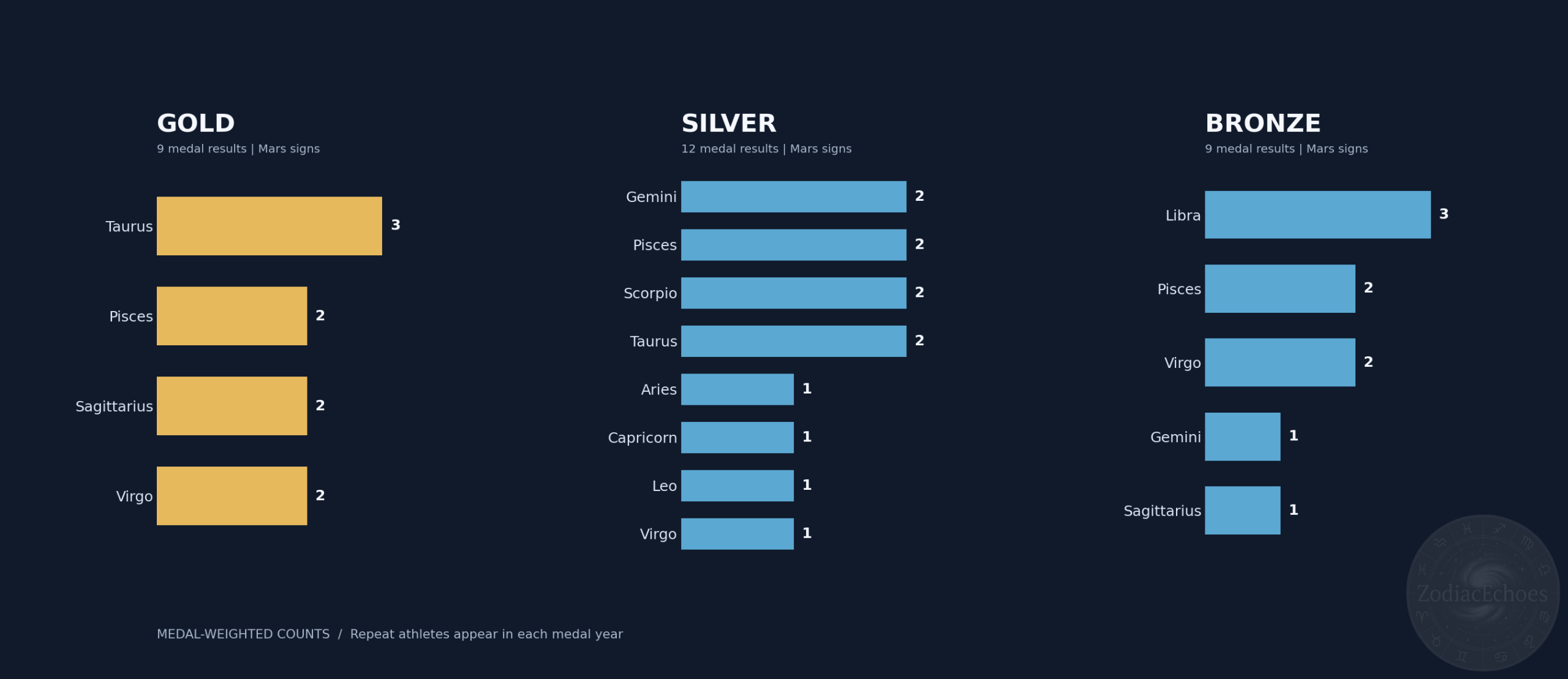
The gold-medal group includes several very different Mars placements. Florence Griffith-Joyner and Julien Alfred both have Mars in Sagittarius, connecting the 1988 and 2024 champions through the same fiery placement despite competing 36 years apart.
Gail Devers represents Mars in Virgo, Elaine Thompson-Herah represents Mars in Taurus, Yuliya Nestsiarenka also has Mars in Taurus, and Shelly-Ann Fraser-Pryce has Mars in Pisces.
That range matters. There is no single Mars sign shared by every Olympic champion. Nevertheless, the repeated success of athletes with Taurus and Virgo placements makes the prominence of these signs in the broader sample worth examining.
The medal-weighted view also reveals why repeat champions should not be confused with separate individuals. A planet appearing in several gold-medal finishes may reflect the achievements of one exceptional athlete rather than several unrelated birth charts.
Jupiter: No Single Sign Dominates the Field
Jupiter is traditionally associated with expansion, opportunity, confidence and the ability to pursue ambitious goals. In sporting astrology, it can symbolize the willingness to think beyond existing limits and compete on the largest possible stage.
Our Jupiter results are remarkably balanced. Virgo, Leo, Gemini and Capricorn each appear three times, or 13.0% of the 23-athlete sample. Sagittarius, Taurus, Pisces, Aries and Scorpio appear twice each, while Libra appears once.
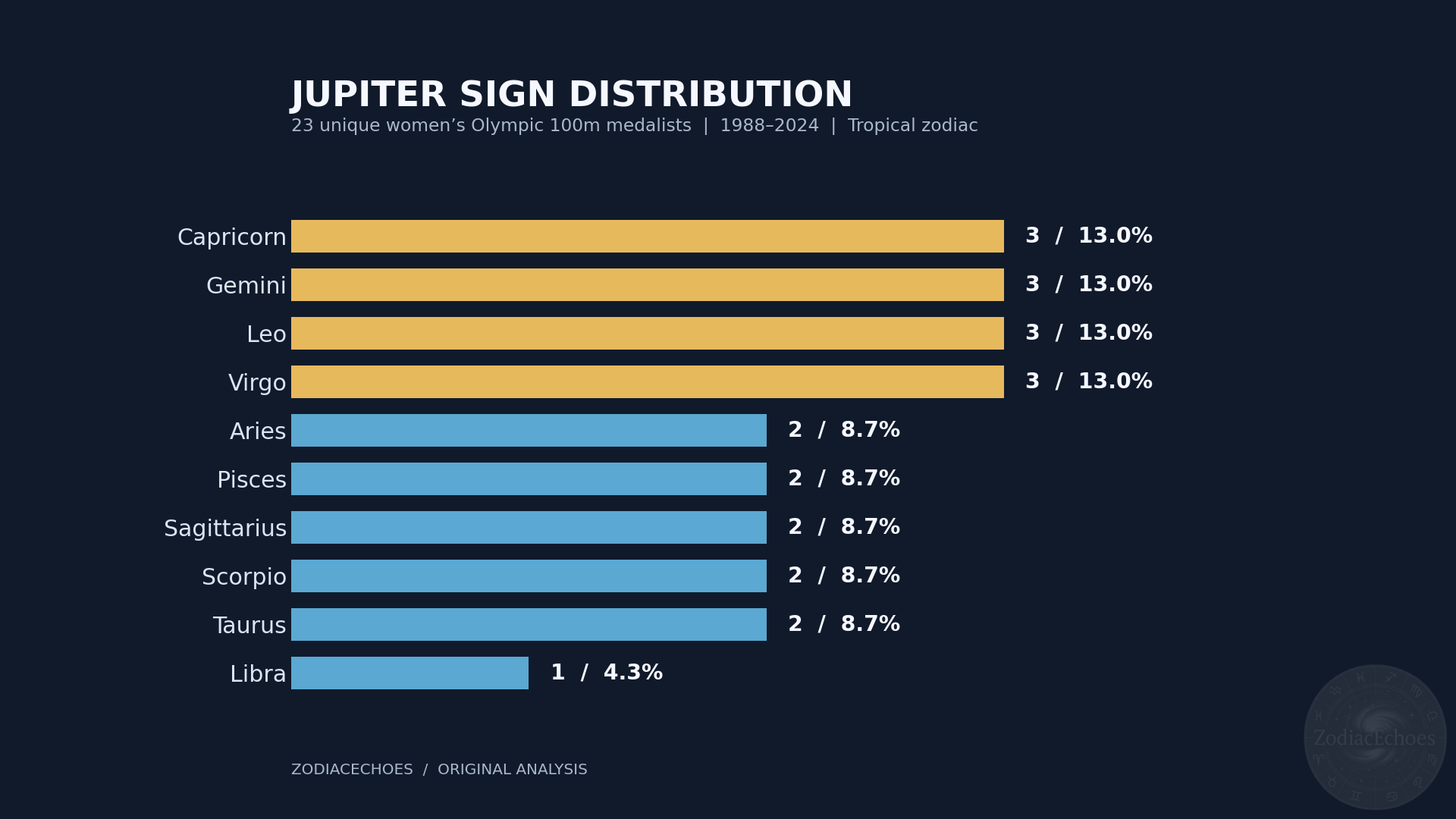
The four leading signs represent distinct astrological styles. Jupiter in Leo emphasizes confidence and the ambition to excel publicly. Jupiter in Gemini suggests adaptability, quick learning and responsiveness. Jupiter in Virgo highlights improvement through disciplined practice, while Jupiter in Capricorn connects growth with structure, endurance and long-term achievement.
Elaine Thompson-Herah has Jupiter in Virgo, while Gail Devers has Jupiter in Leo. Julien Alfred belongs to the Jupiter-in-Gemini group. Their different placements illustrate how Olympic success can emerge through several contrasting astrological combinations.
Unlike the more concentrated Saturn distribution, Jupiter does not produce a single standout sign. Its most interesting feature may be precisely this four-way tie.
Saturn in Pisces: The Strongest Individual Planetary Pattern
Saturn represents discipline, limits, responsibility, repetition and the willingness to endure demanding conditions. These associations make it especially relevant to the training environment of elite athletics, where progress depends on years of structured effort.
Of all the planetary signs examined in our principal distributions, Saturn in Pisces produces the highest individual count: five athletes, or 21.7%. Capricorn and Scorpio follow with three athletes each. Sagittarius, Taurus and Virgo appear twice each, while the remaining represented signs appear once.
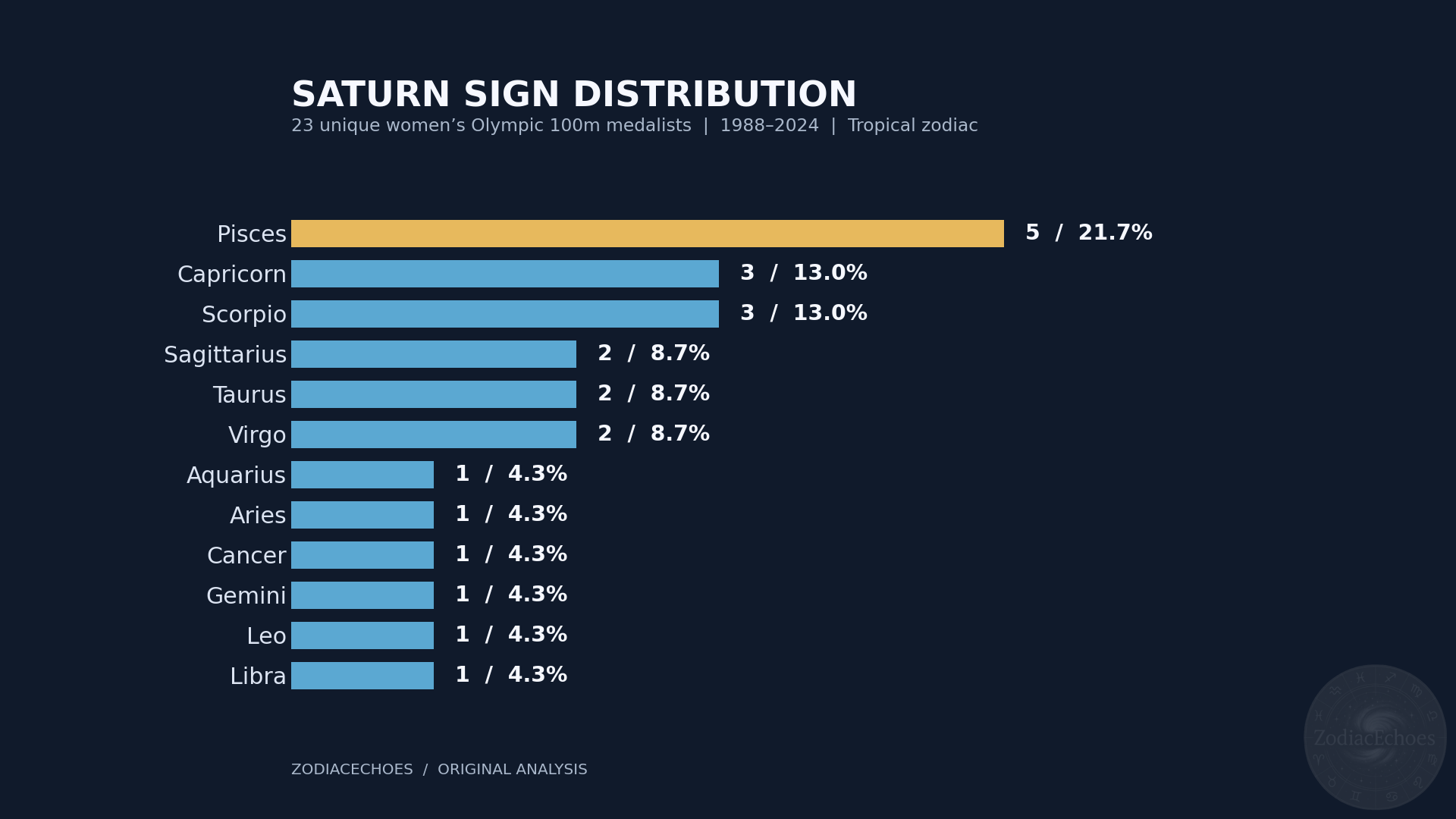
The Saturn-in-Pisces group includes Gail Devers, Heike Drechsler, Gwen Torrence, Juliet Cuthbert and Shericka Jackson. Their Olympic appearances span multiple decades, making this one of the more intriguing recurring placements in the study.
Astrologically, Pisces is a mutable Water sign associated with sensitivity, adaptability and the ability to respond to changing conditions. Saturn brings structure and discipline to that symbolism. Together, they can suggest the transformation of instinct and sensitivity into practiced control.
Gail Devers is an especially striking example. She won consecutive Olympic 100-meter titles in 1992 and 1996, and her chart combines Mars in Virgo with Saturn in Pisces, two signs opposite one another on the zodiac wheel. This creates an interesting sign-level relationship between precision and adaptability, although an exact planetary opposition would require checking their degrees.
Saturn in Pisces does not characterize every champion, but its frequency makes it a central finding of this women’s analysis.
Sun Signs: Aries and Sagittarius Share First Place
Popular zodiac discussions usually begin with the Sun sign, and our dataset offers a result that may feel more familiar to readers interested in competitive personalities.
Aries and Sagittarius are tied for first place, each appearing in four of the 23 birth charts (17.4%). Gemini and Virgo follow with three athletes each, while Taurus and Cancer appear twice each.
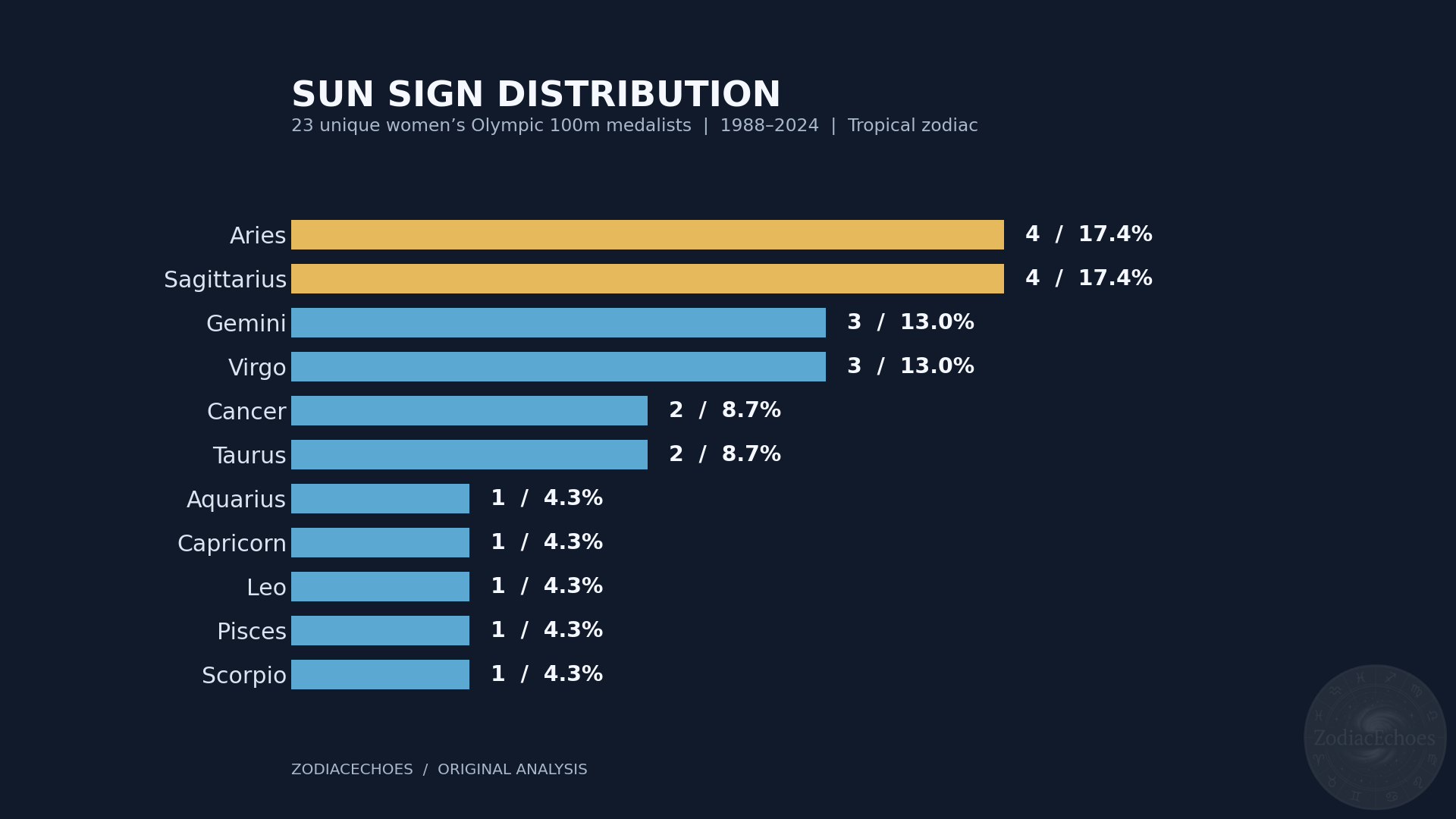
Both leading signs belong to the Fire element, traditionally associated with initiative, enthusiasm and a willingness to pursue challenges. Aries is ruled by Mars and often symbolizes direct competition, while Sagittarius is ruled by Jupiter and represents ambition, exploration and the desire to reach beyond established boundaries.
Florence Griffith-Joyner, whose 1988 Olympic performance remains one of the most memorable moments in sprinting history, was born under Sagittarius. Julien Alfred, who claimed the 2024 Olympic title for Saint Lucia, has the Sun in Gemini, demonstrating that the newest champion belongs to a different solar category.
The Sun-sign results also create a notable contrast with Mars. Aries leads the Sun distribution but appears only once in the Mars distribution. The familiar association between Aries and athletic aggression is therefore much stronger in the solar results than in the natal Mars results of this particular group.
Venus in Aries and Scorpio: Two Contrasting Patterns
Venus is not usually the first planet associated with sprinting, yet its position may offer another perspective on how athletes express confidence, self-worth, composure and their relationship with public recognition.
In our sample, Venus in Aries and Venus in Scorpio each appears four times, representing 17.4% of the athletes. Venus in Leo follows with three appearances.
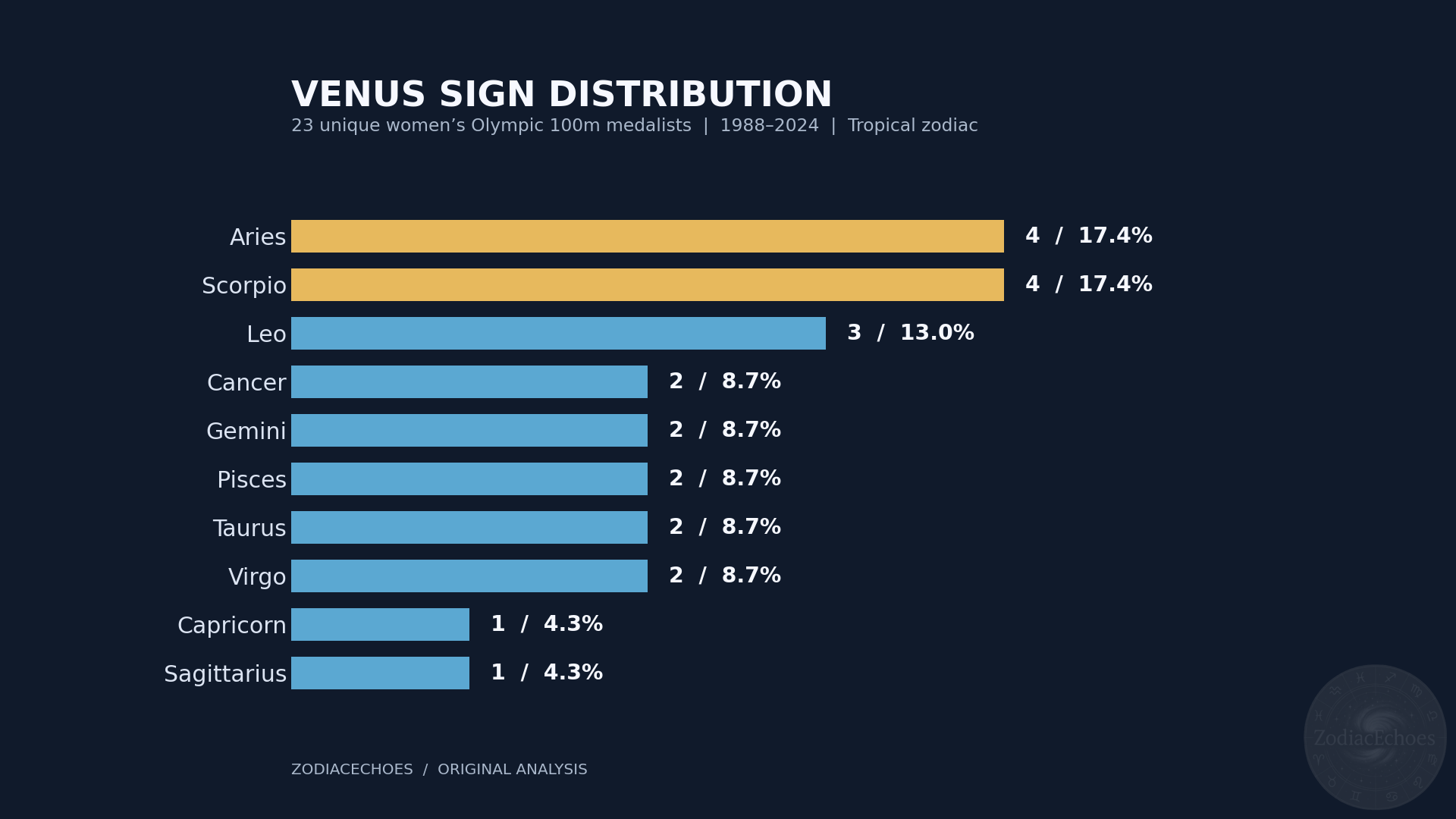
The two leading signs express markedly different themes. Venus in Aries is often interpreted as direct, independent and willing to take initiative. Venus in Scorpio, by contrast, is associated with intensity, determination and deep personal investment.
Gail Devers and Florence Griffith-Joyner both have Venus in Scorpio, despite belonging to different solar and Martian categories. Their shared Venus placement creates another connection between two of the most celebrated American sprinters in Olympic history.
Meanwhile, Venus in Aries appears in the charts of athletes including Evelyn Ashford and Shelly-Ann Fraser-Pryce. The latter’s Olympic record demonstrates an extraordinary ability to remain competitive across successive Games.
Although Venus is not a direct measure of speed or strength, its distribution adds an interesting layer to the wider astrological profile of these athletes.
Mercury in Taurus: A Possible Theme of Composure and Precision
Mercury traditionally governs communication, information processing, coordination and the ability to make rapid decisions. In a 100-meter race, the response to the starting signal and the execution of a carefully rehearsed movement sequence are crucial.
Mercury in Taurus is the most common Mercury placement in our dataset, appearing four times (17.4%). Gemini, Scorpio and Virgo follow with three appearances each.
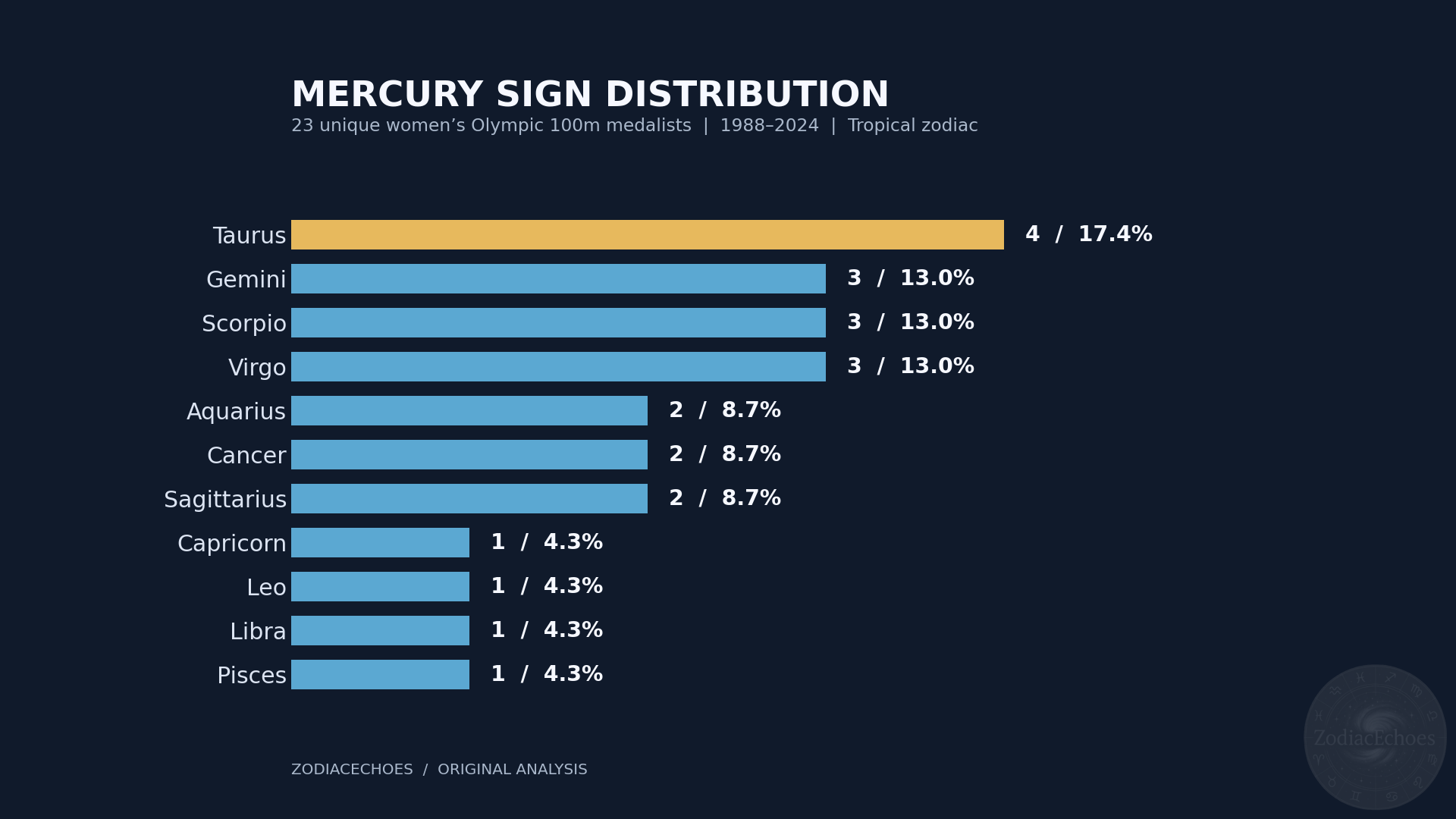
Astrologically, Mercury in Taurus is associated with deliberate thinking, consistency and the ability to remain focused on a practical objective. This is an interesting contrast with the speed of the event itself: the athlete must react quickly, but the movement pattern has been developed through thousands of repetitions.
Merlene Ottey and Evelyn Ashford both have Mercury in Taurus. Their long and distinguished careers make them particularly interesting examples of the relationship between practiced technique and sustained competitive performance.
Mercury’s overall distribution also shows a recurring Earth-sign theme. Taurus and Virgo together account for seven athletes, while Gemini and Scorpio each contribute another three. The result suggests a varied picture rather than one universal mental or technical signature.
Five Olympic Champions, Five Different Astrological Profiles
The individual birth charts help put the statistical findings into perspective. Some champions share important placements, while others demonstrate entirely different combinations.
Florence Griffith-Joyner: Sagittarius Energy
Florence Griffith-Joyner won the 1988 Olympic 100-meter title with the Sun and Mars in Sagittarius. Her chart also places Venus in Scorpio and Saturn in Capricorn. This combination brings together the expansive symbolism of Sagittarius, the intensity of Scorpio and the discipline associated with Capricorn.
Gail Devers: Mars in Virgo, Saturn in Pisces
Gail Devers won Olympic 100-meter gold in both 1992 and 1996. Her Sun is in Scorpio, Mars in Virgo, Jupiter in Leo and Saturn in Pisces. Her chart connects two of the strongest placements in our dataset, making her particularly relevant to the statistical findings.
Shelly-Ann Fraser-Pryce: A Different Expression of Mars
Shelly-Ann Fraser-Pryce won Olympic gold in 2008 and 2012, bronze in 2016 and silver at the Tokyo Games. Her natal Mars is in Pisces, while her Sun is in Capricorn and Jupiter is also in Pisces. Her success shows that the most frequently occurring Mars signs are not the only routes represented among repeat champions.
Elaine Thompson-Herah: Mars in Taurus
Elaine Thompson-Herah won back-to-back Olympic 100-meter titles in 2016 and 2020. With Mars in Taurus, Jupiter in Virgo and Saturn in Aquarius, her chart brings together physical persistence, technical refinement and an unconventional Saturn placement. Her repeated victories make Mars in Taurus one of the most interesting findings in the study.
Julien Alfred: A Sagittarius Mars in the Modern Era
Julien Alfred captured the 2024 Olympic 100-meter gold medal. Her Sun is in Gemini, Mars in Sagittarius, Jupiter in Gemini and Saturn in Gemini. Her Mars placement connects her to Florence Griffith-Joyner, the 1988 champion, while her concentration of Gemini placements gives her a very different overall chart.
What Makes the Women’s Results Different From the Men’s?
Our earlier ZodiacEchoes investigation examined 20 unique men’s Olympic 100-meter medalists from the same period. Comparing the two datasets reveals several notable differences.
Among the men, Mars in Sagittarius was the most common placement, appearing four times. Among the women, Sagittarius Mars appears three times, while Taurus and Virgo lead with four each.
The men’s Jupiter distribution was led by Aquarius, with five athletes. In the women’s dataset, Jupiter is spread more evenly, with Virgo, Leo, Gemini and Capricorn tied at three appearances each. Saturn also produces a contrast. The men’s sample showed Capricorn and Pisces tied at four, while the women’s sample is led by Pisces alone, with five.
Venus offers a point of similarity: Scorpio appears four times in both groups. However, Venus in Aries shares the lead among women, whereas the men’s distribution gives second place to Aquarius and Pisces.
These differences make the two studies useful companions. The most frequent placements are not identical, even though both datasets examine athletes competing in the same event over the same Olympic period.
How We Built the Dataset
We examined the women’s Olympic 100-meter medal results from Seoul 1988 through Paris 2024, covering ten editions of the Games. The sample contains 23 unique athletes and 30 medal placements. Each athlete appears only once in the main planetary distributions. The Mars-by-medal chart uses individual medal finishes instead, allowing repeat Olympic performances to be represented separately.
Two historical results require special handling. Following Marion Jones’s disqualification, the Sydney 2000 women’s 100-meter gold medal remains unallocated. The Beijing 2008 final produced two silver medalists and no bronze medalist. Our medal dataset preserves those distinctions rather than artificially assigning missing medals.
Planetary signs were calculated using Swiss Ephemeris and the tropical zodiac, with 12:00 UTC as the reference time where an athlete’s exact birth time was unavailable. The dataset flags placements that can change during the relevant UTC birth date. We have not treated unknown Ascendants or house positions as verified.
All percentages in the principal sign distributions use the 23 unique athletes as the denominator. These are descriptive frequencies within a selected group of Olympic medalists, rather than a comparison with the full population of professional sprinters.
Conclusion: Is Mars the Planet of Women’s Olympic Sprint Champions?
Mars remains the most natural starting point for an astrological investigation of sprinting, but our findings suggest that its expression among Olympic women is more varied than a simple association with Aries or fiery aggression.
Mars in Taurus and Virgo leads the distribution, pointing toward themes of physical consistency, technical precision and disciplined execution. Saturn in Pisces produces the strongest single sign count among the principal planetary results, while Aries and Sagittarius share the lead for the Sun.
The individual champions make the story even more interesting. Florence Griffith-Joyner and Julien Alfred share Mars in Sagittarius. Gail Devers represents Mars in Virgo. Elaine Thompson-Herah has Mars in Taurus. Shelly-Ann Fraser-Pryce has Mars in Pisces.
There is no universal Olympic sprint birth chart. What emerges instead is a collection of recurring placements, contrasting astrological personalities and a striking difference between the most common Mars signs among women and men.
FAQ
Which Mars sign is most common among women’s Olympic 100-meter medalists?
Taurus and Virgo are tied for first place, each appearing in four of the 23 unique athletes’ birth charts, or 17.4%.
Which Sun sign appears most often among the Olympic sprinters?
Aries and Sagittarius are tied, with four athletes each.
Which Saturn sign is most common?
Saturn in Pisces appears in five of the 23 charts, making it the most frequent Saturn placement in the sample.
Do female and male Olympic sprint medalists share the same dominant Mars sign?
No. The men’s dataset is led by Mars in Sagittarius, while the women’s dataset is led by Mars in Taurus and Virgo.
Where can readers explore the complete data?
The ZodiacEchoes dataset includes the athletes’ recorded Olympic medal finishes, birth dates, planetary sign placements, methodology and seven supporting charts.