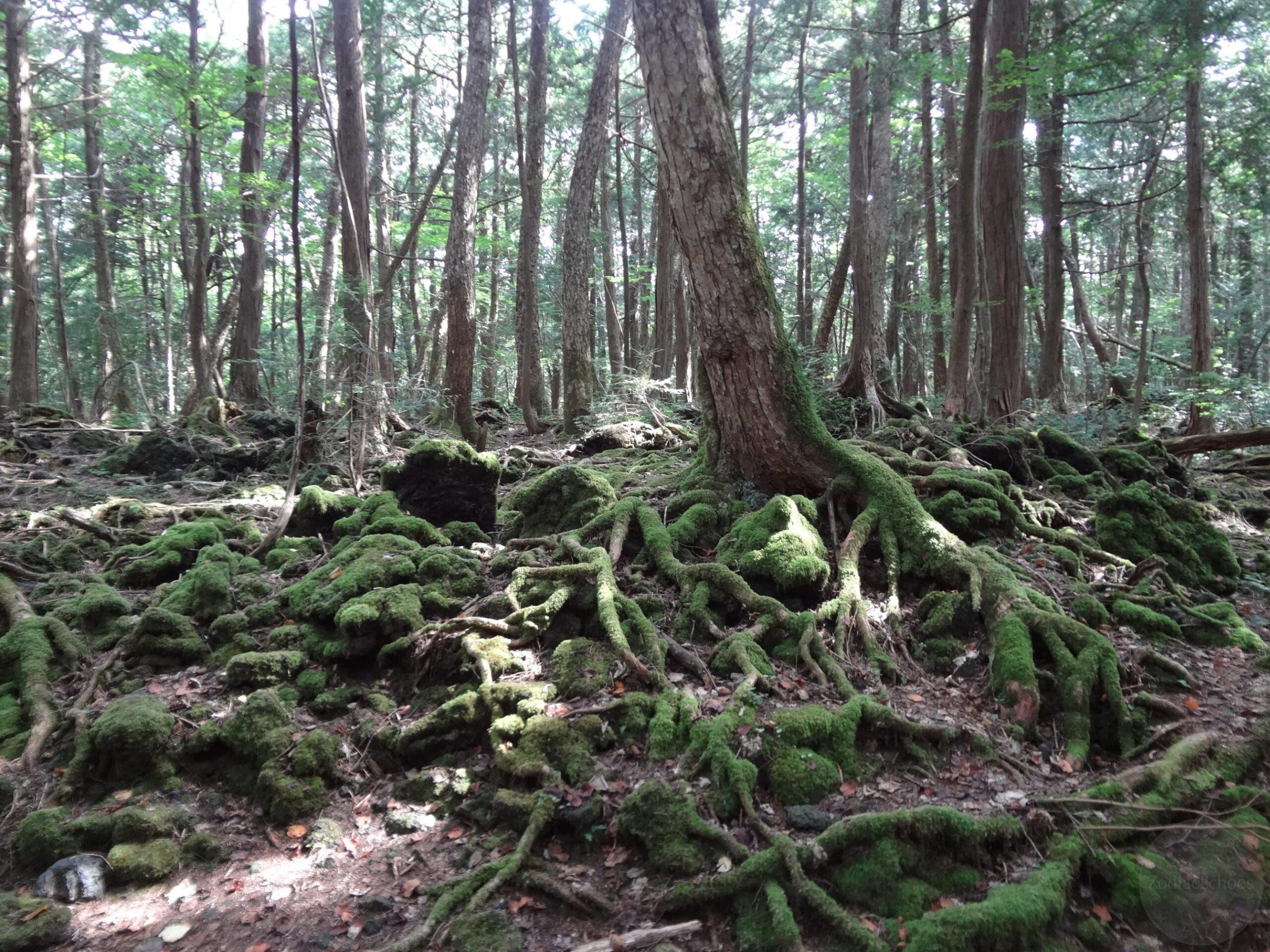
- Aokigahara is a dense forest at the foot of Mount Fuji, formed on lava from a major eruption in 864 CE.
- Its unusually quiet atmosphere, tangled roots, and confusing terrain have helped create its mysterious reputation.
- Japanese ghost folklore and modern popular culture have linked the forest with restless spirits known as yurei.
- The forest’s association with suicide is real, but many stories about ancient curses, abandoned elders, and malfunctioning compasses are exaggerated or unverified.
At the northwestern foot of Mount Fuji lies a forest unlike almost any other in Japan. Its trees grow over ancient volcanic rock, their exposed roots twisting across the ground like enormous veins. Moss covers the dark lava, while dense vegetation conceals much of the surrounding landscape.
Visitors sometimes describe an unusual silence beneath the trees. The terrain is difficult to read, familiar landmarks disappear quickly, and the forest can seem almost detached from the world outside. This is Aokigahara, also known as Jukai, the Sea of Trees.
Although it is a remarkable natural landscape, Aokigahara has become internationally famous under a much darker name: Japan’s Suicide Forest. Its reputation combines documented tragedies, supernatural stories, and a landscape that appears almost designed for mystery.
The Forest Born From a Volcanic Catastrophe
Aokigahara did not exist in its present form throughout ancient Japanese history. The forest developed on lava produced by Mount Fuji’s Jogan eruption in 864 CE. The eruption transformed the surrounding landscape, sending molten rock across a large area and changing the shape of nearby lakes.
Over the following centuries, vegetation gradually established itself on the cooled lava. Today, Aokigahara covers approximately 30 square kilometers. Because the soil is thin, many trees spread their roots across the volcanic surface rather than penetrating deeply into the ground.
The result is an extraordinary landscape of exposed roots, moss-covered rocks, cracks, and small cavities. Even without its darker legends, Aokigahara would be one of Japan’s most visually unusual forests.
Why Is Aokigahara So Unnaturally Quiet?
One of the forest’s most frequently reported characteristics is its remarkable quietness. According to Japan’s official tourism information, the porous volcanic rock beneath the trees can absorb and dampen sound.
The dense vegetation also contributes to the atmosphere, creating stretches where distant noises are difficult to hear. For visitors accustomed to ordinary woodland environments, the effect can feel unsettling. There is no supernatural explanation required. The silence emerges from the forest’s geology and vegetation.
Nevertheless, the combination of quiet surroundings, dense trees, and unfamiliar terrain has helped transform an ordinary natural phenomenon into part of Aokigahara’s frightening reputation.
The Legend of the Restless Spirits
In Japanese folklore, yurei are spirits of deceased people who have not found peace. Traditional beliefs sometimes describe these spirits as remaining attached to the living world because of grief, resentment, unfinished obligations, or the circumstances surrounding their deaths.
Unlike benevolent ancestral spirits, yurei may be portrayed as troubled presences unable to move on. Modern ghost stories and popular culture have associated Aokigahara with such spirits, sometimes portraying the forest as a place where the dead remain among the trees.
These stories draw upon genuine Japanese supernatural traditions, but there is little evidence that Aokigahara possessed a continuous, centuries-old reputation as a haunted forest. Much of its present-day ghostly identity developed alongside its modern association with death.
Was Aokigahara Once a Place Where Elderly People Were Abandoned?
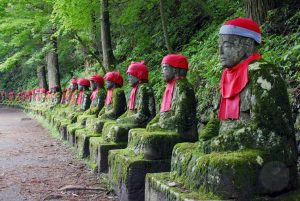
One of the darkest stories connected with Aokigahara concerns ubasute, a legendary practice in which elderly or infirm relatives were supposedly abandoned in remote mountains. Versions of this story appear in Japanese folklore and literature, often exploring poverty, family obligations, and the treatment of older generations.
Some modern accounts claim that Aokigahara was once used for this purpose. However, historians have questioned whether ubasute was ever a widespread historical practice, and there is no reliable evidence establishing Aokigahara as a traditional site where families abandoned elderly relatives.
The connection appears to be a later addition to the forest’s mythology rather than a documented local custom. Yet the story continues circulating because it fits the image of a remote woodland supposedly associated with suffering and death.
How Did Aokigahara Become Known as the Suicide Forest?
Aokigahara’s association with suicide is documented, although the international fascination with the location is considerably more recent than its volcanic origins. Japanese literature played an important role in shaping the forest’s public image during the twentieth century.
In 1960, author Seicho Matsumoto published the novel Nami no To, commonly translated as Tower of Waves, which helped connect Aokigahara with a tragic fictional story. Later publications, television programs, films, and internet coverage reinforced its reputation.
Over time, the forest became increasingly defined by the deaths associated with it rather than by its extraordinary natural environment.
Local authorities and community organizations have undertaken prevention and outreach efforts, including signs encouraging people in distress to seek support. Many Japanese visitors, however, know Aokigahara primarily as a destination for walking, exploring volcanic caves, and experiencing the natural landscape around Mount Fuji.
Do Compasses Really Stop Working in Aokigahara?
One of the most persistent legends claims that compasses malfunction inside the forest, leaving visitors unable to find their way out. The story has a small geological basis. Volcanic rock can contain magnetic minerals capable of influencing a compass needle when the instrument is placed directly against certain rocks.
However, Japan’s official tourism guidance explains that ordinary compass navigation is not generally disrupted throughout the forest.
The more significant navigational challenge comes from the dense vegetation, uneven volcanic terrain, and shortage of obvious landmarks away from established trails. The idea of a forest that mysteriously disables navigation equipment has become part of Aokigahara’s mythology, but it should not be mistaken for a supernatural phenomenon.
The Caves Hidden Beneath the Sea of Trees
Aokigahara’s geological history has created another remarkable feature: a network of lava caves beneath the forest. Among the best-known are Narusawa Ice Cave and Fugaku Wind Cave, both popular visitor attractions.
These underground spaces formed through volcanic processes as lava cooled and moved beneath the surface. Some maintain unusually cool conditions, creating environments very different from the forest above.
For centuries, the volcanic landscape has shaped the relationship between local communities and Mount Fuji. The caves provide a reminder that Aokigahara’s most extraordinary mysteries are not necessarily supernatural. Some are hidden in the geological world beneath the trees.
Why Does Aokigahara Continue to Fascinate People?
Aokigahara occupies an unusual place in the public imagination because several different stories overlap within the same landscape.
There is the real forest, created by volcanic activity and home to distinctive wildlife. There are Japanese traditions concerning spirits and the afterlife. And there is the modern history of suicide, which has been amplified by books, films, and international media.
These layers have created a reputation far more frightening than the forest’s physical appearance alone. Yet reducing Aokigahara entirely to its association with death overlooks its ecological significance and the efforts of those who work to protect both the forest and vulnerable people.
Its most compelling mystery may be how an extraordinary natural landscape became one of the world’s most recognizable symbols of fear.
Conclusion
Aokigahara is a forest where geology, folklore, and modern tragedy have become inseparable in the public imagination. Its ancient lava fields, unusual silence, tangled roots, and underground caves create an atmosphere that has inspired generations of stories.
Legends of restless spirits and abandoned elders have added supernatural dimensions, even when their historical foundations are uncertain. But beyond its frightening reputation, Aokigahara remains a living forest with a remarkable natural history.
Perhaps the greatest mystery of Japan’s Sea of Trees is not what might be hiding within it, but why its real beauty has become so thoroughly overshadowed by the stories people tell about death.
Cosmic Highlights

FAQ
Where is Aokigahara Forest?
Aokigahara is located at the northwestern foot of Mount Fuji in Yamanashi Prefecture, Japan.
Why is Aokigahara called the Suicide Forest?
The name reflects documented deaths by suicide and a reputation reinforced by twentieth-century literature, media coverage, and popular culture.
Is Aokigahara believed to be haunted?
Modern ghost stories associate the forest with yurei, or restless spirits, although there is no verified evidence of supernatural activity.
Do compasses malfunction in Aokigahara?
Magnetic minerals in volcanic rock can affect compasses placed directly against some rocks, but ordinary compass use is not generally disrupted throughout the forest.
Can tourists visit Aokigahara?
Yes. The forest has established walking routes and nearby attractions, including volcanic caves. Visitors should remain on designated trails and respect local conservation and safety guidance.
Sources (English):