- A mysterious eighteenth-century grimoire preserves an authentic magical circle associated with necromantic operations and spirit conjuration.
- The original diagram, Circulus Operationis Magica, appears on folio 7r of Compendium Rarissimum, dating to approximately 1775.
- The ritual system involved magical symbols, ceremonial gloves, a sword, incense, and a protective boundary.
- The manuscript describes frightening demonic apparitions that supposedly attempted to lure magicians outside their circles.
Imagine standing inside a circle marked with mysterious symbols, surrounded by darkness and the smell of burning incense. Somewhere beyond the boundary, a supernatural presence begins to take shape. You have summoned it deliberately, but there is one rule you must never break: do not leave the circle while the spirit remains.
For centuries, European practitioners of ceremonial magic believed that a properly prepared magical circle could separate a human operator from dangerous supernatural forces. The most frightening part of these ceremonies was not necessarily the appearance of a demon. It was the possibility that the entity might trick the magician into abandoning their protection.
One extraordinary eighteenth-century manuscript preserves a diagram associated with this terrifying tradition. Its name is Circulus Operationis Magica, meaning the Circle of Magical Operation.
The diagram survives in Compendium Rarissimum Totius Artis Magicae, a mysterious illustrated grimoire filled with demonic figures, magical characters, ceremonial equipment, and scenes of necromantic activity.
The Forbidden Grimoire That Claimed to Be 700 Years Older
The Compendium Rarissimum is preserved in the Wellcome Collection in London under the manuscript reference MS.1766.
Its title page claims the year 1057, but historians date the surviving manuscript to approximately 1775. The enormous difference suggests that its creator wanted the book to appear far older than it actually was. The title page also carries the Latin warning Noli me tangere, meaning “Do not touch me.”
Inside are extraordinary watercolor illustrations of demons, monstrous beings, magical signs, ritual gloves, and supernatural operations. Some pages depict terrifying creatures, while others describe the ceremonial substances associated with their appearance.
Among these illustrations is a particularly important diagram: the protective circle used for magical operations. Unlike the manuscript’s portraits of demons, this drawing concerns the ritual environment itself. It shows how the operator’s space was symbolically organized before confronting supernatural forces.
The Original Magic Circle: A Historical Diagram from 1775
The diagram appears on folio 7r of Compendium Rarissimum, under the Latin title Circulus Operationis Magica.
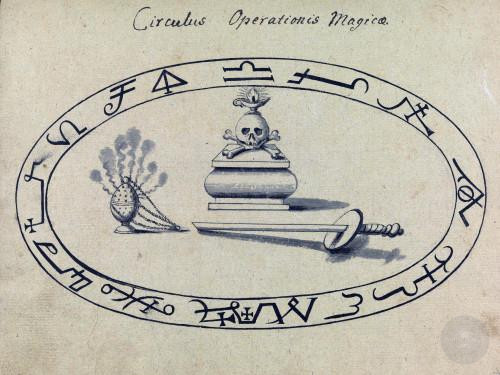
The illustration depicts an oval ritual boundary surrounded by magical characters, accompanied by ceremonial instruments. These elements belong to a broader tradition in which the magical circle was considered a protected area separating the practitioner from the supernatural world.
The circle represented authority and protection. Its symbols reinforced the boundary, while the ceremonial instruments formed part of the magician’s equipment. A sword could symbolize command over spirits, and incense was associated with purification, preparation, and supernatural manifestation.
The diagram does not provide a complete explanation of every character or an uninterrupted set of instructions. However, the surrounding manuscript preserves additional equipment and descriptions that help reconstruct the ceremonial framework.
How the Forbidden Magic Circle Ritual Was Performed
The Compendium Rarissimum presents its magical system through a combination of illustrations, labels, and descriptions rather than a single continuous instruction manual for this particular circle.
Its surviving material nevertheless reveals several stages of ritual preparation. The following reconstruction distinguishes the equipment shown in the manuscript from practices documented in the wider tradition of European ceremonial magic.
Step 1: Preparing the Magical Boundary
The central feature of the operation was the magical circle itself. The diagram on folio 7r shows an oval enclosure surrounded by mysterious characters. This arrangement established a designated ceremonial space. In historical conjuration traditions, such boundaries were sometimes drawn directly onto the ground, while others could be prepared on portable materials.
The essential purpose was to separate the magician’s position from the surrounding environment, where the summoned entity was expected to appear. The manuscript does not specify the exact material or dimensions required to reproduce this particular circle.
Step 2: Preparing the Ritual Gloves
The manuscript contains two remarkable illustrations of ceremonial gloves. Folio 5r is labeled Der Handschuch bey der Operation, inwendig, identifying the inside of the glove used during the operation. Folio 6r illustrates its exterior. Both designs incorporate magical characters.
These gloves were not ordinary clothing. Within the manuscript’s ritual system, they were marked objects associated with the operator’s preparation. Their inclusion suggests that the magician’s protection and ceremonial authority extended beyond the circle to equipment worn on the body.
Step 3: Arranging the Sword and Incense
The original circle illustration includes ceremonial instruments associated with the magical operation. In European ritual traditions, the sword represented authority, command, and the separation of sacred or protected space from ordinary surroundings.
Incense played another important role. Burning aromatic substances could prepare the ritual atmosphere and was sometimes associated with the manifestation of particular spirits.
The Compendium Rarissimum includes separate descriptions of substances linked to demonic appearances, although these should not automatically be treated as ingredients required for the circle on folio 7r. The diagram establishes the importance of ritual equipment, but it does not preserve an exact sequence for arranging every object.
Step 4: Entering the Protected Space
In traditional ceremonial conjuration, the operator’s position within the circle was fundamental. The magician was expected to maintain authority while confronting whatever supernatural presence had been invoked. Remaining within the boundary was considered essential to personal protection. The Compendium Rarissimum makes this fear especially vivid in another illustration, on folio 40r.
Its German caption describes how evil beings supposedly appeared during necromantic operations to frighten the operator and lure them out of the circle. This is one of the manuscript’s most disturbing details. The danger was imagined not merely as an attack but as an attempt to manipulate the magician’s fear.
Step 5: Confronting the Supernatural Presence
The manuscript contains numerous depictions of demonic entities, including Astaroth, Beelzebub, and Asmodai. Some are accompanied by descriptions of the substances associated with their appearance. These illustrations demonstrate the supernatural environment in which the magical circle was understood.
In historical conjuration traditions, the operator might attempt to summon, question, command, or dismiss an entity through established formulas. The greatest danger was believed to arise when the magician lost authority over the encounter.
However, the surviving folio 7r does not identify a particular demon or preserve a complete spoken invocation for this circle. Assigning a specific summoning formula to the diagram would therefore go beyond the surviving evidence.
Step 6: Dismissing the Spirit and Ending the Operation
In many historical grimoires, the dismissal of a summoned spirit was an important final stage. The magician was not simply expected to abandon the ceremonial space when the encounter appeared to be over.
Instead, traditions of spirit conjuration often required a formal dismissal before the operator departed. The terrifying possibility was that a supernatural presence might refuse to leave or continue threatening the magician.
Although Compendium Rarissimum does not provide a complete dismissal formula alongside the circle diagram, this concern was central to the wider tradition of protective ceremonial magic. The circle therefore represented more than the beginning of the ritual. It remained symbolically important until the encounter had ended.
The Demons That Tried to Lure Magicians Outside the Circle
One of the most frightening illustrations in Compendium Rarissimum appears on folio 40r. Its caption describes the frightening forms supposedly assumed by evil beings during necromantic operations. According to the manuscript, these apparitions attempted to terrify the practitioner and draw them beyond the protected boundary.
This detail reveals a disturbing feature of historical necromantic belief: the supernatural threat was not always imagined as direct violence. Instead, an entity might exploit fear, confusion, or curiosity. A magician who panicked and fled could abandon the very protection the ceremony was supposed to provide.
The circle was therefore both a supernatural barrier and a test of the practitioner’s discipline. The manuscript’s imagery presents a world in which magical authority could be challenged by frightening appearances designed to undermine human confidence.
The Terrifying Connection to Astaroth
The Compendium Rarissimum contains several references to Astaroth, a demonic figure known from European magical traditions. One folio concerns the binding of Astaroth, while another depicts an especially dangerous necromantic operation associated with the entity.
On folio 29r, the manuscript identifies an Operatio Nigromantica involving Astaroth and describes the operation as exceptionally dangerous. The illustration presents a disturbing ritual scene involving a human operator and ceremonial objects.
This is separate from the magic circle diagram on folio 7r. The manuscript does not establish that the same exact circle was used in every operation involving Astaroth.
Nevertheless, the proximity of protective equipment, spirit-binding material, and dangerous necromantic scenes reveals the larger system of beliefs behind the grimoire. The practitioner was imagined as someone attempting to approach supernatural forces while maintaining control through symbols, ritual preparation, and magical authority.
Why the Magic Circle Was More Frightening Than the Demon
At first glance, the monstrous figures in Compendium Rarissimum seem like its most disturbing illustrations. But the magic circle reveals something psychologically more unsettling. Its very existence implies that the magician expected danger.
Why construct a protective boundary unless the forces being contacted were believed capable of causing harm? Why prepare ceremonial equipment unless ordinary human authority was considered insufficient? And why warn about frightening apparitions attempting to lure the operator outside the circle unless leaving that space was imagined as a serious threat?
The diagram reflects a world in which supernatural encounters were understood as dangerous negotiations. The magician was not merely seeking knowledge or power. They were attempting to maintain control over something believed to exist beyond ordinary human experience.
The ritual’s most frightening moment was not necessarily when the spirit appeared. It was when the operator had to decide whether the boundary would hold.
Conclusion
The Circulus Operationis Magica is one of the most fascinating surviving diagrams of eighteenth-century ceremonial magic. Its mysterious characters, enclosed boundary, ceremonial equipment, and connection to a manuscript filled with demonic imagery reveal a ritual tradition dominated by protection, supernatural authority, and the fear of losing control.
The Compendium Rarissimum even describes frightening apparitions that supposedly attempted to lure practitioners outside their circles. For those who believed in these operations, the boundary represented the difference between confronting a supernatural presence and becoming vulnerable to it.
And the most terrifying possibility was never that nothing would answer the invocation. It was that something would appear — and the magician would discover that the circle was not enough.
Cosmic Highlights

Read the Original Compendium Rarissimum Manuscript
The complete historical manuscript, Compendium Rarissimum Totius Artis Magicae, survives in the Wellcome Collection, London, under the reference MS.1766. Although its title page bears the year 1057, the manuscript is dated to approximately 1775. The digitized manuscript contains the original magical circle, ceremonial gloves, demonic illustrations, necromantic scenes, and other ritual material.
- View the original manuscript and access the PDF: https://iiif.wellcomecollection.org/pdf/b1968583x
- Original magical circle: Circulus Operationis Magica, folio 7r.
- Manuscript: Compendium Rarissimum Totius Artis Magicae.
- Date: Approximately 1775.
FAQ
Is the forbidden magic circle a genuine historical diagram?
Yes. The Circulus Operationis Magica appears on folio 7r of Compendium Rarissimum, an eighteenth-century magical manuscript preserved in the Wellcome Collection.
What was the purpose of the magical circle?
In European ceremonial magic, circles were associated with protection and ritual authority. They separated the operator’s designated space from the surrounding environment where supernatural entities were believed to manifest.
Did magicians believe demons could cross the circle?
Historical traditions varied, but protective circles were commonly understood as barriers against dangerous spirits. Some texts warned that leaving the protected space could expose the operator to supernatural threats.
What equipment was associated with the ritual?
The manuscript illustrates a magical circle, ceremonial gloves, and ritual instruments. Its broader collection also contains images of demonic entities and necromantic operations.
Does the manuscript explain how to summon Astaroth?
It contains material associated with Astaroth, including spirit-binding imagery and a dangerous necromantic operation. However, the circle diagram on folio 7r does not independently provide a complete Astaroth invocation.
Can the original manuscript be viewed online?
Yes. The manuscript is available as a digitized facsimile through the Wellcome Collection and in a PDF reproduction.