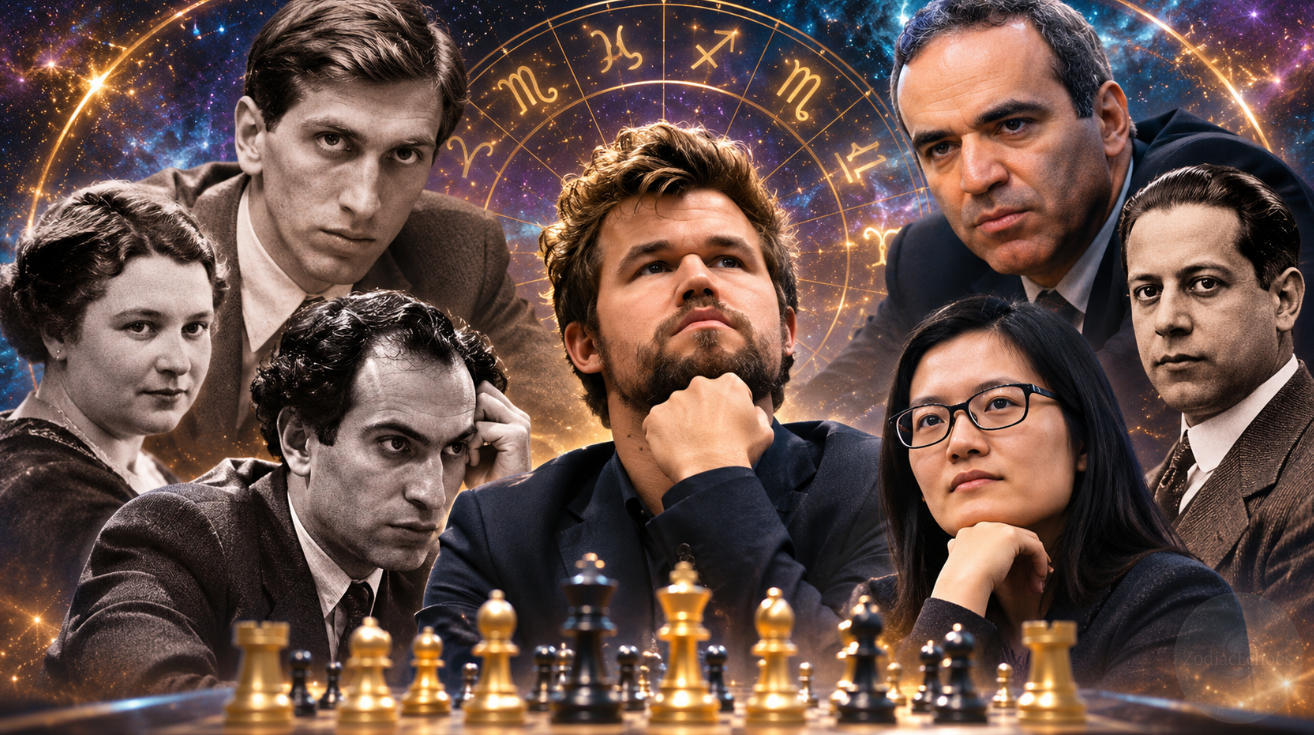
- Aries and Pisces share first place among the Sun signs of 59 world chess champions, with eight representatives each (13.6%).
- Mercury in Scorpio and Venus in Aries each appear nine times, leading their respective planetary distributions.
- Saturn in Capricorn occurs ten times (16.9%), the highest individual planet–sign concentration in the dataset.
- Sun–Saturn conjunctions appear among six women’s champions and two open-category champions, forming one of the study’s most intriguing historical planetary patterns.
What makes a world chess champion? Exceptional memory, strategic imagination, precise calculation, discipline, and the ability to make difficult decisions under extraordinary pressure.
Astrology traditionally associates these characteristics with different planets. Mercury represents intellectual processing, Mars symbolizes competition, Jupiter governs growth and learning, and Saturn is linked to patience and long-term achievement. But do any of these planetary placements appear more frequently among chess champions?
For this ZodiacEchoes Original Analysis, we assembled a dataset of 59 unique world chess champions, covering classical, separate FIDE-era, women’s, rapid, and blitz championship titles through 2025.
Rather than examining Sun signs alone, we calculated six planetary positions for each champion and compared their distributions across all twelve zodiac signs. We also investigated differences between championship categories and tested major planetary aspects against statistical reference models.
The findings reveal several intriguing concentrations, including an unexpected tie between Aries and Pisces and a particularly strong Saturn presence in Capricorn.
Which Zodiac Signs Have Produced the Most World Chess Champions?
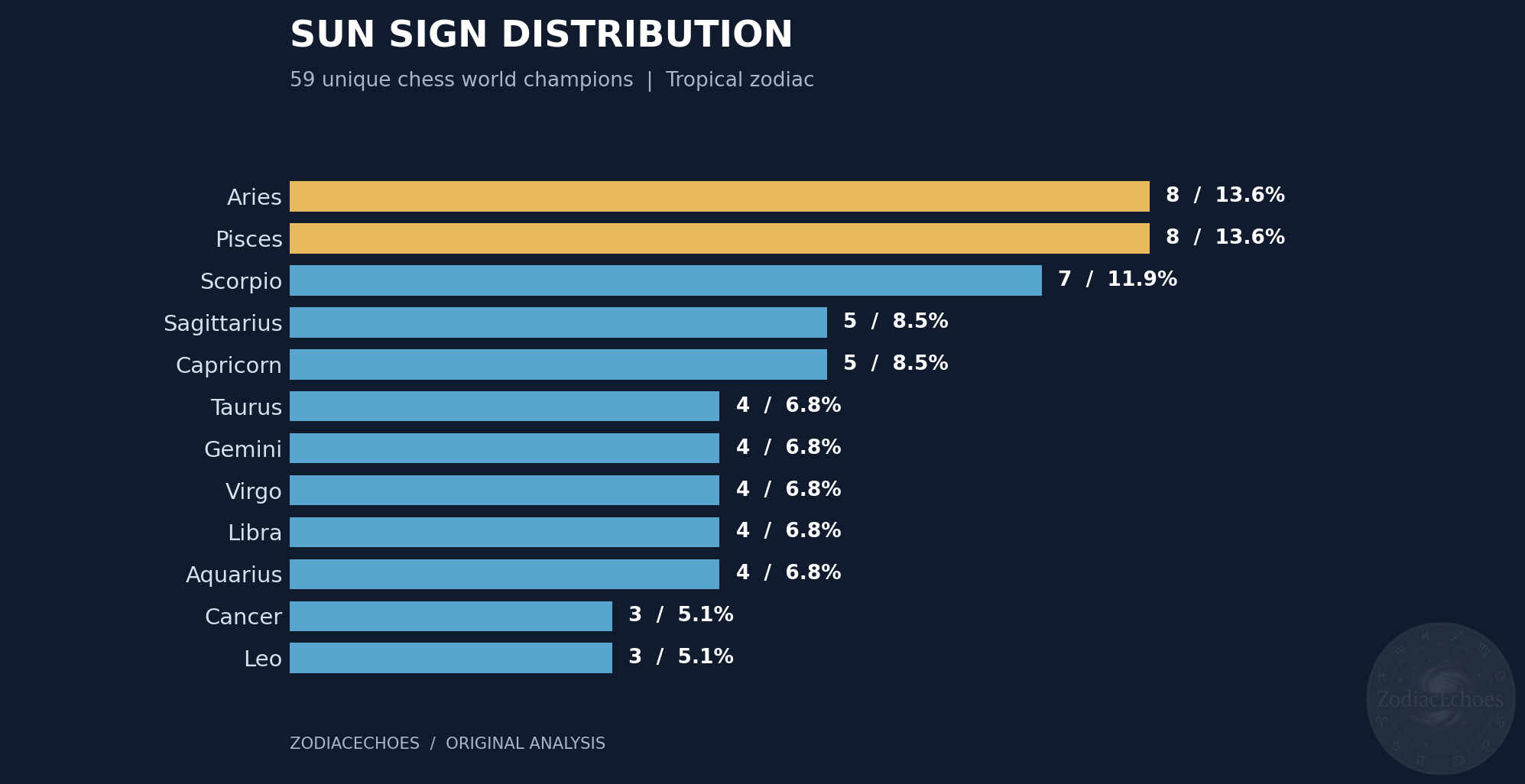
Aries and Pisces lead the rankings, with eight champions each. Scorpio follows with seven, while Sagittarius and Capricorn each have five. Cancer and Leo occupy the bottom positions, with three champions each.
The complete ranking provides a clearer picture of how the sample is distributed.
Complete Ranking of World Chess Champions by Zodiac Sign
| Rank | Zodiac Sign | Champions | Share |
|---|---|---|---|
| 1 | Aries | 8 | 13.6% |
| 1 | Pisces | 8 | 13.6% |
| 3 | Scorpio | 7 | 11.9% |
| 4 | Sagittarius | 5 | 8.5% |
| 4 | Capricorn | 5 | 8.5% |
| 6 | Taurus | 4 | 6.8% |
| 6 | Gemini | 4 | 6.8% |
| 6 | Virgo | 4 | 6.8% |
| 6 | Libra | 4 | 6.8% |
| 6 | Aquarius | 4 | 6.8% |
| 11 | Cancer | 3 | 5.1% |
| 11 | Leo | 3 | 5.1% |
| Total | 59 | 100% |
Complete Sun-sign ranking of 59 unique world chess champions. Percentages are rounded to one decimal place.
Aries and Pisces stand at the top of the championship rankings, each producing eight world champions, while Scorpio follows closely with seven. The five-champion difference between the highest- and lowest-ranked signs reveals a competitive field in which three zodiac signs nevertheless emerge as the most prominent.
Aries — The Competitive Challenger
Aries traditionally represents initiative, courage, direct action, and the determination to overcome obstacles. The Aries group includes Garry Kasparov, Vasily Smyslov, Susan Polgar, Antoaneta Stefanova, Daniil Dubov, and Humpy Koneru.
Garry Kasparov embodies the competitive intensity traditionally associated with Aries. His aggressive opening preparation, willingness to take calculated risks, and relentless determination helped define his extraordinary career.
Alongside the other Aries champions, Kasparov provides a compelling example of how the sign’s traditional symbolism of courage, initiative, and confrontation resonates with elite chess.
Pisces — Intuition and Strategic Imagination
Pisces traditionally symbolizes intuition, imagination, sensitivity, and the ability to recognize subtle patterns. Its representatives include Bobby Fischer, Hou Yifan, Veselin Topalov, Vasyl Ivanchuk, Zhu Chen, and Bibisara Assaubayeva.
The symbolic connection is interesting because experienced chess players sometimes recognize promising positions before consciously calculating every possible continuation.
Fischer’s extraordinary originality and Hou Yifan’s remarkable strategic versatility illustrate different expressions of the imaginative, intuitive qualities traditionally associated with Pisces.
Scorpio — Psychological Depth and Persistence
Scorpio ranks third with seven champions, including José Raúl Capablanca, Alexander Alekhine, Mikhail Tal, Alexander Grischuk, Xie Jun, and Xu Yuhua. Astrologically, Scorpio is associated with investigation, strategic awareness, persistence, and psychological insight.
These themes fit naturally with chess, where identifying an opponent’s intentions can be as important as calculating the strongest move. Tal’s explosive tactical imagination and Capablanca’s exceptional positional precision represent two contrasting expressions of Scorpio’s traditional association with psychological insight, concentration, and strategic depth.
The Sun-sign results are only the beginning. A more detailed analysis requires examining the planets traditionally associated with thinking, competition, motivation, and discipline.
Mercury — Does the Planet of Intelligence Reveal a Pattern?
Mercury traditionally governs logic, memory, communication, calculation, and information processing. These associations make it one of the most relevant planets for an astrological investigation of chess.
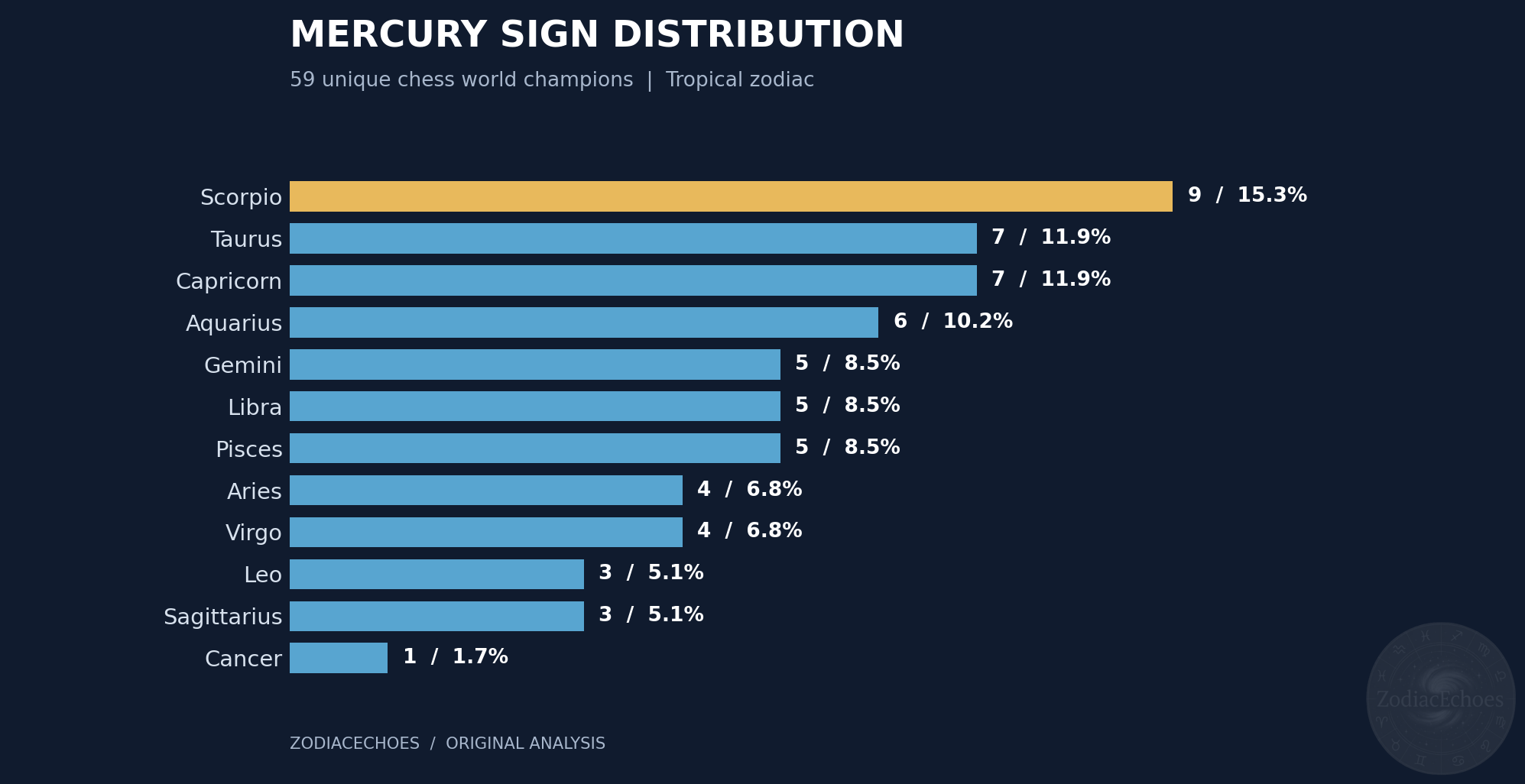
Mercury in Scorpio appears nine times, making it the leading Mercury placement in the dataset. Among the champions with this placement are Capablanca, Alekhine, Tal, Ding Liren, Grischuk, and Xie Jun.
Traditional astrology associates Mercury in Scorpio with investigative thinking, concentration, and the ability to examine information beneath its obvious surface. These qualities offer an appealing symbolic comparison with strategic calculation.
Mercury in Scorpio emerges as the leading intellectual placement in the study, appearing among nine world champions. The concentration is particularly interesting alongside Scorpio’s third-place position in the Sun-sign rankings, reinforcing the sign’s prominence across two separate planetary distributions. Because Mercury remains astronomically close to the Sun, these distributions are naturally interconnected.
Venus — Why Does Aries Lead Again?
Venus is traditionally associated with preferences, enjoyment, values, motivation, and attraction. Although it is less directly connected with chess than Mercury or Saturn, its distribution produces one of the study’s strongest concentrations.
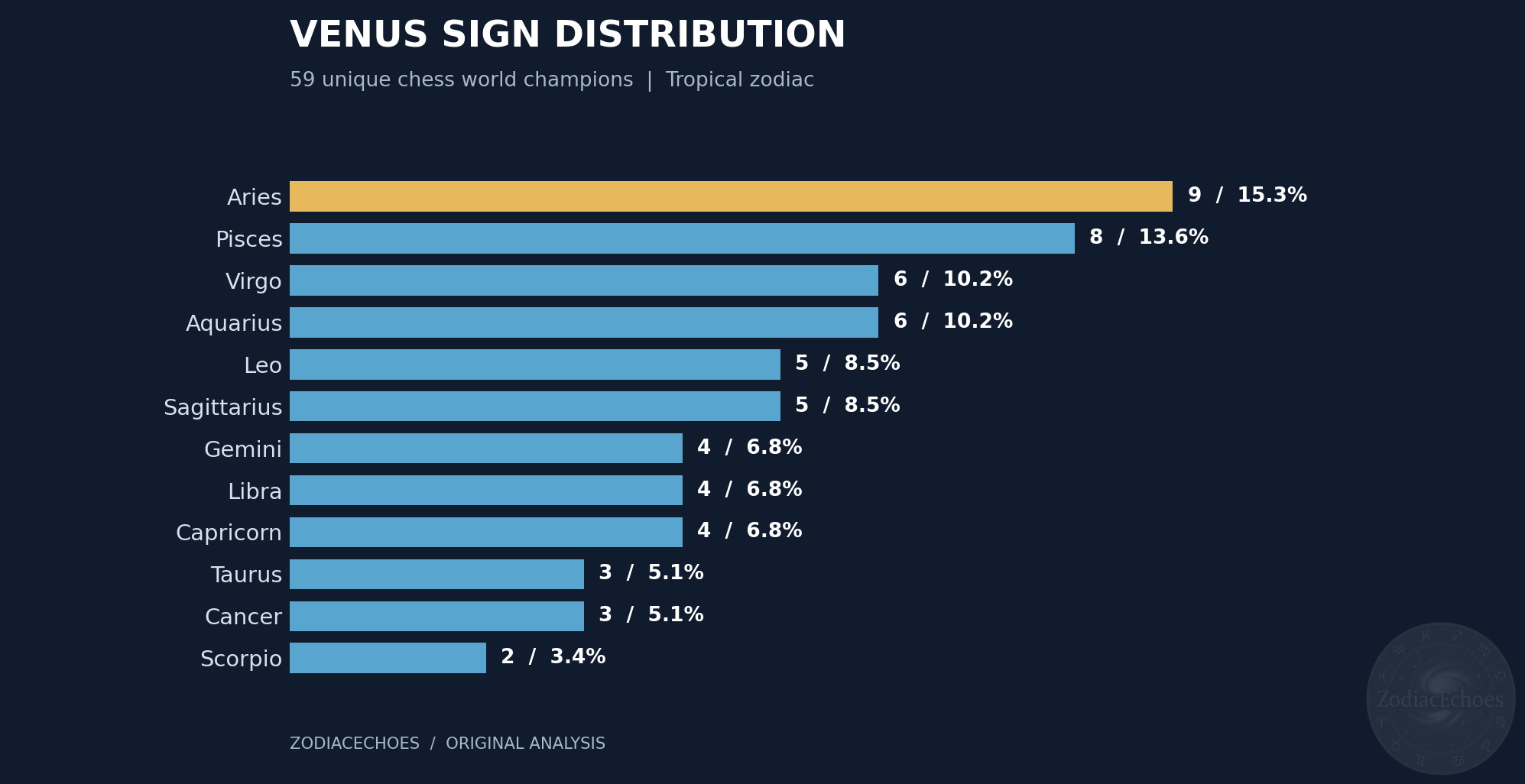
Venus in Aries appears nine times, including among Bobby Fischer, Susan Polgar, Alexandra Kosteniuk, Gukesh Dommaraju, Veselin Topalov, and Bibisara Assaubayeva. Astrologically, Venus in Aries is associated with enthusiasm, initiative, and enjoyment of challenge.
One possible symbolic interpretation is that competition itself becomes rewarding. Venus in Aries contributes another distinctive concentration to the champions’ astrological profiles.
Its association with enthusiasm, initiative, and enjoyment of challenge provides a compelling symbolic contrast with Mercury in Scorpio, whose traditional emphasis falls on investigation, concentration, and strategic thinking.
Mars — Four Signs Share the Competitive Lead
Mars traditionally represents action, courage, determination, initiative, and competitive drive. If one planetary placement were expected to dominate among world chess champions, Mars might appear a logical candidate. Instead, the results reveal a four-way tie.
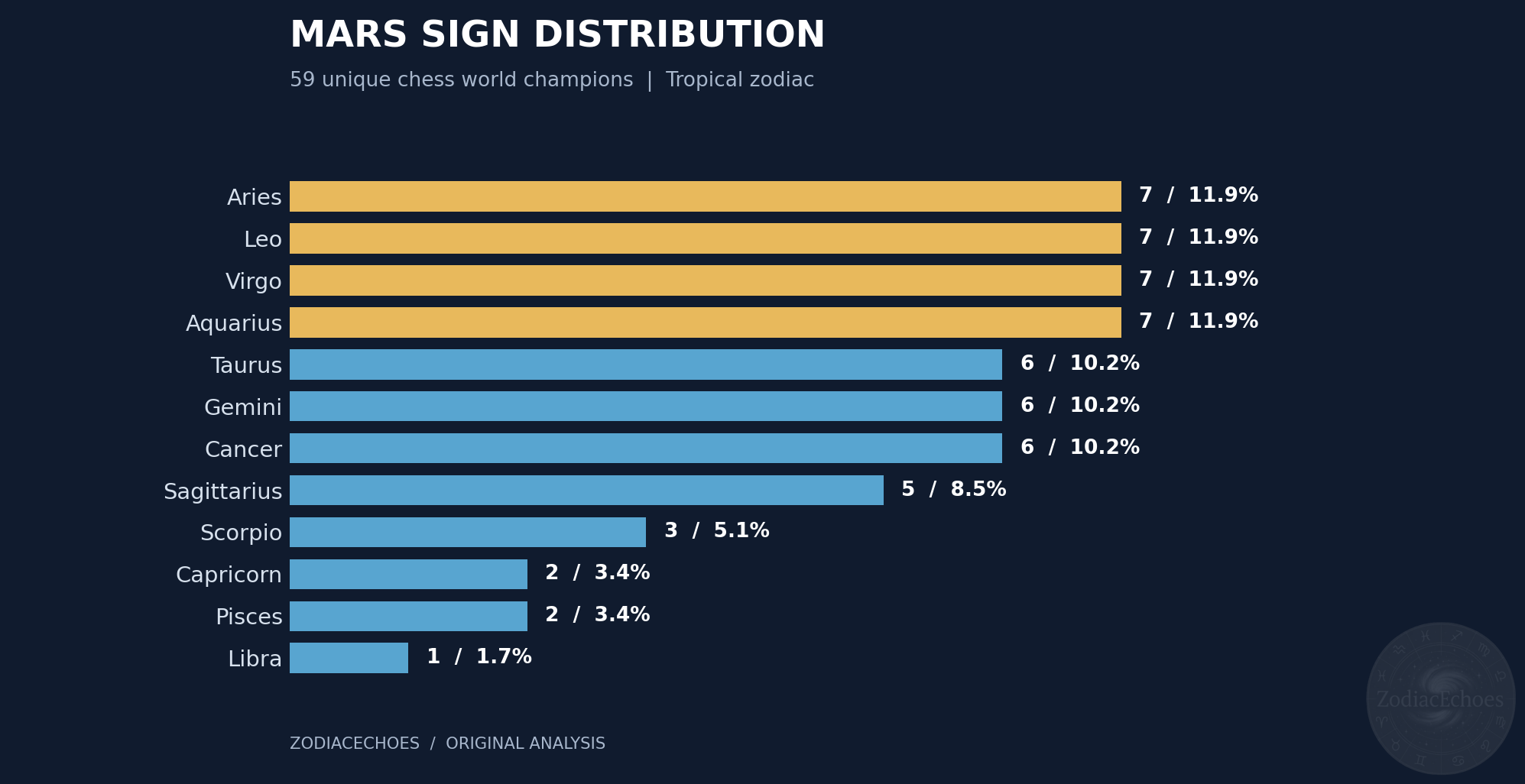
Aries, Leo, Virgo, and Aquarius each appear seven times. Traditional astrology assigns different competitive characteristics to these placements.
Mars in Aries emphasizes direct initiative. Mars in Leo symbolizes confidence and determination. Mars in Virgo represents precision and technical refinement, while Mars in Aquarius suggests independence and unconventional approaches.
Among champions with Mars in Leo are Kasparov, Tigran Petrosian, Tan Zhongyi, and Aleksandra Goryachkina. The diversity is significant from an interpretive perspective. World chess champions do not share one dominant Mars placement.
Jupiter — Two Contrasting Approaches to Mastery
Jupiter traditionally represents learning, growth, confidence, opportunity, and intellectual development. Its distribution produces another tie between two contrasting astrological archetypes.
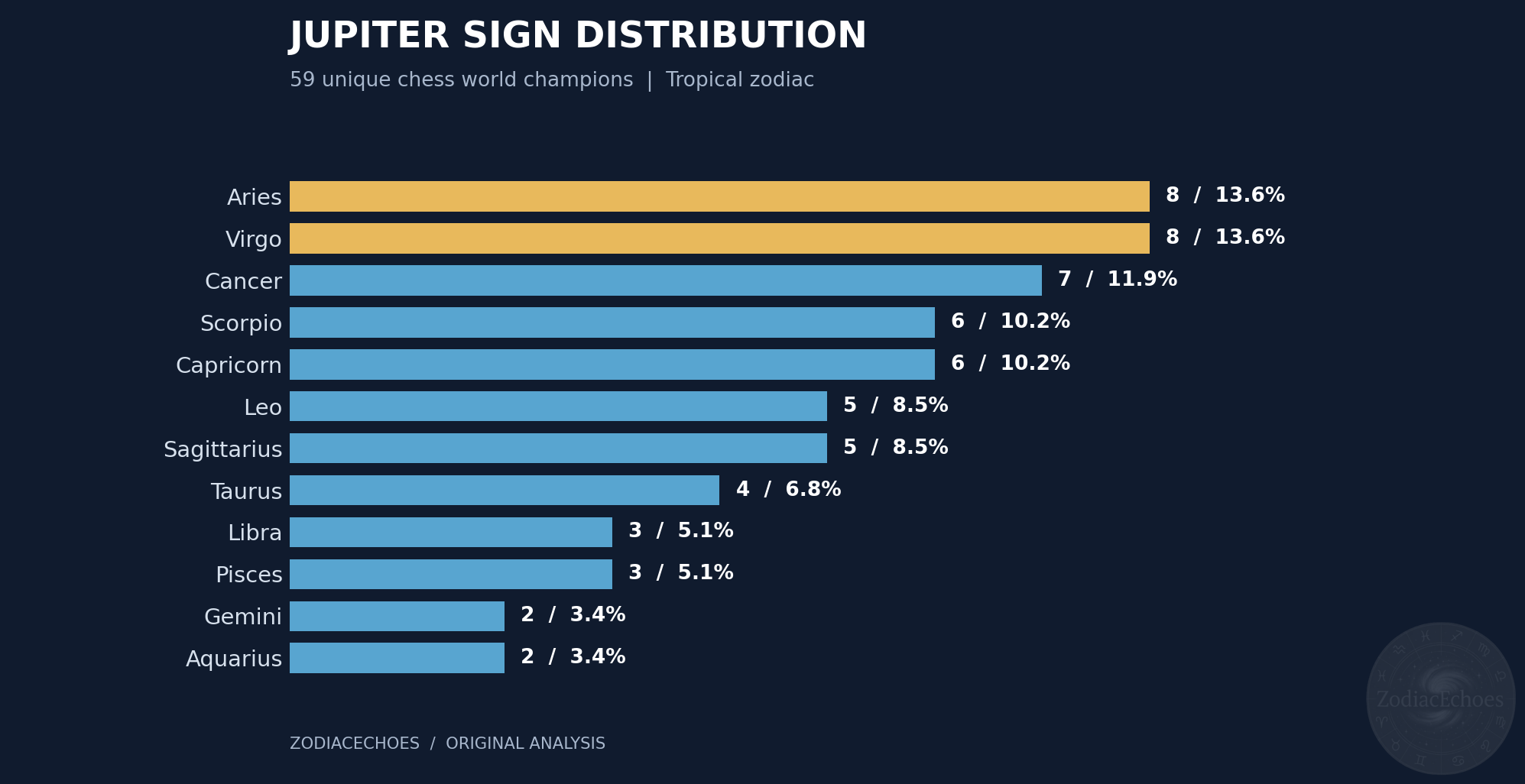
Jupiter in Aries and Jupiter in Virgo each appear eight times. Aries is associated with learning through initiative, experimentation, and action. Virgo symbolizes careful refinement, analysis, and methodical improvement. Among the champions with Jupiter in Virgo are Smyslov, Susan Polgar, Nodirbek Abdusattorov, and Bibisara Assaubayeva.
The equal prominence of Jupiter in Aries and Jupiter in Virgo highlights two contrasting astrological approaches to mastery. Aries symbolizes growth through experimentation, initiative, and bold decisions, while Virgo emphasizes systematic improvement, careful observation, and technical refinement. Together, these placements reflect two qualities that frequently coexist in elite chess: the courage to explore unfamiliar possibilities and the discipline to perfect established techniques.
Saturn — The Strongest Individual Planetary Concentration
Saturn traditionally represents discipline, endurance, patience, responsibility, and sustained commitment. These characteristics closely resemble the demands of elite chess preparation. Among all six planets examined, Saturn produces the highest individual planet–sign count.
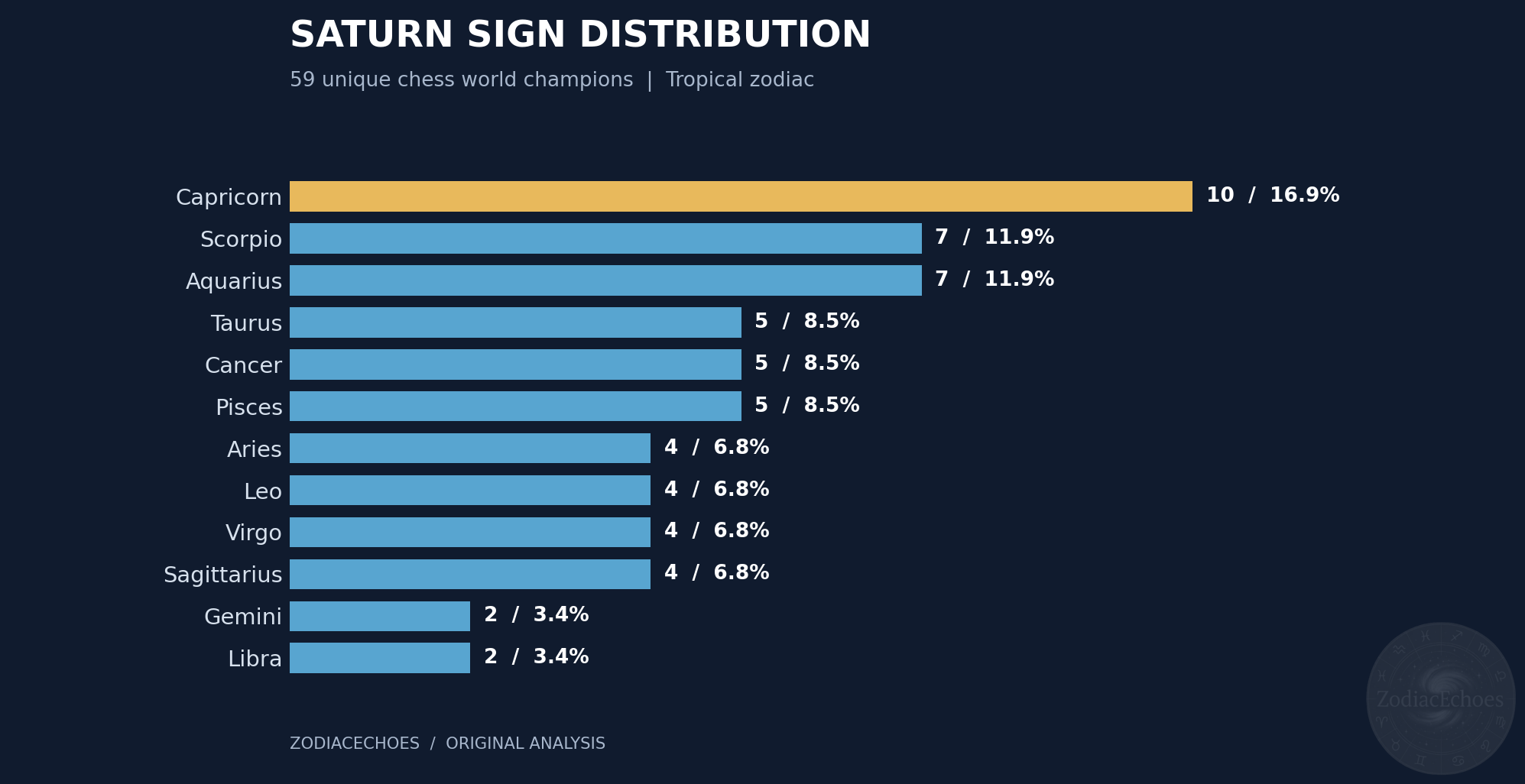
Saturn in Capricorn appears ten times, including among Magnus Carlsen, Max Euwe, Maia Chiburdanidze, Ju Wenjun, and Anna Muzychuk. The symbolism is especially interesting because Saturn traditionally rules Capricorn.
Both are associated with structure, persistence, ambition, and the ability to work toward demanding objectives. Chess mastery requires years of training, making this an appealing symbolic connection.
Saturn in Capricorn is the single most frequent planet–sign combination identified across all six planetary distributions, appearing ten times among the 59 champions. Its traditional associations with endurance, discipline, long-term planning, and structured ambition make it one of the study’s most compelling symbolic connections to the demands of professional chess. Saturn’s approximately two-and-a-half-year passage through each sign also makes historical birth generations an important part of interpreting this concentration.
Which Planetary Placements Stand Out Across the Entire Study?
The six planetary distributions reveal different leaders. Aries and Pisces lead the Sun rankings, Scorpio leads Mercury, Aries leads Venus, four signs share the Mars lead, Aries and Virgo lead Jupiter, and Capricorn leads Saturn.
Comparing the leading placements in one table makes these differences easier to examine.
Most Common Planetary Placements Among World Chess Champions
| Planet | Leading Zodiac Sign(s) | Champions | Share |
|---|---|---|---|
| Sun | Aries, Pisces | 8 each | 13.6% |
| Mercury | Scorpio | 9 | 15.3% |
| Venus | Aries | 9 | 15.3% |
| Mars | Aries, Leo, Virgo, Aquarius | 7 each | 11.9% |
| Jupiter | Aries, Virgo | 8 each | 13.6% |
| Saturn | Capricorn | 10 | 16.9% |
Leading zodiac placements for each of the six planets examined among 59 unique world chess champions. Percentages use 59 individuals as the denominator.
The strongest individual concentration is Saturn in Capricorn, with ten appearances. However, no single zodiac sign leads all six planetary categories. Aries appears particularly prominent across several distributions, while Scorpio and Capricorn lead specific planets traditionally associated with intellectual depth and discipline.
The six-planet comparison reveals a considerably richer astrological picture than Sun signs alone. Aries stands out through its prominence in the Sun, Venus, Mars, and Jupiter distributions, while Scorpio leads Mercury and Capricorn dominates Saturn.
These contrasting concentrations suggest several distinct astrological themes within the historical championship roster, from competitive initiative and strategic investigation to patience and sustained discipline.
Open and Women’s Champions — Are Their Zodiac Patterns Different?
The main research sample includes 34 open-category champions and 25 women’s-category champions. Each individual is counted once, regardless of the number of titles won. We compared the Sun-sign distributions to determine whether the leading signs differed between championship categories.
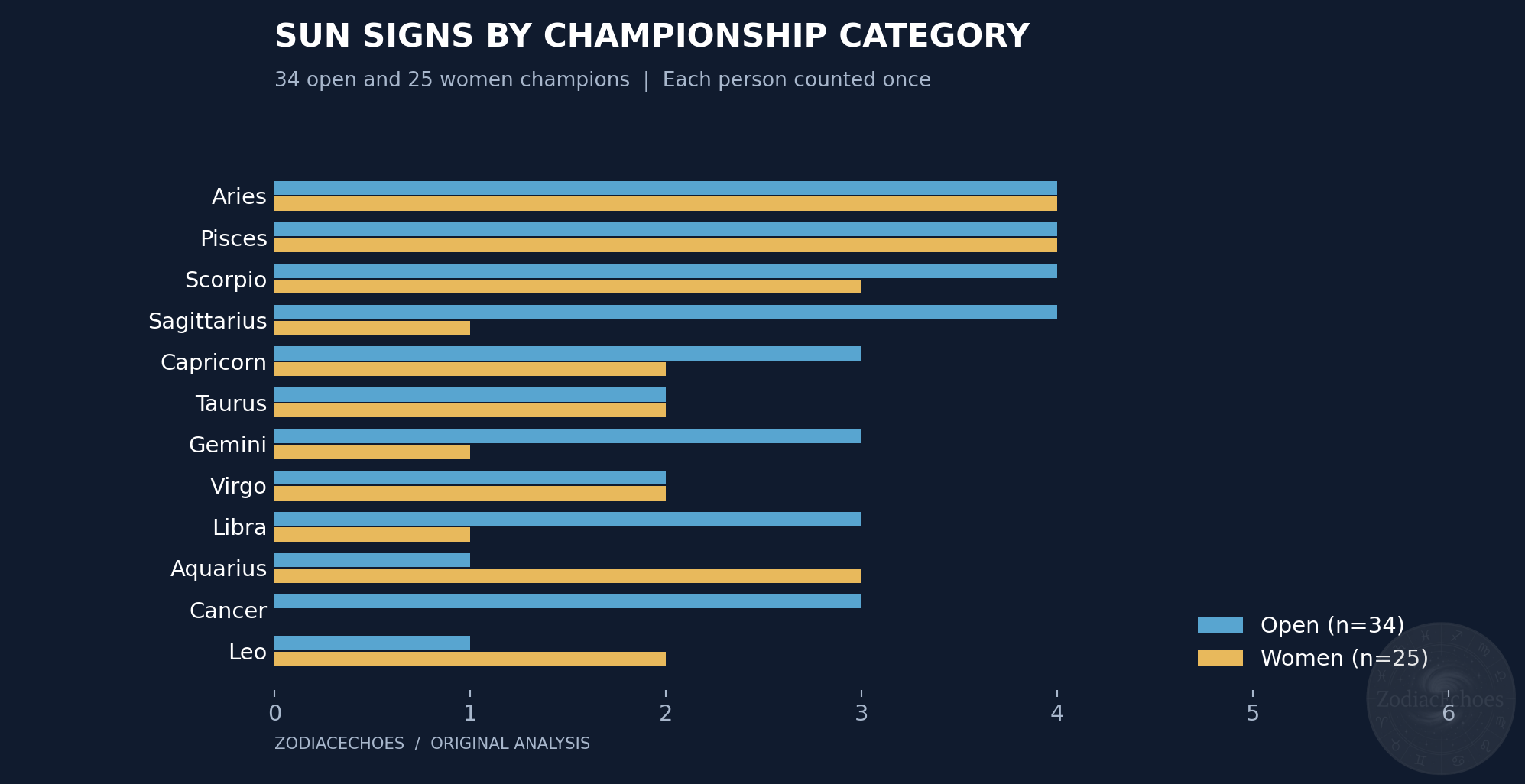
Aries and Pisces each appear four times in both categories, producing an unusually balanced result. Scorpio follows a similar pattern, with four open-category champions and three women’s champions.
Beyond Aries and Pisces, the two championship categories reveal several notable contrasts. Sagittarius appears four times among open-category champions but only once among women’s champions, while Aquarius reverses that pattern with three women’s champions and one open-category champion. These differences add another dimension to the study’s comparison of zodiac distributions.
Sun-Sign Distribution by Championship Category
| Zodiac Sign | Open Champions | Women’s Champions | Total |
|---|---|---|---|
| Aries | 4 | 4 | 8 |
| Pisces | 4 | 4 | 8 |
| Scorpio | 4 | 3 | 7 |
| Sagittarius | 4 | 1 | 5 |
| Capricorn | 3 | 2 | 5 |
| Taurus | 2 | 2 | 4 |
| Gemini | 3 | 1 | 4 |
| Virgo | 2 | 2 | 4 |
| Libra | 3 | 1 | 4 |
| Aquarius | 1 | 3 | 4 |
| Cancer | 3 | 0 | 3 |
| Leo | 1 | 2 | 3 |
| Total | 34 | 25 | 59 |
Sun-sign distribution among 34 open-category and 25 women’s-category world chess champions. Every individual is counted once.
Cancer appears among three open-category champions but none of the women’s champions in the primary sample. Aquarius shows the opposite tendency, appearing among three women’s champions and one open-category champion.
The strongest common feature is the remarkable balance of Aries and Pisces, each appearing four times in both championship categories. Beyond that shared pattern, Cancer, Aquarius, and Sagittarius display different distributions, providing a more detailed picture of how the zodiac profiles of open-category and women’s champions compare.
Classical Chess Versus Rapid and Blitz — Different Astrological Patterns?
Classical chess rewards prolonged calculation, strategic preparation, and the ability to maintain concentration over several hours. Rapid and blitz demand many of the same abilities under substantially greater time pressure. To explore possible differences, we examined an expanded dataset of 61 champions, including two additional historical rapid titleholders.
This comparison contained 39 classical-title holders and 22 champions whose included titles were restricted to rapid or blitz competitions. One apparent difference involved Venus sextile Mars within an eight-degree orb.
Venus sextile Mars appeared among five of the 22 speed-chess-only champions, compared with none of the 39 classical-title holders. This was one of the most striking differences in the expanded dataset, particularly because the aspect appeared exclusively within the rapid and blitz group.
Venus sextile Mars stands out as one of the most intriguing differences between classical and speed-chess champions. The aspect appeared among five of the 22 rapid- and blitz-only champions, compared with none of the 39 classical-title holders.
The result did not meet the corrected statistical significance threshold, but its concentration within the speed-chess group remains a noteworthy finding.
Sun–Saturn Conjunctions — The Study’s Most Intriguing Finding
The most interesting aspect-level result involved a conjunction between the Sun and Saturn within eight degrees. In the expanded 61-person dataset, eight champions met this criterion.
- Six were women’s champions: Vera Menchik, Nona Gaprindashvili, Maia Chiburdanidze, Susan Polgar, Hou Yifan, and Nana Dzagnidze.
- The two open-category champions were Alexander Grischuk and Sergey Karjakin.
Astrologically, the Sun symbolizes identity and personal direction, while Saturn represents discipline, responsibility, limitations, and perseverance. Their conjunction is traditionally associated with the development of ambition through sustained effort.
The symbolism has a particularly strong connection with the demands of elite chess. Exceptional achievement requires years of preparation, sustained concentration, and the determination to overcome setbacks. The presence of eight Sun–Saturn conjunctions among the expanded group of champions therefore provides an intriguing astrological parallel to the qualities traditionally associated with Saturn.
Why the Initial Statistical Result Looked Remarkable
An initial simulation preserved each champion’s birth year while randomizing birthdays within that year. Under this reference model, approximately 1.19 Sun–Saturn conjunctions were expected among the 25 women’s champions. The observed number was six.
The initial model highlighted a remarkable concentration of Sun–Saturn conjunctions among women’s champions. To investigate this result further, the research introduced a more precisely matched reference model preserving both birth year and Sun sign, allowing the observed conjunctions to be examined against the champions’ actual zodiac distribution.
What Happened Under the Stricter Model?
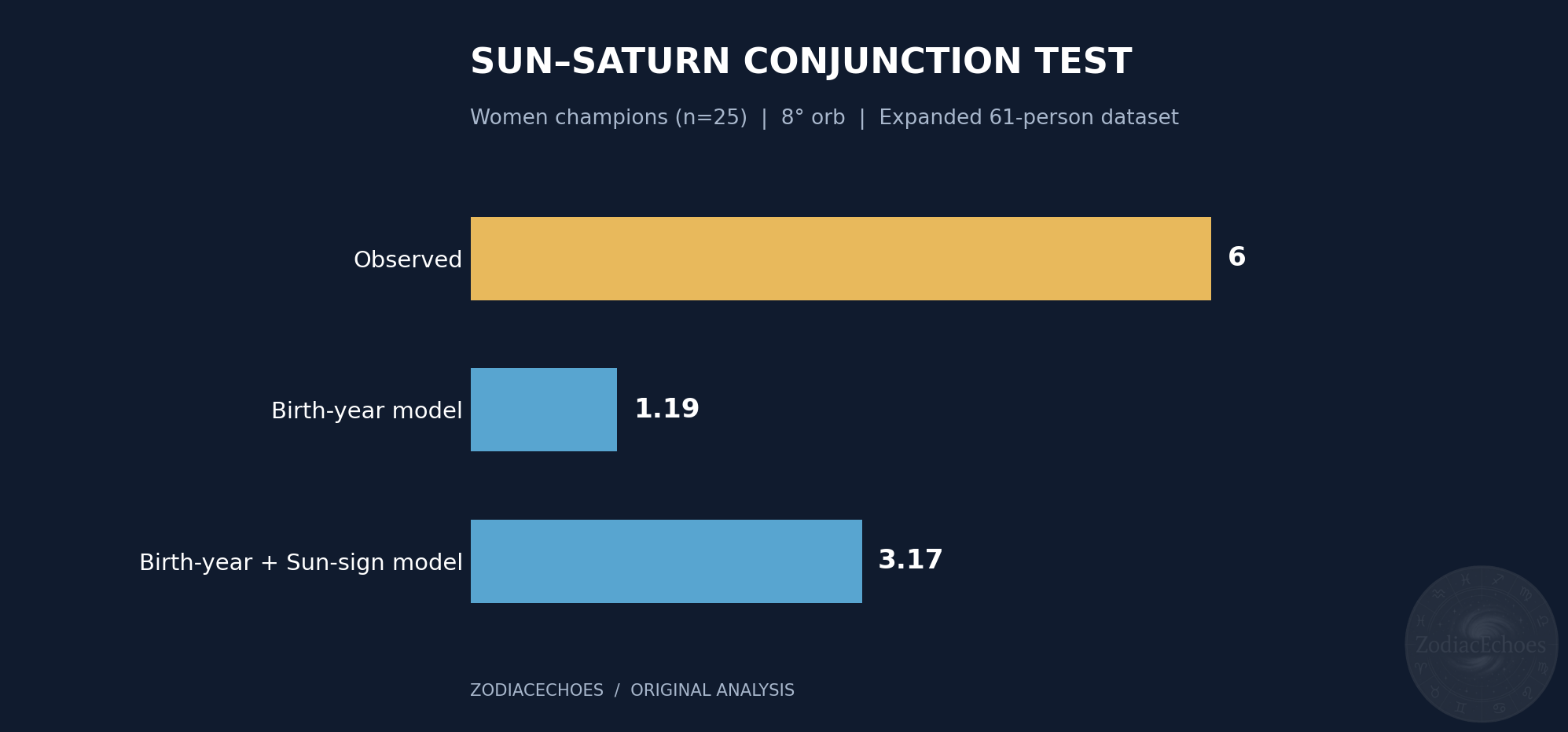
When the model preserved both birth year and Sun sign, the expected number increased from approximately 1.19 to 3.17. The observed count of six remained interesting, producing an uncorrected probability near 0.033.
The Sun–Saturn conjunction remains one of the most distinctive historical patterns identified in the research. Six conjunctions were observed among women’s champions, compared with approximately 3.17 expected under the model preserving both birth year and Sun sign.
The uncorrected probability was approximately 0.033, while the globally adjusted value across the broader testing framework was approximately 0.882. The pattern therefore remains a notable descriptive finding, although it did not reach the corrected statistical significance threshold.
The Historical Generation Effect
The six conjunctions among women’s champions were not evenly distributed across generations. Four occurred among seven women’s champions born before 1970, compared with two among eighteen born later. This historical concentration contributed substantially to the initial result.
The generational concentration is particularly noteworthy: four of the seven women’s champions born before 1970 had a Sun–Saturn conjunction, compared with two of the eighteen born later. Decade-conditioned comparisons did not establish a statistically significant difference between championship categories, but the historical distribution adds an important dimension to the study’s findings.
What Happened When We Compared Other Elite Chess Players?
To investigate whether Sun–Saturn conjunctions distinguished world champions from other elite players, we examined a small contemporary control sample drawn from the November 2026 FIDE top-ten rankings in the open and women’s categories. The sample contained twenty players.
Nine held titles included in our research definition, while eleven did not. One of the nine titleholders had a Sun–Saturn conjunction within eight degrees, compared with two of the eleven other elite players. The difference was not statistically significant.
The comparison with other elite players adds another dimension to the Sun–Saturn findings. The conjunction appeared among one of nine titleholders and two of eleven other elite players in the contemporary control group, including Hikaru Nakamura and Alireza Firouzja. Although the difference was not statistically significant, the results extend the analysis beyond world champions and provide an additional perspective on this planetary configuration.
The accompanying ZodiacEchoes research dataset provides the underlying evidence for this investigation. It includes 59 individual champion records, recorded birth dates, championship classifications, and calculated zodiac placements of the Sun, Mercury, Venus, Mars, Jupiter, and Saturn.
The PDF also contains the planetary distributions, methodological explanations, statistical comparisons, and eight research figures presented in this article.
Research Methodology
This original ZodiacEchoes study examines 59 unique world chess champions across classical, women’s, rapid, and blitz competitions through 2025. An expanded dataset of 61 champions was used for additional comparisons.
Planetary positions were calculated using Swiss Ephemeris. The research examined six planetary placements and 75 major planetary aspects, applying historical birth-year controls and multiple-testing corrections.
The analysis identifies the most common zodiac signs, planetary placements, and notable astrological configurations among world chess champions, supported by comparative charts and statistical testing.
Conclusion — Is There an Astrological Formula for Chess Greatness?
Aries and Pisces share first place among the Sun signs of 59 world chess champions, followed by Scorpio. Mercury in Scorpio, Venus in Aries, and Saturn in Capricorn produce additional concentrations, while Mars reveals a four-way tie.
Sun–Saturn conjunctions provide another intriguing historical finding, appearing among six women’s champions and two open-category champions in the expanded dataset.
Taken together, the findings reveal several distinctive astrological patterns across championship chess, from the prominence of Aries and Pisces to Mercury in Scorpio, Saturn in Capricorn, and the historical concentration of Sun–Saturn conjunctions among women’s champions.
The study’s contribution is a transparent six-planet dataset that allows readers to examine historical distributions, compare championship categories, and distinguish interesting patterns from statistically supported conclusions.
Frequently Asked Questions
Which zodiac sign has the most world chess champions?
Aries and Pisces share first place among the 59 world chess champions examined, with eight representatives each. Scorpio follows with seven, making these the three most represented Sun signs in the historical dataset.
What is the best zodiac sign for playing chess?
Aries and Pisces share first place in the ZodiacEchoes analysis, with eight world chess champions each among the 59 individuals examined. Scorpio follows with seven. These three signs occupy the leading positions in the study’s historical Sun-sign rankings.
Which planet represents chess intelligence in astrology?
Mercury traditionally represents logic, calculation, memory, and information processing. Saturn is associated with discipline and endurance, while Mars symbolizes competitive determination.
Is Saturn in Capricorn common among chess champions?
Saturn in Capricorn appears ten times among the 59 champions, the highest individual planet–sign count in the study. Historical birth cohorts influence this concentration.
Do women’s chess champions have different astrological patterns?
Several differences emerge between the championship categories. Aquarius appears among three women’s champions and one open-category champion, while Cancer appears exclusively among three open-category champions. The expanded dataset also identifies Sun–Saturn conjunctions among six women’s champions.
Sources and Research Data
- FIDE — International Chess Federation
- FIDE World Rapid & Blitz Championship
- Chess.com — World Rapid and Blitz Champions
- Swiss Ephemeris