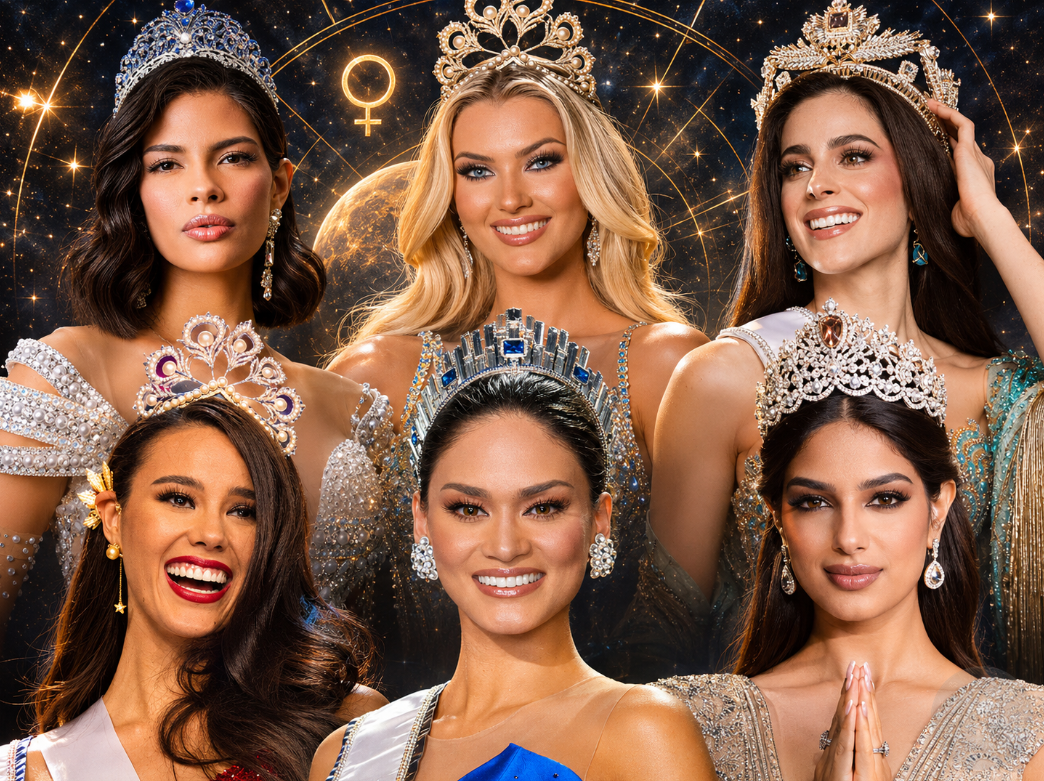
- Venus in Taurus and Venus in Pisces lead the Venus rankings, with three Miss Universe winners each.
- Pisces is the most frequent Sun sign, appearing in four reference-time birth charts, although one classification depends on an unknown birth time.
- Capricorn follows with three winners, while Taurus, Gemini, Virgo, and Libra each have two.
- All 20 Venus signs remain stable throughout their recorded birth dates, making the Venus comparison more reliable than time-sensitive placements.
- The research includes 140 calculated planetary sign positions across 20 winners from 2006–2025.
Does the planet of beauty reveal a hidden pattern among the world’s most celebrated beauty queens? We examined 20 consecutive Miss Universe winners, their zodiac signs, and their planetary placements to investigate whether certain astrological configurations appear more frequently among women who have claimed the crown.
The results reveal an intriguing connection to Venus in Taurus and Venus in Pisces, two placements traditionally associated with beauty, artistic sensitivity, and personal magnetism. But the Sun-sign rankings tell a different story, with Pisces and Capricorn emerging as the most represented signs.
Our research covers every Miss Universe winner from 2006 through 2025, including their birth dates, countries, and planetary positions calculated using Swiss Ephemeris. Rather than relying on celebrity zodiac lists, we assembled a structured astrological dataset to explore the patterns behind the crown.
And while astrology cannot establish why someone wins a beauty competition, these 20 birth charts offer a fascinating opportunity to examine the symbolism traditionally associated with attraction, elegance, charisma, and public recognition.

Why Venus Is the Most Interesting Planet in This Study
In traditional astrology, Venus is associated with beauty, attraction, harmony, pleasure, aesthetics, and the way individuals express affection and personal charm. It is also connected with artistic taste, social grace, and the qualities that make someone appealing to others.
For that reason, Venus offers an especially interesting starting point when examining the birth charts of Miss Universe winners. The competition evaluates much more than physical appearance, but presentation, confidence, communication, and personal presence remain important parts of the experience.
A person’s Venus sign is not the same as their Sun sign. Someone born under Capricorn, for example, might have Venus in Pisces, Taurus, or another sign, depending on the positions of the planets at birth.
This distinction matters because an analysis based exclusively on birthdays would overlook the planet most traditionally associated with beauty and aesthetic expression.
Our calculations examined Venus alongside the Sun, Mercury, Mars, Jupiter, Saturn, and Neptune. The positions were calculated using the tropical zodiac and a reference time of 12:00 UTC, with additional checks for sign changes during each recorded birth date.
Venus in Taurus and Pisces: The Two Leading Placements
The most striking result is a tie.
Three of the 20 Miss Universe winners have Venus in Taurus, and another three have Venus in Pisces. Each placement therefore accounts for 15% of the sample, or 30% combined.
Taurus and Pisces are particularly interesting from a traditional astrological perspective. Venus rules Taurus and is considered exalted in Pisces, giving both placements a special symbolic relationship with the planet.
In Taurus, Venus is traditionally associated with sensuality, elegance, stability, natural beauty, and an appreciation for physical comfort and aesthetic harmony. Its symbolism emphasizes a grounded, composed form of attraction.
In Pisces, Venus is associated with romantic imagination, empathy, sensitivity, softness, and an almost dreamlike quality of personal charm. Rather than emphasizing stability, this placement is traditionally interpreted through emotional connection and idealism.
The two signs represent different expressions of Venus, yet both occupy prominent positions in our sample.
Venus Signs of Miss Universe Winners, 2006–2025
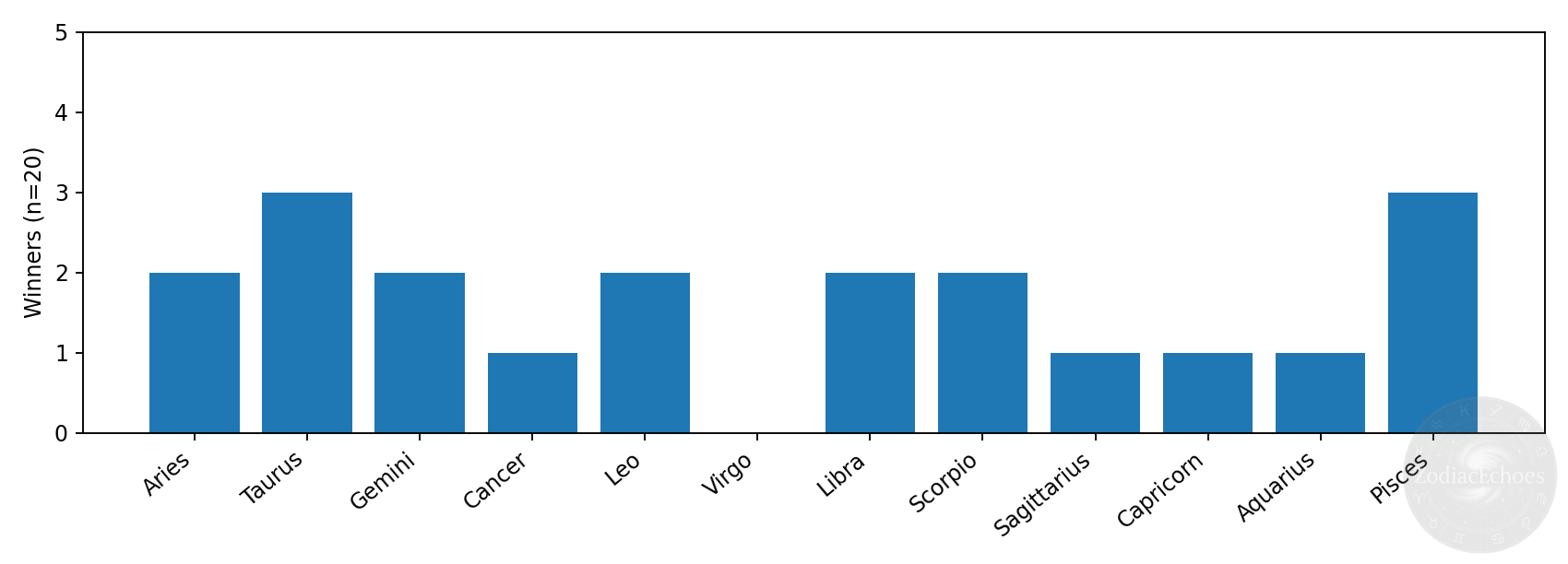
Distribution of Venus signs among 20 Miss Universe winners from 2006 to 2025, calculated using Swiss Ephemeris. Taurus and Pisces share first place with three winners each.
One particularly useful detail is that none of the 20 Venus placements changes sign during the corresponding recorded birth date. This means that the absence of verified birth times does not affect the Venus-sign classifications in this sample.
However, the results should not be interpreted as evidence that Venus in Taurus or Pisces makes someone more likely to win Miss Universe. With only 20 winners, a difference of one or two individuals can substantially alter the rankings.
| Venus Sign | Winners | Share |
|---|---|---|
| Taurus | 3 | 15% |
| Pisces | 3 | 15% |
| Aries | 2 | 10% |
| Gemini | 2 | 10% |
| Leo | 2 | 10% |
| Libra | 2 | 10% |
| Scorpio | 2 | 10% |
| Cancer | 1 | 5% |
| Capricorn | 1 | 5% |
| Aquarius | 1 | 5% |
| Sagittarius | 1 | 5% |
| Virgo | 0 | 0% |
Which Sun Signs Have Produced the Most Miss Universe Winners?
The Sun-sign results reveal a different distribution.
Pisces appears most frequently, with four winners in the reference-time calculations, followed by Capricorn with three. Taurus, Gemini, Virgo, and Libra each account for two winners.
The remaining represented signs appear once each, while Sagittarius does not appear among the 20 reference-time Sun signs.
Sun Signs of Miss Universe Winners
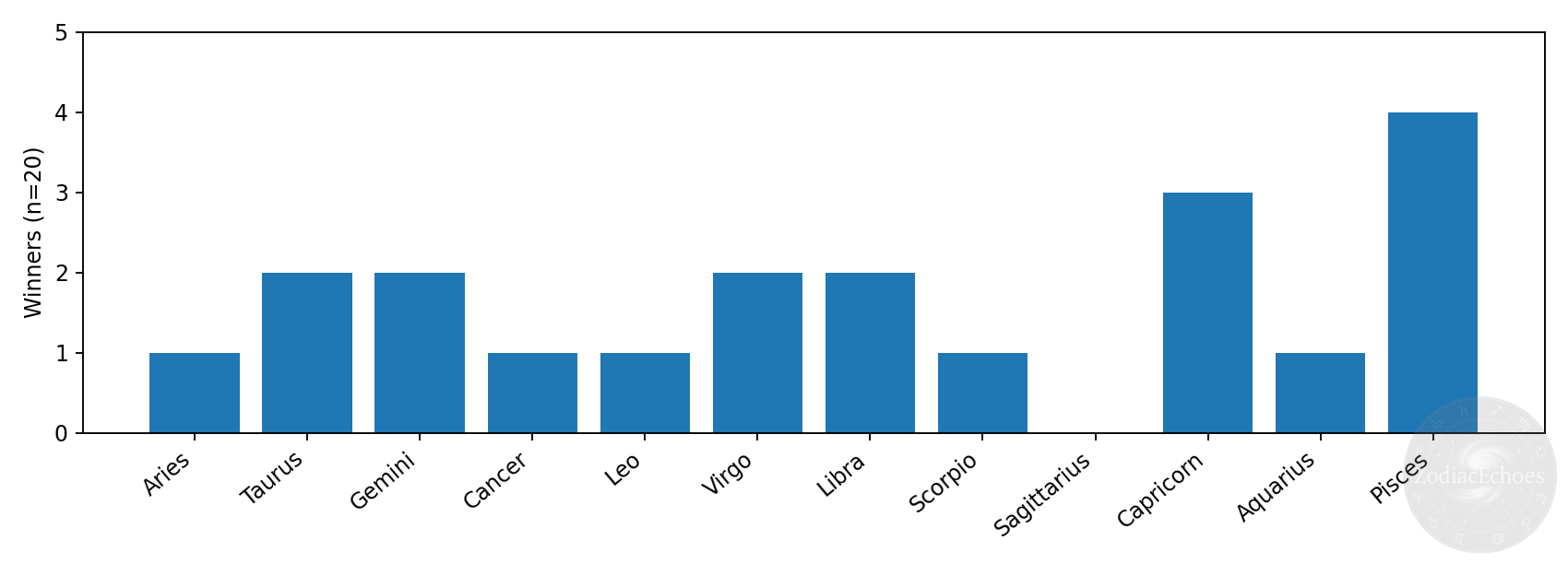
Sun-sign distribution among 20 Miss Universe titleholders. The Pisces total includes one birth-date-sensitive classification that cannot be confirmed without an exact birth time.
There is an important qualification to the Pisces result. R’Bonney Gabriel, Miss Universe 2022, was born on March 20, 1994, a date on which the Sun moved between Pisces and Aries. The reference-noon calculation places her in Pisces, but without a verified birth time, her exact Sun sign cannot be established confidently.
Consequently, Pisces has either three or four winners, depending on Gabriel’s actual birth time. The apparent lead should therefore be treated as provisional.
| Sun Sign | Winners | Share |
|---|---|---|
| Pisces | 4 | 20% |
| Capricorn | 3 | 15% |
| Taurus | 2 | 10% |
| Gemini | 2 | 10% |
| Virgo | 2 | 10% |
| Libra | 2 | 10% |
| Aries | 1 | 5% |
| Cancer | 1 | 5% |
| Leo | 1 | 5% |
| Scorpio | 1 | 5% |
| Aquarius | 1 | 5% |
| Sagittarius | 0 | 0% |
The Pisces Connection: Sensitivity, Grace, and Imagination
Pisces has a particularly interesting relationship with the symbolism of beauty competitions because traditional astrology associates the sign with emotional sensitivity, imagination, empathy, and a capacity to connect with others.
Among the winners in our research, Harnaaz Sandhu, Miss Universe 2021, and Leila Lopes, Miss Universe 2011, both have Pisces Sun signs. Ximena Navarrete, who won in 2010, is another Pisces representative.
Their victories span different countries, backgrounds, and periods of the competition, reminding us that shared zodiac placements do not imply identical personalities or paths to success.
From an astrological perspective, Pisces is often interpreted as a sign that communicates through emotion, imagination, and subtle expression. Those themes can be connected symbolically to the ability to create a memorable impression on an audience.
Yet the most interesting question is not whether Pisces women are inherently more beautiful. It is whether the symbolic qualities associated with Pisces appear in the way these winners present themselves, communicate, and connect with the public. That remains a matter of interpretation rather than a scientifically established relationship.
Capricorn: The Unexpected Challenger
Capricorn takes second place in the Sun-sign distribution, appearing among three winners: Catriona Gray (2018), Paulina Vega (2014), and Riyo Mori (2007).
At first glance, Capricorn may seem less closely associated with the traditional Venusian symbolism of beauty. Its ruling planet, Saturn, represents discipline, structure, ambition, persistence, and responsibility.
But Miss Universe is not simply a competition in physical attractiveness. Contestants must prepare extensively, perform under pressure, communicate clearly, and demonstrate confidence before an international audience.
Within traditional astrology, Capricorn’s symbolism offers an alternative interpretation of success: preparation, professionalism, self-control, and the ability to deliver when expectations are high.
Catriona Gray, for example, became widely recognized for her carefully developed stage presentation and distinctive performance style. Her victory illustrates how preparation and personal identity can combine in a memorable competition appearance.
The presence of three Capricorn winners suggests that the dataset is not dominated exclusively by signs traditionally associated with softness, glamour, or romantic charm.

A Closer Look at the Winners’ Birth Charts
Several individual charts illustrate why planetary placements can reveal more variety than Sun signs alone.
Fátima Bosch — Miss Universe 2025
Sun in Taurus | Venus in Taurus
The 2025 winner, representing Mexico, has both her Sun and Venus in Taurus according to the dataset. This creates a particularly strong concentration of Taurus symbolism, traditionally associated with composure, aesthetic appreciation, and a grounded personal presence.
Venus is the ruling planet of Taurus, making this combination especially relevant to the study’s central question.
Victoria Kjær Theilvig — Miss Universe 2024
Sun in Scorpio | Venus in Sagittarius
Denmark’s 2024 winner demonstrates how different Sun and Venus signs can be. Scorpio is traditionally associated with intensity and emotional depth, while Venus in Sagittarius is linked to independence, openness, enthusiasm, and an adventurous approach to life.
Her chart illustrates why reducing an individual’s astrological identity to a single zodiac sign can overlook important distinctions.
Sheynnis Palacios — Miss Universe 2023
Sun in Gemini | Venus in Gemini
Nicaragua’s 2023 winner has both her Sun and Venus in Gemini. In traditional astrology, this combination emphasizes communication, adaptability, curiosity, and social expression.
Gemini’s symbolism is particularly interesting in a competition where contestants must speak confidently and respond to questions under considerable pressure.
Catriona Gray — Miss Universe 2018
Sun in Capricorn | Venus in Capricorn
Catriona Gray’s Sun and Venus both fall in Capricorn, emphasizing a different astrological theme from the Venus-ruled Taurus examples.
Capricorn is traditionally associated with discipline, control, and long-term effort. Its presence in both placements offers an interesting symbolic contrast with the softer interpretations of Venus in Pisces.
Iris Mittenaere — Miss Universe 2016
Sun in Aquarius | Venus in Pisces
France’s 2016 winner combines an Aquarius Sun with Venus in Pisces. Aquarius is traditionally associated with individuality and independence, while Venus in Pisces is linked to romantic sensitivity and imagination.
Her chart demonstrates how a winner can possess one of the study’s leading Venus placements without belonging to the leading Sun-sign groups.
What About Mars, Jupiter, Saturn, and Neptune?
Although Venus provides the central theme of the research, the wider dataset includes several additional planetary placements that may be useful for future analysis.
Mars traditionally represents motivation, assertiveness, energy, and the way an individual approaches challenges. In the context of a demanding international competition, these themes can be interpreted through confidence, determination, and performance under pressure.
Jupiter is associated with opportunity, growth, expansion, and recognition. Its placement is particularly interesting when examining individuals who achieved success on an international stage.
Saturn represents discipline, preparation, resilience, and long-term commitment. Its symbolism may be especially relevant to the extensive preparation required before contestants reach the final competition.
Neptune, in modern astrology, is associated with imagination, glamour, idealization, and the construction of compelling images. These themes offer an intriguing symbolic connection to fashion, visual presentation, and the public perception of beauty.
Planetary Placements Beyond Venus: What the Data Reveals
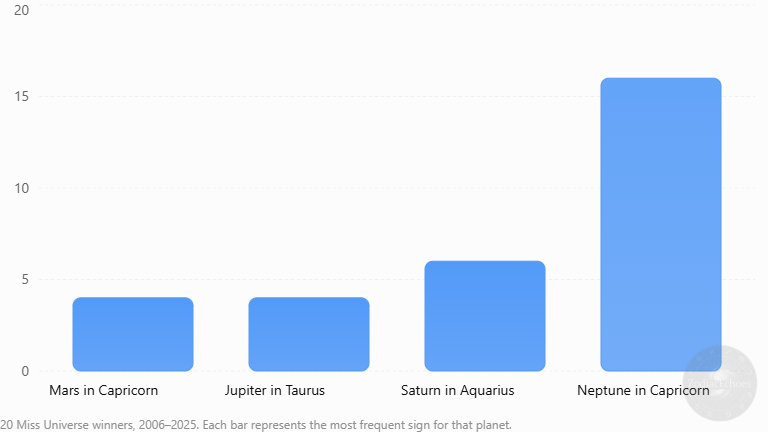
Beyond Venus, the analysis reveals several recurring planetary placements among the 20 Miss Universe winners. Saturn in Aquarius appears in six birth charts (30%), including those of Catriona Gray and Iris Mittenaere, while Jupiter in Taurus appears four times (20%), including Fátima Bosch, Sheynnis Palacios, and Harnaaz Sandhu. Mars in Capricorn also appears in four reference-time charts (20%), although Ximena Navarrete’s Mars position requires an exact birth time for confirmation.
The most common placement is Neptune in Capricorn, found in 16 winners (80%). However, Neptune moves slowly through the zodiac, making this concentration largely a generational effect rather than evidence of a distinctive characteristic among beauty-pageant winners. These findings highlight the importance of distinguishing potentially interesting personal planetary placements from patterns explained by the contestants’ birth years.

The Complete Miss Universe Astrology Dataset
To make the research transparent, we compiled a dedicated dataset covering 20 consecutive Miss Universe titleholders from 2006 through 2025. For every winner, the dataset records the competition year, name, representing country, date of birth, and seven planetary sign placements: Sun, Mercury, Venus, Mars, Jupiter, Saturn, and Neptune.
The calculations use Swiss Ephemeris, the tropical zodiac, and a reference time of 12:00 UTC. Planetary positions were checked for potential sign changes during the recorded birth date, and placements requiring an exact birth time were identified. The dataset also contains tables showing individual winners and their astrological profiles, along with charts summarizing the distributions of Sun and Venus signs.
The study covers all Miss Universe winners from 2006 through 2025. The 2026 competition is scheduled for November 24, 2026, and its winner will be included in a future dataset update.
Can Astrology Really Predict a Miss Universe Winner?
The most important limitation of this research is the sample itself. Our dataset contains only 20 winners, not the hundreds of contestants who competed during those years. Without examining the birth charts of unsuccessful contestants, it is impossible to establish whether a particular placement is genuinely more common among winners than among competitors overall.
For example, three winners with Venus in Taurus may appear noteworthy, but that observation becomes meaningful only when compared with the frequency of Venus in Taurus among all eligible contestants.
The same limitation applies to Pisces Sun signs, Capricorn Sun signs, and every other planetary placement examined in the study. Additionally, 20 individuals constitute a relatively small sample. Even an apparently striking pattern can emerge through ordinary chance variation.
The results should therefore be understood as an exploratory astrological analysis of documented winners, not evidence that planetary positions determine physical beauty, personality, or competition outcomes.
Conclusion: Does Venus Reveal a Pattern Among Miss Universe Winners?
Our analysis of 20 Miss Universe winners reveals two distinct astrological patterns. Venus in Taurus and Venus in Pisces share first place among Venus placements, appearing three times each. Both signs have a special relationship with Venus in traditional astrology, making their prominence an interesting symbolic finding.
Meanwhile, Pisces and Capricorn lead the Sun-sign rankings, although the Pisces total remains sensitive to one winner’s unknown birth time. The contrast is revealing. The most frequent Sun signs are not identical to the most frequent Venus signs, demonstrating why a fuller natal-chart approach offers a richer perspective than simple zodiac rankings.
The research does not establish that any particular sign or planetary placement makes someone more likely to win Miss Universe. Instead, it identifies patterns that can be explored through traditional astrological symbolism and, potentially, compared with a broader contestant dataset in future research.
For now, the most compelling result is that the planet traditionally associated with beauty appears most frequently in two signs where its astrological symbolism is especially significant: Taurus and Pisces.
FAQ
Which zodiac sign has produced the most Miss Universe winners?
Pisces leads the reference-time calculations with four winners between 2006 and 2025, followed by Capricorn with three. However, one Pisces classification depends on an unknown birth time.
Which Venus sign is most common among Miss Universe winners?
Venus in Taurus and Venus in Pisces are tied, each appearing among three of the 20 winners.
Does Venus in Taurus make someone more beautiful?
Traditional astrology associates Venus in Taurus with sensuality, aesthetic appreciation, and natural elegance. However, there is no scientific evidence that this placement determines physical attractiveness.
How many Miss Universe winners were analyzed?
The study includes 20 consecutive titleholders from 2006 through 2025.
Were exact birth times used?
No. The calculations use a reference time of 12:00 UTC, with checks for planetary sign changes during the birth date. Ascendants, houses, and Moon placements were excluded.
Where can I download the research dataset?
The full Miss Universe Astrology Dataset 2006–2025 is available as a PDF, including the winners’ birth dates, planetary positions, statistical charts, and methodology.