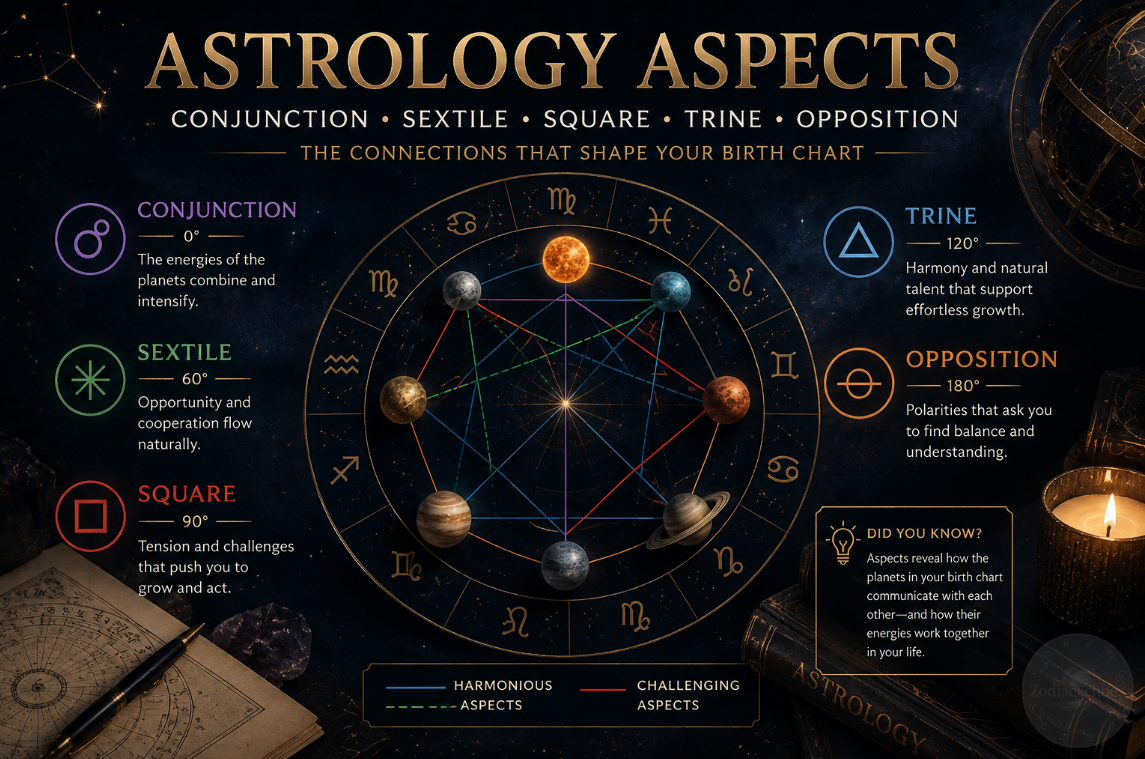
When you first look at a Natal Chart, the colorful lines crossing the center can make it seem far more complicated than it really is. Those lines represent Astrology Aspects—the angular relationships between planets and other important points in the chart. Aspects show how different parts of your astrological personality interact.
Some create an easy flow of energy, while others produce tension that requires action, adjustment, or growth. Understanding the five major aspects—conjunction, sextile, square, trine, and opposition—is therefore one of the most important steps toward learning how to read a Birth Chart.
What Are Astrology Aspects?
Every planet occupies a particular position within the 360-degree zodiac wheel at the moment of your birth. When two planets form certain angles with one another, astrologers call the relationship between them an aspect.
Imagine Venus positioned at one point of the zodiac and Mars somewhere else. The angular distance between them determines whether they form a conjunction, sextile, square, trine, opposition, or another aspect. These relationships matter because planets do not operate completely independently in a Natal Chart.
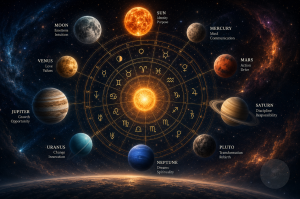
An aspect connects their symbolism. For example, Mercury represents areas such as communication and thinking, while Saturn is associated with structure, responsibility, and discipline. An aspect between Mercury and Saturn therefore connects these two themes—but the way they interact depends heavily on the type of aspect.
The Five Major Aspects in Astrology
The five major Astrology Aspects are based on specific angular distances:
| Aspect | Angle | General Meaning |
|---|---|---|
| Conjunction | 0° | Combination, intensity |
| Sextile | 60° | Opportunity, cooperation |
| Square | 90° | Tension, challenge |
| Trine | 120° | Harmony, natural ability |
| Opposition | 180° | Polarity, balance |
You do not need to memorize every angle immediately. Understanding what each relationship represents is much more useful when you’re beginning to interpret your chart.
Conjunction: 0°
A conjunction occurs when two planets occupy approximately the same position in the zodiac. Their energies become strongly connected, almost as though the two planets are working from the same place.
This makes conjunctions powerful aspects, but they are not automatically positive or negative. Much depends on which planets are involved. For example, a Venus-Jupiter conjunction may amplify themes of affection, pleasure, generosity, and optimism.
A Mars-Saturn conjunction combines the drive of Mars with Saturn’s restraint and discipline, creating a very different dynamic. Think of a conjunction as two planetary energies being placed in the same room. They cannot easily ignore each other.
- Key theme: Fusion and intensity.
Sextile: 60°
A sextile occurs when two planets are approximately 60 degrees apart. Sextiles are traditionally considered harmonious aspects. They suggest that two planetary energies can cooperate relatively easily.
However, there is an important distinction between sextiles and trines. A sextile often represents an opportunity that benefits from action. The potential exists, but you may need to consciously use it.
Someone with helpful Mercury-Venus aspects, for example, may find it easier to combine communication with charm, creativity, or diplomacy. Whether that ability becomes important depends on how they develop it.
- Key theme: Opportunity and cooperation.
Square: 90°
A square forms when two planets are approximately 90 degrees apart. Squares are considered challenging aspects because the planets involved appear to want different things. This can create friction, frustration, or internal conflict.
But challenging does not necessarily mean bad. Squares can become powerful sources of motivation. Because the tension demands attention, people may spend significant energy learning how to manage the two conflicting forces.
For example, a square involving Mars and Saturn can symbolize tension between action and restriction. Learning how to balance these energies may eventually produce considerable discipline and persistence. Squares frequently show areas where growth requires effort.
- Key theme: Tension and action.
Trine: 120°
A trine occurs when two planets are approximately 120 degrees apart. Traditionally, trines are considered among the most harmonious Astrology Aspects. The planets involved tend to support each other naturally, allowing their energies to flow with relatively little resistance.
This can indicate talents, instincts, or qualities that feel effortless. But effortless energy has an interesting downside: because it comes naturally, you may take it for granted.
A strong talent shown by a trine may remain underdeveloped simply because you never feel pressured to improve it. Trines therefore represent potential that often works best when consciously recognized and used.
- Key theme: Harmony and natural ability.
Opposition: 180°
An opposition occurs when two planets sit approximately opposite each other in the zodiac. This creates polarity. Instead of the direct friction associated with a square, an opposition often feels like being pulled between two different sides of an issue.
One planetary need may seem to contradict another. For example, an opposition involving Venus and Saturn might create a need to balance affection and connection with caution, boundaries, or responsibility.
Oppositions can also appear through relationships, where another person seems to embody qualities you have difficulty recognizing within yourself. The goal is usually not to choose one side permanently, but to find a workable balance between both.
- Key theme: Polarity and integration.
Hard and Soft Aspects
You may encounter the terms hard aspects and soft aspects when reading about Birth Chart Aspects. Traditionally:
- Trines and sextiles are considered soft or harmonious aspects.
- Squares and oppositions are considered hard or challenging aspects.
- Conjunctions can behave differently depending on the planets involved.
These labels can be useful, but they should not be interpreted as simply “good” and “bad.” A chart filled with harmonious aspects may indicate natural abilities, but challenging aspects can provide motivation, resilience, and a strong drive for development. In practice, most Natal Charts contain a mixture of both.
What Is an Orb in Astrology?
Planets rarely form perfectly exact angles. For example, two planets do not necessarily need to be exactly 120 degrees apart to form a trine. Astrologers allow a small range around the exact angle known as an orb. If the exact aspect is 120 degrees and the planets are 118 degrees apart, they may still be considered trine.
The acceptable orb varies depending on the planets, aspect, and astrological method being used. As a general principle, however, the closer an aspect is to exact, the stronger it is usually considered.
You may therefore see aspects in a Natal Chart listed with numbers such as 1°, 3°, or 5°. These indicate how far the aspect is from its exact angle.
Why Astrology Aspects Matter in a Natal Chart
- Planetary signs tell you how a planet expresses itself.
- Houses tell you where in life that energy is most likely to appear.
- Aspects reveal how the planets interact with one another.
This is where a Natal Chart starts becoming much more personal. Two people might both have Venus in Leo, for example, but one person’s Venus could form a harmonious trine with Jupiter while another person’s Venus forms a challenging square with Saturn.
The same Venus sign can therefore operate within two very different planetary networks. This is one reason Sun sign descriptions alone can never capture the complexity of an entire Birth Chart.
Aspect Patterns in Your Birth Chart
Once several aspects begin connecting planets, recognizable geometric patterns can sometimes appear within the chart. You may encounter names such as Grand Trine, T-Square, Grand Cross, or Yod. These patterns combine multiple aspects and add another layer to chart interpretation.
However, you do not need to understand complex aspect patterns before learning the basics. Becoming comfortable with conjunctions, sextiles, squares, trines, and oppositions gives you the foundation needed to explore them later.
Discover the Aspects in Your Natal Chart
Understanding Astrology Aspects helps transform a Birth Chart from a collection of separate planets and zodiac signs into an interconnected system. Conjunctions show where energies combine, sextiles reveal opportunities, squares create productive tension, trines highlight natural flow, and oppositions ask you to balance two sides of yourself.
Your own chart contains a unique network of these planetary relationships.
Generate your free Natal Chart to discover your planetary placements, houses, and aspects and receive your full personalized PDF report for free.
FAQ
What are the most important Astrology Aspects?
The five major aspects are conjunction, sextile, square, trine, and opposition. They are usually the best place to start when learning how planetary relationships work.
What is the strongest aspect in astrology?
There is no single strongest aspect in every situation, although conjunctions can be particularly powerful because the planets occupy nearly the same position. The strength of an aspect also depends on factors such as its orb and the planets involved.
Which Astrology Aspects are considered positive?
Trines and sextiles are traditionally considered harmonious aspects. However, this does not automatically make them “better” than squares or oppositions, which can encourage action and personal development.
Are squares bad in a Birth Chart?
No. Squares indicate tension between planetary energies, but that tension can become a source of motivation, determination, and growth.
What does a conjunction mean in astrology?
A conjunction occurs when two planets are positioned close together. Their energies become strongly combined, making the themes represented by those planets particularly connected.
Why are there colored lines in a Natal Chart?
The lines commonly shown across the center of a Natal Chart represent aspects between planets. Different colors are often used to distinguish harmonious and challenging aspects, although the exact color system depends on the chart calculator.