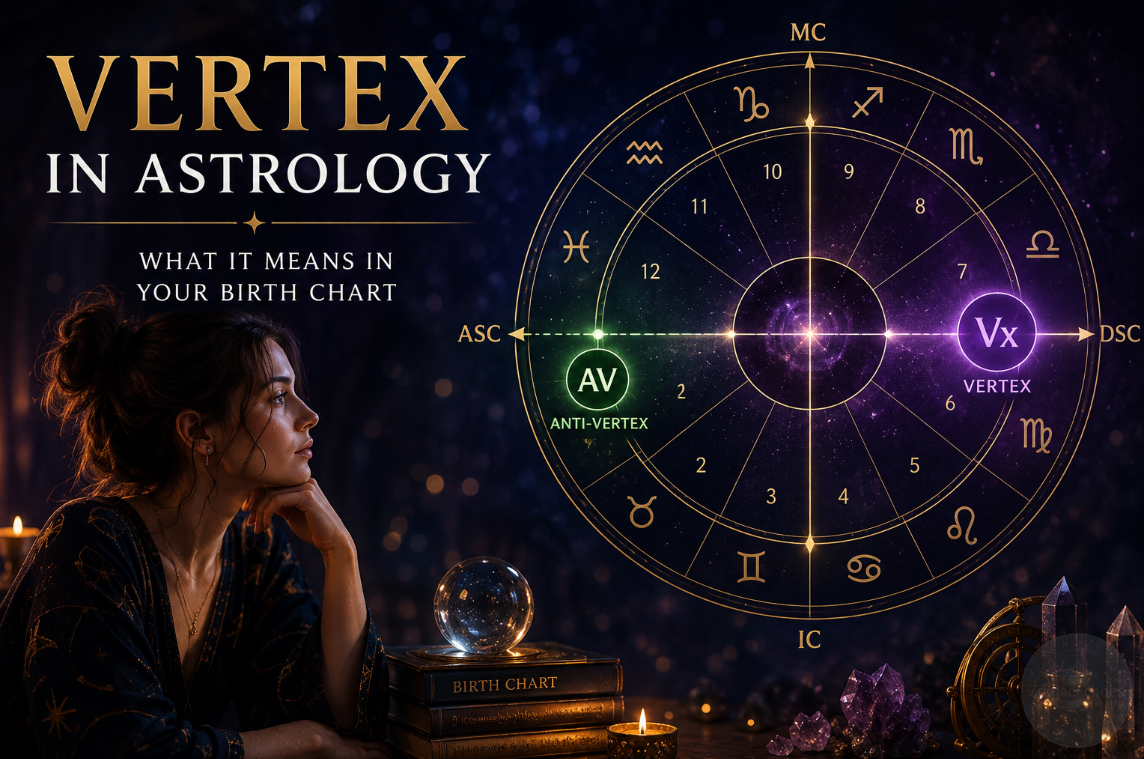
The Vertex is one of the more mysterious points you may encounter in a Birth Chart. Unlike the Sun, Moon, or planets, there is no physical object in space called the Vertex. It is a mathematically calculated point created by the intersection of important astronomical circles.
In modern astrology, the Vertex in Astrology is commonly associated with significant encounters, relationships, turning points, and experiences that seem to arrive through other people or external circumstances. This has earned it dramatic nicknames such as the “point of fate” or even the “second Descendant.”
Those descriptions can be useful symbolically, but they are also easy to exaggerate. Finding someone’s planet on your Vertex does not prove that you have met your soulmate, and a Vertex transit does not guarantee that a life-changing event is about to occur.
The Vertex becomes much more useful when its sign, house, opposite Anti-Vertex, and planetary contacts are interpreted together.
What Is the Vertex in Astrology?
The Vertex is a mathematical point determined by the intersection of the ecliptic with the prime vertical, an astronomical circle passing through the east and west points of the horizon and the point directly overhead. That sounds considerably more complicated than its practical use in a Birth Chart.
What matters for beginners is that the Vertex depends on both birth time and location. It therefore belongs to the group of chart features that cannot be reliably calculated from a birth date alone. In a chart, it is usually labeled:
Vx or Vertex
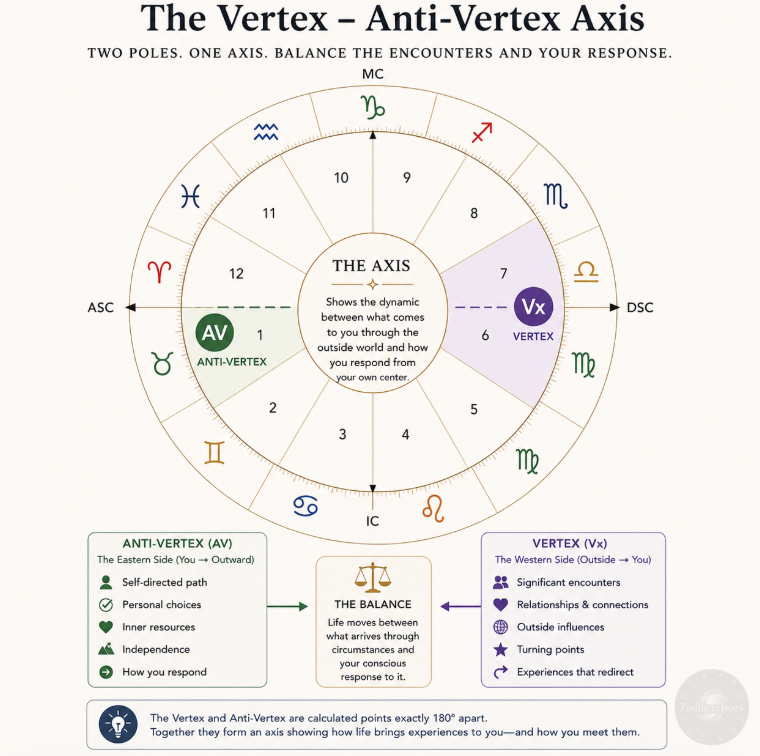
Directly opposite it is another calculated point called the Anti-Vertex. Together they form the:
Vertex ↔ Anti-Vertex axis
The Vertex is normally found on the western side of the chart, while the Anti-Vertex occupies the corresponding point on the eastern side.
What Does the Vertex Represent?
Modern astrologers generally connect the Vertex with experiences that seem to enter life through circumstances outside your immediate control. This is one reason relationships feature so prominently in Vertex interpretations.
Another person can introduce an opportunity, challenge an assumption, change your direction, expose you to a completely different environment, or simply become important in a way you did not anticipate. Vertex themes are therefore often associated with:
- significant encounters
- relationships
- unexpected connections
- turning points
- outside influences
- experiences involving other people
- circumstances that redirect attention
- periods of accelerated personal development
However, none of these outcomes is guaranteed by a Vertex placement. The Vertex is best understood as one additional layer of chart interpretation, not a prediction mechanism operating independently of everything else.

Why Is the Vertex Called the Point of Fate?
The expression “point of fate” comes from the observation by some astrologers that strong Vertex contacts seem to appear around meaningful encounters or turning points. The language can sound more deterministic than it needs to be. In astrology, fated does not necessarily have to mean:
“This event was predetermined and could never have happened differently.”
A more cautious interpretation is:
“This experience may feel unusually significant or may arrive through circumstances you did not consciously initiate.”
That distinction matters. A relationship involving the Vertex can be meaningful without lasting forever. An encounter can change your thinking without becoming romantic. A Vertex transit can coincide with an important period without producing one dramatic event. The symbolism is about significance, not proof of destiny.
Vertex vs. Anti-Vertex
Every Vertex automatically creates an Anti-Vertex exactly 180 degrees opposite it. They should therefore be understood as an axis rather than two unrelated placements. A simple way to approach them is:
- Vertex → encounters and experiences arriving through the external world
- Anti-Vertex → the more personally directed or self-oriented side of the same axis
Modern astrologers generally give the Vertex more attention, particularly in synastry and transit work. However, the Anti-Vertex helps reveal the polarity involved. If the Vertex emphasizes what arrives through other people or circumstances, the Anti-Vertex can help describe the qualities you bring from your own side of the axis.
| Vertex (Vx) | Anti-Vertex (AV) | |
|---|---|---|
| Core Meaning | Encounters and experiences arriving through the external world | The more self-directed side of the axis |
| Emphasis | Other people, circumstances, significant encounters | Personal choices, responses and initiative |
| Orientation | External and relational | Internal and self-directed |
| Common Use | Synastry, significant encounters and transits | Understanding the opposite pole of the Vertex axis |
| Position | Usually on the western side of the chart | Exactly 180° opposite the Vertex |
Why Is the Vertex Usually on the Western Side of the Chart?
The astronomical method used to calculate the Vertex normally places it on the western half of a standard Birth Chart, often somewhere between the 5th and 8th Houses in many commonly used quadrant house systems.
This is one reason Vertex interpretations have become closely connected with relationships and encounters with others. However, you should not assume that everyone has the Vertex in the 7th House.
Its exact house depends on birth time, geographic location, and the house system being used. The Vertex can also behave differently at extreme geographic latitudes, which is another reason accurate chart calculation matters.
Vertex Sign vs. Vertex House
As with many placements, separating sign and house makes interpretation much clearer. Use this simple framework:
- Vertex Sign = How
- Vertex House = Where
The sign describes the qualities associated with significant encounters and Vertex experiences. The house describes the area of life in which those experiences may become particularly noticeable. For example:
Vertex in Libra → relationships, cooperation, balance, diplomacy
Add:
Vertex in Libra in the 7th House → these themes become especially connected with partnerships and one-to-one relationships.
That combination may look strongly relationship-oriented, but it still does not automatically mean “soulmate.”
Vertex in Aries
A Vertex in Aries can bring significant experiences involving independence, courage, initiative, competition, or the need to act for yourself. Important people may encourage you to become more decisive or expose situations where waiting for approval is no longer useful. The challenge can involve learning when independence is necessary without turning every encounter into a contest of wills.
Vertex in Taurus
A Vertex in Taurus emphasizes stability, security, values, patience, resources, and the physical world. Significant encounters may challenge your understanding of what makes life secure or worthwhile. Other people can sometimes encourage greater stability—or reveal where attachment to familiarity has become restrictive.
Vertex in Gemini
A Vertex in Gemini connects important experiences with communication, information, curiosity, learning, and social connections. A conversation, introduction, message, class, short journey, or exchange of ideas may become more significant than initially expected. People who challenge your thinking or expose you to new information can play an important role.
Vertex in Cancer
A Vertex in Cancer emphasizes emotional connection, family, belonging, security, home, and nurturing. Important encounters may activate questions about where you belong or what emotional safety means to you. Relationships can reveal both the desire to care for others and the importance of allowing yourself to receive support.
Vertex in Leo
A Vertex in Leo brings creativity, visibility, confidence, recognition, romance, and self-expression into focus. Certain people may encourage you to become more visible or take your own creative abilities seriously. Encounters can also challenge dependence on external approval, pushing toward a more authentic form of self-expression.
Vertex in Virgo
A Vertex in Virgo emphasizes practical skills, work, organization, service, routines, and improvement. Significant experiences may arrive through everyday circumstances rather than dramatic events. People who teach useful skills, reveal problems that need solving, or change the way you organize daily life can become particularly influential.
Vertex in Libra
A Vertex in Libra naturally emphasizes partnership, cooperation, diplomacy, fairness, attraction, and balance. Relationships can become important vehicles for development. Other people may expose where compromise is valuable and where maintaining harmony has started to cost too much personally.
Vertex in Scorpio
A Vertex in Scorpio can bring intensity, intimacy, trust, shared resources, vulnerability, and transformation into important encounters. Some connections may feel unusually powerful because they expose deeper emotional material. The lesson is not that every intense relationship is destined. Intensity and compatibility are not the same thing.
Vertex in Sagittarius
A Vertex in Sagittarius emphasizes exploration, beliefs, education, travel, truth, and broader perspectives. Important people may introduce different cultures, philosophies, opportunities, or ways of understanding the world. Encounters that expand your perspective can become particularly memorable.
Vertex in Capricorn
A Vertex in Capricorn connects significant experiences with responsibility, ambition, authority, discipline, structure, and long-term goals. Important people may influence professional direction or force a more serious evaluation of priorities. Relationships with mentors, employers, authority figures, or highly ambitious people can sometimes become especially meaningful.
Vertex in Aquarius
A Vertex in Aquarius emphasizes individuality, communities, friendship, technology, networks, and unconventional ideas. Unexpected connections may arrive through groups, online communities, social causes, or environments outside your usual circle. Some encounters can challenge assumptions about what kind of people belong in your life.
Vertex in Pisces
A Vertex in Pisces brings imagination, intuition, compassion, creativity, spirituality, and emotional sensitivity into focus. Certain encounters may feel difficult to explain logically or carry a strong sense of emotional familiarity. Maintaining clear boundaries is important because feeling a profound connection does not automatically mean the relationship is healthy or permanent.
Vertex Signs at a Glance
| Vertex Sign | Central Theme | Significant Experiences May Emphasize |
|---|---|---|
| Aries | Independence | Initiative, courage, new beginnings, taking action |
| Taurus | Stability | Values, security, resources, patience, the physical world |
| Gemini | Communication | Conversations, ideas, learning, connections, short trips |
| Cancer | Belonging | Emotional bonds, family, home, nurturing, sensitivity |
| Leo | Self-expression | Creativity, visibility, romance, confidence, recognition |
| Virgo | Practicality | Work, service, routines, skills, improvement, health habits |
| Libra | Partnership | Relationships, cooperation, balance, attraction, diplomacy |
| Scorpio | Transformation | Intimacy, trust, shared resources, change, deep bonds |
| Sagittarius | Expansion | Travel, higher learning, beliefs, truth, broader perspectives |
| Capricorn | Achievement | Responsibility, ambition, authority, structure, long-term goals |
| Aquarius | Individuality | Friendships, groups, networks, innovation, new ideas |
| Pisces | Sensitivity | Intuition, compassion, creativity, spirituality, emotional depth |
Vertex Through the Houses
The Vertex house shows the area of life where significant encounters or externally initiated experiences may become particularly noticeable.
There is one important caveat: depending on the calculation and house system, the Vertex is commonly concentrated in a limited portion of the chart rather than being evenly distributed across all twelve houses. House interpretations outside its usual range should therefore be treated with appropriate context.
Vertex in the 5th House
Creativity, romance, pleasure, children, hobbies, and self-expression can become important areas for significant encounters. A relationship or experience may encourage greater creative confidence or change what you consider genuinely enjoyable. Romantic experiences can be prominent, but romance is only one possible expression.
Vertex in the 6th House
Work, routines, service, health habits, responsibilities, and everyday environments become emphasized. Important people may enter through employment or ordinary daily activities rather than dramatic circumstances. A seemingly routine connection can eventually have a much larger influence.
Vertex in the 7th House
Partnerships and one-to-one relationships receive particularly strong emphasis. This is one reason Vertex in the 7th House attracts so much attention in relationship astrology. Significant people may challenge how you cooperate, compromise, commit, or define partnership. But even here, Vertex does not guarantee marriage or a soulmate.
Vertex in the 8th House
Intimacy, trust, shared resources, vulnerability, transformation, and deeper emotional bonds become prominent. Encounters may expose issues that are normally kept private. Some relationships can correspond with substantial internal change, although intensity should not automatically be interpreted as permanence.
What About Vertex in the Other Houses?
You may encounter calculators or interpretive systems that place or discuss the Vertex outside the 5th–8th House range. The Vertex’s astronomical position is constrained by its geometry, and its house placement also depends on latitude and the house system used.
For that reason, generic lists claiming that the Vertex operates identically through all twelve houses can be misleading. When interpreting your own chart, use the actual calculated position rather than trying to force the Vertex into a universal twelve-house framework.
Example: Vertex in Libra in the 7th House
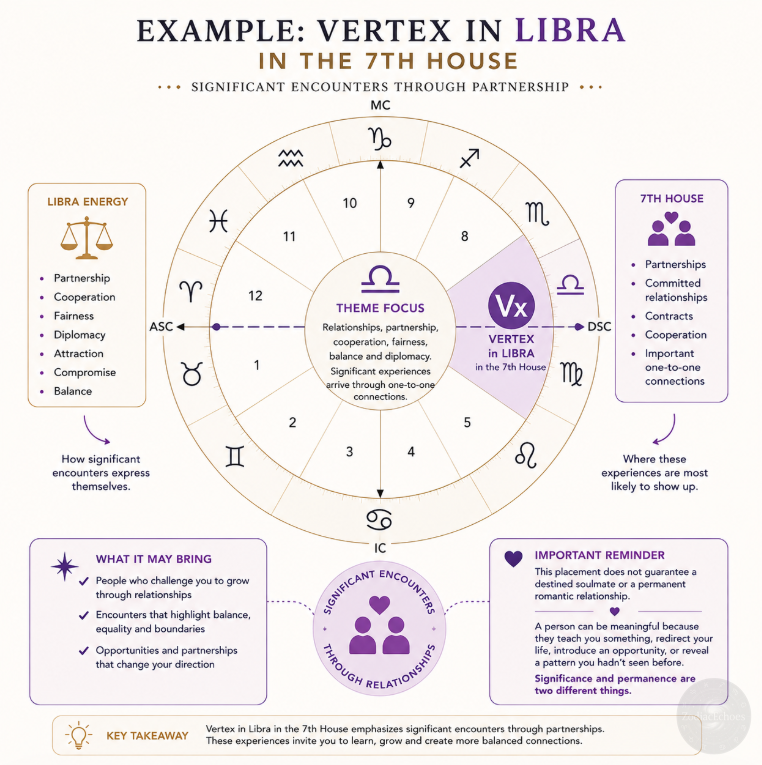
Imagine someone has: Vertex in Libra in the 7th House
Start with Libra. Libra is associated with partnership, cooperation, fairness, diplomacy, attraction, compromise, and balance. Now add the 7th House. The 7th House represents partnerships, committed relationships, contracts, cooperation, and important one-to-one connections.
The themes strongly reinforce one another. Significant encounters may repeatedly encourage this person to examine how they relate to others. Certain relationships could expose questions involving compromise, equality, boundaries, or the difference between maintaining peace and creating genuine balance.
Someone entering their life could feel unusually significant because the relationship activates exactly these themes. But this is where responsible interpretation becomes important.
Vertex in Libra in the 7th House does not mean that every powerful romantic encounter is a destined soulmate relationship.
A person can be significant because they teach you something, redirect your life, introduce an opportunity, or reveal a pattern you had not previously recognized. Significance and permanence are two different things.
Vertex Aspects to Planets
Vertex interpretation becomes particularly interesting when planets form close contacts with it. Modern astrologers tend to pay greatest attention to the Conjunction and Opposition because these place a planet directly on the Vertex–Anti-Vertex axis.
Other aspects such as squares, trines, and sextiles are also used by some astrologers, although practices vary considerably. Because the Vertex is a mathematical point rather than a physical body, many astrologers use relatively tight orbs when examining contacts.
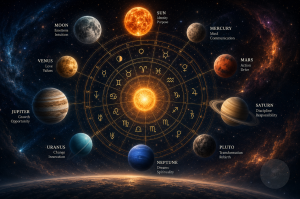
Sun Conjunct Vertex
The Sun represents identity, vitality, purpose, and conscious self-expression. A person whose Sun closely conjuncts your Vertex may feel particularly noticeable. Their identity or direction can activate themes represented by your Vertex placement. This does not determine whether the relationship will be romantic, positive, difficult, or permanent.
Moon Conjunct Vertex
The Moon relates to emotional needs, instincts, familiarity, security, and habitual responses. A Moon–Vertex conjunction can correspond with a strong feeling of emotional significance or familiarity. This is one of the contacts sometimes described online as evidence of an immediate “fated” bond.
That interpretation should be treated cautiously. Emotional intensity tells you that something feels important; it does not tell you whether two people are compatible.
Venus Conjunct Vertex
Venus naturally attracts attention in relationship astrology because it represents attraction, affection, values, pleasure, and relating. Venus conjunct Vertex can therefore correspond with a connection that feels particularly appealing or meaningful. It can appear in romantic relationships, but it can also describe friendships, creative partnerships, or people who significantly influence your tastes and values.
Mars Conjunct Vertex
Mars introduces action, desire, competition, assertiveness, and physical energy. Someone’s Mars on your Vertex may create a connection that feels energizing, provocative, motivating, or confrontational. The rest of the synastry determines whether that energy is easy to manage.
Jupiter Conjunct Vertex
Jupiter brings themes of expansion, knowledge, opportunity, belief, travel, and growth. A Jupiter–Vertex contact can describe someone who introduces possibilities, encouragement, knowledge, or a broader perspective. Teachers and mentors can sometimes fit this symbolism just as easily as romantic partners.
Saturn Conjunct Vertex
Saturn represents responsibility, boundaries, commitment, structure, time, and limitation. A Saturn–Vertex connection may feel serious or consequential. Some astrologers associate it with relationships involving responsibility or longevity, but Saturn does not guarantee permanence. It can also represent boundaries, obligations, delays, or difficult lessons.
Vertex in Synastry
Synastry compares two Birth Charts to examine how their placements interact. This is probably where the Vertex receives the most attention today.
Suppose Person A has:
Vertex at 18° Libra
and Person B has:
Venus at 18° Libra
Person B’s Venus is conjunct Person A’s Vertex.
An astrologer might interpret this as a potentially significant connection involving Venus themes such as attraction, affection, relationships, pleasure, or shared values. But you would still examine:
The Sun and Moon, Venus and Mars, Ascendants, house overlays, Saturn contacts, Nodes, and the rest of the synastry. One Vertex contact cannot describe an entire relationship.
Does Vertex Synastry Mean Soulmates?
No. This deserves a direct answer because the claim appears so frequently online. There is no astrological placement that can objectively prove two people are soulmates. Strong Vertex synastry may be interpreted as indicating a significant encounter, particularly when several other chart factors support the same theme.
But significant relationships take many forms. A person can profoundly influence your life and still remain in it for only a short period. Likewise, a stable lifelong relationship does not require dramatic Vertex contacts. Treat Vertex synastry as additional context, not a cosmic relationship certificate.
Vertex vs. Descendant
The Vertex is sometimes called a secondary Descendant because both are located on the western side of the chart and can involve experiences with other people. They are not the same point. The Descendant is one of the four primary chart angles and directly opposes the Ascendant. It has a central role in relationship and partnership interpretation.
The Vertex is calculated differently and forms its own axis with the Anti-Vertex. The Descendant describes partnership as a fundamental area of the Birth Chart. The Vertex is more specifically associated in modern astrology with significant encounters and experiences that seem to arrive through external circumstances.
Vertex vs. North Node
The Vertex and North Node are also sometimes mixed together because both can be described using language involving destiny or development. Astronomically and astrologically, they are different. The North Node is created where the Moon’s orbit crosses the ecliptic. The Vertex is created by the intersection of the ecliptic and prime vertical.
The North Node is generally associated with developmental direction in modern Western astrology. The Vertex is more commonly associated with significant encounters and externally initiated experiences. They can form aspects with each other, but one does not replace the other.
Vertex vs. Part of Fortune
Both are mathematical points, but they are calculated differently. The Part of Fortune is derived from the relationship between the Sun, Moon, and Ascendant. The Vertex comes from astronomical geometry involving the ecliptic and prime vertical.
Their meanings are also different. Part of Fortune is traditionally connected with material circumstances, prosperity, the body, and well-being. Vertex interpretations focus much more heavily on encounters, relationships, and turning points.
How to Find Your Vertex
Not every basic Birth Chart displays the Vertex automatically. Look for Vx or an option labeled Vertex. Some calculators place it under additional points or chart objects. Once you find it, record:
Vertex → Zodiac Sign → Degree → House
Then find the point exactly opposite it:
Anti-Vertex
For example, Vertex 18° Libra automatically gives Anti-Vertex 18° Aries. You can then examine planets close to either end of the axis.
Why Accurate Birth Time Matters
Accurate birth time is particularly important for calculating the Vertex. Unlike a slow-moving planet that may remain in the same zodiac sign for months or years, the Vertex depends on the orientation of the chart for a specific time and geographic location.
An incorrect birth time can therefore change its degree, house, or sign. If your birth time is unknown or highly uncertain, Vertex interpretations should be treated cautiously.
Can the Vertex Predict When You Will Meet Someone?
Astrologers sometimes examine transits to the Vertex when studying periods associated with important encounters or external developments. For example, a transiting planet might conjunct the natal Vertex.
However, this does not provide a reliable prediction such as:
“You will meet your future spouse on this date.”
A transit can have many possible expressions. It may correspond with a person, opportunity, professional connection, change in circumstances, or an experience that becomes significant only later. The Vertex can add context to timing techniques, but it should not be used as a standalone prediction tool.
FAQ
What is the Vertex in Astrology?
The Vertex is a mathematically calculated point created by the intersection of the ecliptic and prime vertical. Modern astrologers associate it with significant encounters, relationships, turning points, and experiences involving outside circumstances.
Is the Vertex a planet?
No. The Vertex is a calculated astronomical point rather than a physical celestial body.
What is the Anti-Vertex?
The Anti-Vertex is the point exactly opposite the Vertex. Together they form the Vertex–Anti-Vertex axis.
Why is the Vertex called the point of fate?
Some astrologers have observed prominent Vertex contacts around meaningful encounters and turning points. “Point of fate” is a symbolic description rather than proof that events are predetermined.
Does Vertex conjunct Venus mean soulmates?
No. It can be interpreted as a potentially significant Venus-related connection, but it does not prove that two people are soulmates or that a relationship will last.
Is Vertex important in synastry?
Many modern astrologers use it as an additional synastry factor, especially when another person’s Sun, Moon, Venus, Mars, Ascendant, Nodes, or other important placements closely contact the Vertex axis.
Is the Vertex the same as the Descendant?
No. They are separate points calculated differently. The Descendant is one of the four primary chart angles, while the Vertex forms its own axis with the Anti-Vertex.
Do I need my exact birth time to find my Vertex?
Ideally, yes. The Vertex depends strongly on birth time and geographic location, so inaccurate birth data can produce an incorrect placement.
Understanding the Vertex in Your Birth Chart
The Vertex in Astrology is fascinating precisely because it introduces a different perspective to Birth Chart interpretation. Rather than focusing entirely on personality, it directs attention toward encounters, relationships, and circumstances that can introduce something unexpected into your life.
Start with the Vertex sign and house, then examine the opposite Anti-Vertex and any planets making close contacts with the axis. In relationship astrology, compare the Vertex with the other person’s important placements—but resist the temptation to turn one conjunction into proof of destiny.
Use your Natal Chart to locate your Vertex alongside your Rising Sign, Midheaven, Lunar Nodes, Chiron, Part of Fortune, planets, houses, and aspects—and see how this lesser-known point fits into the larger structure of your chart.