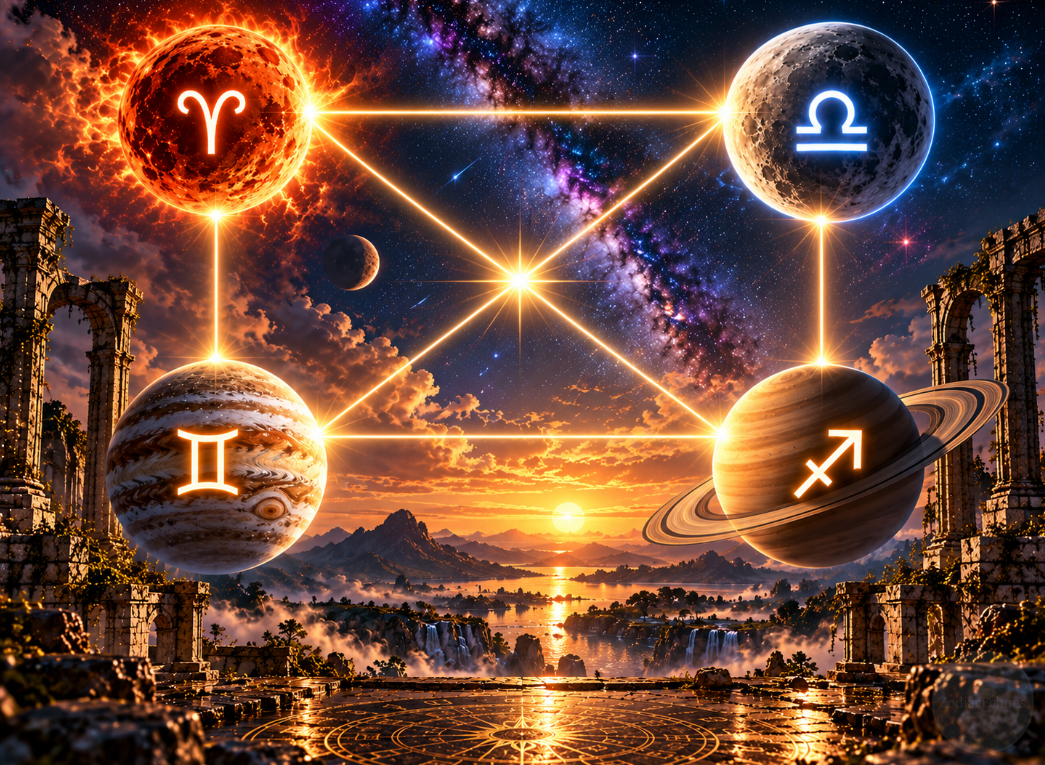
- A Mystic Rectangle is an aspect pattern involving four planets or important chart points.
- It consists of two oppositions (180°), two trines (120°), and two sextiles (60°).
- The four placements form a rectangular configuration inside the Natal Chart.
- Unlike a Grand Cross, the Mystic Rectangle combines challenging and harmonious aspects.
- The oppositions represent competing needs or contrasting planetary functions, while the trines and sextiles provide opportunities for cooperation.
- The pattern is traditionally associated with balance, integration, adaptability, and constructive problem-solving.
- Its interpretation depends on the planets involved, their zodiac signs, houses, and the exactness of the aspects.
Some aspect patterns immediately suggest tension. The Grand Cross, for example, contains four squares and two oppositions, creating a configuration filled with competing pressures. The Mystic Rectangle offers something different: a geometric structure in which challenging and harmonious aspects coexist.
Four planets form a rectangle across the Natal Chart, connecting two oppositions through a network of trines and sextiles. The result is a configuration that astrologers traditionally associate with the ability to reconcile differences and transform contrasting influences into something constructive. Its name sounds mysterious, but the underlying geometry is surprisingly straightforward.
What Is a Mystic Rectangle in Astrology?
A Mystic Rectangle forms when four planets occupy positions that create six interconnected aspects. These include two oppositions, two trines, and two sextiles.
| Aspect | Number | Angle | Main Theme |
|---|---|---|---|
| Opposition | 2 | 180° | Polarity and contrasting needs |
| Trine | 2 | 120° | Natural cooperation and flow |
| Sextile | 2 | 60° | Opportunity and constructive interaction |
The two oppositions form the diagonals of the rectangle, while the trines and sextiles connect its four corners. This structure distinguishes the Mystic Rectangle from patterns dominated entirely by challenging aspects. Rather than concentrating pressure on one apex planet, the configuration distributes its influences across four interconnected placements.
How Does a Mystic Rectangle Work?
The key to understanding a Mystic Rectangle is recognizing that its harmonious aspects do not eliminate its oppositions. Instead, they provide additional relationships through which the opposing planets may interact.
An opposition often represents two planetary functions pulling in different directions. A trine introduces a relatively natural connection, while a sextile offers possibilities for cooperation that may require conscious participation.
In a Mystic Rectangle, these influences operate simultaneously.
The configuration can therefore suggest an ability to recognize contrasting perspectives, negotiate competing priorities, and find productive ways to work with internal tension.
However, the exact expression depends on which planets form the pattern.
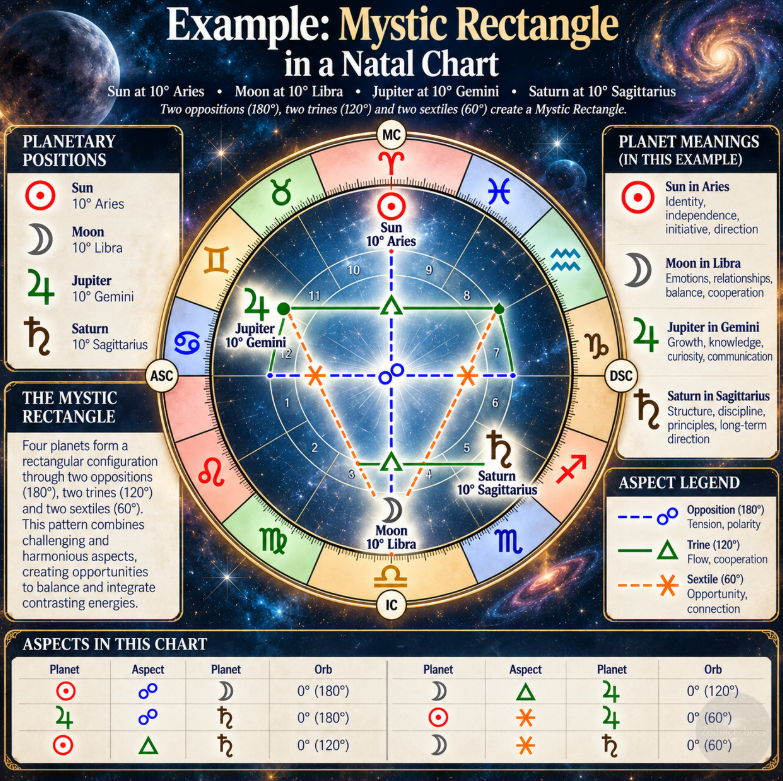
Example: Sun–Moon–Jupiter–Saturn Mystic Rectangle
Consider the following hypothetical Natal Chart:
- Sun — 10° Aries
- Moon — 10° Libra
- Jupiter — 10° Gemini
- Saturn — 10° Sagittarius
These four placements create a complete Mystic Rectangle.
The two oppositions are:
Sun ☍ Moon — 180°
Jupiter ☍ Saturn — 180°
The harmonious connections are:
Sun △ Saturn — 120°
Moon △ Jupiter — 120°
Sun ⚹ Jupiter — 60°
Moon ⚹ Saturn — 60°
Together, these six aspects create the characteristic rectangular configuration. The Sun in Aries represents identity, independence, initiative, and personal direction. The Moon in Libra introduces emotional needs connected with cooperation, relationships, and balance. Their opposition may emphasize the contrast between individual independence and consideration for others.
Meanwhile, Jupiter in Gemini encourages curiosity, communication, and intellectual exploration, while Saturn in Sagittarius emphasizes structure, responsibility, principles, and long-term direction.
The Jupiter–Saturn opposition introduces another polarity: expansion versus restraint. Yet the harmonious aspects connect these contrasting influences.
The Sun–Saturn trine can support disciplined initiative, while the Moon–Jupiter trine encourages communication and openness in relationships. The Sun–Jupiter sextile provides opportunities for growth, while the Moon–Saturn sextile can support emotional steadiness and responsible cooperation.
Rather than allowing either opposition to dominate the entire configuration, the Mystic Rectangle creates several pathways for integration.
Mystic Rectangle vs. Grand Cross
Although both patterns involve four planets and two oppositions, their remaining aspects are very different.
| Feature | Mystic Rectangle | Grand Cross |
|---|---|---|
| Planets | 4 | 4 |
| Oppositions | 2 | 2 |
| Squares | 0 | 4 |
| Trines | 2 | 0 |
| Sextiles | 2 | 0 |
| Main Theme | Integration and cooperation | Pressure and competing demands |
A Grand Cross creates repeated friction through its squares. A Mystic Rectangle connects its oppositions through harmonious aspects, introducing greater opportunities for cooperation between contrasting planetary functions. This does not make one pattern universally better than the other. They simply describe different relationships between the planets.
Why Houses Matter
The houses reveal where the Mystic Rectangle’s themes may become particularly noticeable. For example, a configuration involving the 1st, 3rd, 7th, and 9th Houses could connect identity, communication, partnerships, education, and personal beliefs.
The same four planets placed in different houses would shift the emphasis toward entirely different life experiences. This is why interpreting a Mystic Rectangle requires more than identifying its geometric shape.
The planets describe the functions involved, the signs explain their expression, and the houses show where their interactions may unfold.
Is a Mystic Rectangle Rare?
A complete Mystic Rectangle requires four placements to form six compatible aspects simultaneously. That makes it more specialized than an individual trine, sextile, or opposition.
However, its apparent rarity depends partly on the orb allowances used by the astrologer or chart software. Tighter orbs produce a more clearly defined configuration, while wider allowances can identify patterns that are less geometrically precise.
Understanding a Mystic Rectangle in Your Birth Chart
A Mystic Rectangle in Astrology combines two oppositions, two trines, and two sextiles into one interconnected configuration. The oppositions introduce contrasting needs and priorities, while the harmonious aspects provide opportunities to reconcile those differences.
Its defining characteristic is not the absence of tension, but the presence of multiple connections that can help transform opposing influences into constructive cooperation. When interpreting this pattern, the most important question is how its four planets work together — and what their combined influence reveals about the wider Birth Chart.
Cosmic Highlights
FAQ
What does a Mystic Rectangle mean in Astrology?
A Mystic Rectangle is an aspect pattern involving four planets connected by two oppositions, two trines, and two sextiles. It is traditionally associated with balance, integration, and constructive cooperation.
Is a Mystic Rectangle a positive aspect pattern?
It is generally considered constructive because its harmonious aspects provide ways to work with the tensions created by its oppositions. However, its interpretation depends on the planets, signs, and houses involved.
How many planets form a Mystic Rectangle?
A standard Mystic Rectangle involves four planets or important chart points, each connected to the others through specific angular relationships.
Is a Mystic Rectangle the same as a Grand Cross?
No. Both contain two oppositions, but a Grand Cross also contains four squares. A Mystic Rectangle instead contains two trines and two sextiles.
Does a Mystic Rectangle have an apex planet?
No. Unlike a Yod or T-Square, the Mystic Rectangle does not have a single apex planet. Its four placements form a balanced geometric configuration.