Not every difficult part of a Birth Chart is something we would want to remove. Sometimes friction is exactly what forces movement. A problem becomes impossible to ignore. Two needs repeatedly interfere with each other. Staying exactly where you are becomes less comfortable than doing something about it.
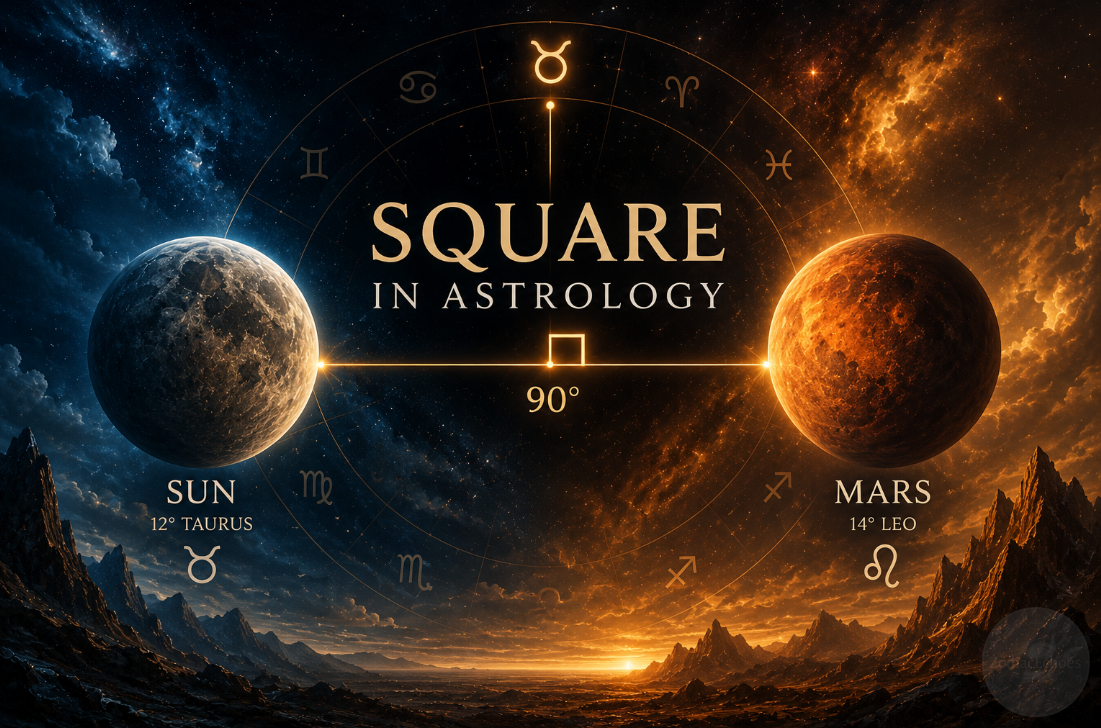
This is the basic principle behind a square in Astrology. With an exact angle of 90°, the square connects two planetary functions in a way that can create tension—but also provides the pressure needed to develop new skills, make changes, and take action.
What Is a Square in Astrology?
A square occurs when two planets are positioned approximately:
90° apart
Imagine the Sun at:
12° Taurus
and Mars at:
14° Leo
The exact square from 12° Taurus would occur at 12° Leo. Mars is at 14° Leo, meaning the aspect is only 2° away from exact. We therefore have a square with an:
Orb of 2°
The Sun represents identity, vitality, purpose, and conscious self-expression. Mars represents action, assertion, motivation, competition, and drive. Because these two functions form a square, they do not necessarily operate smoothly together. But that tension can become productive.
How Does a Square Work?
Think of a square as pressure demanding a response. A conjunction combines two planetary functions. An opposition creates polarity between them. A square creates friction. For example:
- Mercury square Saturn may create tension between communication and caution, structure, or self-restraint.
- Venus square Uranus can connect relationships and stability with a competing need for freedom, novelty, or independence.
- Mars square Pluto may intensify questions involving action, control, power, and determination.
The planets tell us what is interacting. The square tells us that their relationship may require effort, adjustment, and active problem-solving.
What Is the Orb of a Square?
A perfect square is exactly 90°, but astrologers allow an orb around that angle. There is no universally accepted limit. For beginners, a practical guideline is:
| Orb | General Interpretation |
|---|---|
| 0°–2° | Very tight square |
| 3°–5° | Strong square |
| 6°–8° | Wider square |
| Beyond 8° | Depends on planets and method |
As with other aspects, the Sun and Moon are often given wider allowable orbs. Minor asteroids and calculated points generally receive tighter ones. A 1° square between major planets usually deserves considerably more attention than a very wide square involving secondary chart points.
Which Signs Form Squares?
Signs of the same modality commonly form square relationships.
| Modality | Signs |
|---|---|
| Cardinal | Aries, Cancer, Libra, Capricorn |
| Fixed | Taurus, Leo, Scorpio, Aquarius |
| Mutable | Gemini, Virgo, Sagittarius, Pisces |
For example:
Taurus and Leo form a square. Both are Fixed signs. Taurus may seek stability, consistency, and security, while Leo emphasizes expression, creativity, confidence, and visibility. Neither side necessarily wants to change direction easily.
This helps explain why squares can create persistent tension. But aspects should still be calculated by degrees, not simply assumed because two planets occupy signs traditionally associated with a square.
Common Squares
| Square | Potential Tension |
|---|---|
| Sun square Saturn | Self-expression ↔ restraint |
| Moon square Mars | Emotional needs ↔ immediate action |
| Mercury square Saturn | Communication ↔ caution |
| Venus square Uranus | Connection ↔ independence |
| Mars square Saturn | Action ↔ limitation |
| Mars square Pluto | Assertion ↔ power |
| Jupiter square Saturn | Expansion ↔ structure |
These descriptions are only starting points. The signs, houses, orb, and other aspects determine how the square actually operates within an individual Natal Chart.
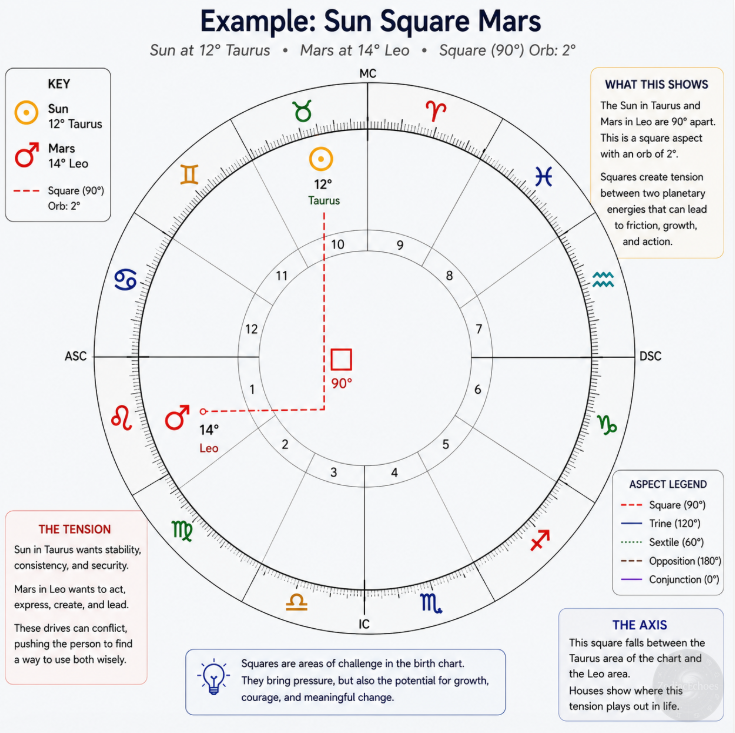
Example: Sun Square Mars
Imagine someone has:
- Sun at 12° Taurus
- Mars at 14° Leo
The planets are approximately 92° apart. That creates a square with an Orb of 2°.
Start with the Sun. The Sun represents identity, vitality, conscious direction, purpose, and self-expression. Mars represents drive, action, assertion, anger, competition, and motivation. Now add the signs. Taurus tends toward stability, patience, consistency, practicality, and maintaining what has already been established. Leo brings confidence, creativity, visibility, pride, and expressive action.
The square suggests that how this person wants to maintain their direction and how they instinctively take action may not always cooperate smoothly.
They could become frustrated when circumstances force them to move faster than they would prefer. At other times, Mars may push them into action while another part of them would rather maintain stability.
But the aspect also contains considerable energy. Repeated friction can teach the person how to act decisively without abandoning persistence and how to remain determined without turning every obstacle into a battle.
Is a Square a Bad Aspect?
Squares are traditionally considered challenging aspects, but calling them simply bad is misleading. An easy aspect can describe something that comes naturally. A square often describes something that requires work. That difference matters.
Repeated frustration can encourage someone to develop abilities they might otherwise never need. A difficult Mercury–Saturn square, for example, does not automatically mean poor communication. Working through uncertainty or excessive caution could eventually contribute to unusually careful and disciplined thinking.
Squares often become easier to understand when we stop asking: “What problem does this cause?” and instead ask: “What does this pressure force me to develop?”
Square vs. Opposition
Both are traditionally classified as challenging aspects, but they work differently.
Square = 90°
Creates friction and pressure.
Opposition = 180°
Creates polarity and awareness between two sides.
An opposition can feel like being pulled between opposite ends of an axis. A square is more like encountering an obstacle that repeatedly demands a response. Both can create tension. But the square is particularly associated with action, adjustment, and development through friction.
Understanding Squares in Your Birth Chart
A square in Astrology reveals where two planetary functions may struggle to cooperate automatically. Its central principle is 90° creates friction. That friction is not necessarily a flaw in the chart. Start with the planets, examine their signs and houses, calculate the orb, and then look at the surrounding aspects.
A square may show where life repeatedly asks for effort—but it can also reveal where pressure becomes motivation, obstacles produce skills, and tension eventually creates movement.
FAQ
What does a square mean in Astrology?
A square occurs when two planets or chart points are approximately 90° apart, creating a dynamic relationship associated with tension, pressure, and action.
What is the symbol for a square?
The traditional square symbol is □.
Is a square a bad aspect?
No. Squares can be challenging, but they can also generate motivation, resilience, and growth because their tension encourages active responses.
Is a tight square stronger?
Generally, yes. A square with an orb of 1° or 2° usually receives more interpretive attention than a much wider square.
Do squares always occur between signs of the same modality?
Traditional sign-based squares commonly connect signs sharing a modality, but actual aspects depend on planetary degrees. Out-of-sign squares are therefore possible.
Can you have several squares in a Birth Chart?
Yes. Multiple squares are common. Several interconnected squares can also form larger aspect patterns, such as a T-square or Grand Cross.