
- A Cradle Pattern is an astrological configuration involving four planets or important chart points.
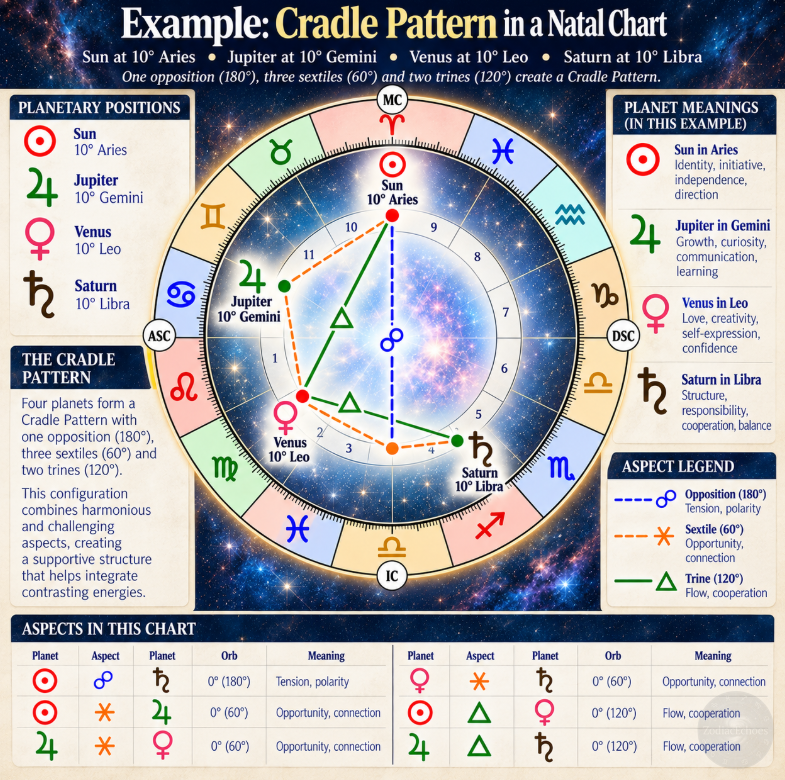
- It consists of one opposition (180°), three sextiles (60°), and two trines (120°).
- The four placements form a distinctive geometric structure resembling a cradle inside the Natal Chart.
- Unlike a Grand Cross, the Cradle contains more harmonious aspects than challenging ones.
- The opposition introduces tension, while the trines and sextiles create opportunities for cooperation and adjustment.
- Cradle Patterns are traditionally associated with support, adaptability, emotional integration, and constructive problem-solving.
- The planets, zodiac signs, houses, and aspect orbs determine how the configuration is interpreted.
Some astrological patterns concentrate pressure, while others create networks of supportive planetary connections. The Cradle Pattern in Astrology belongs primarily to the second category, although its structure also contains an important opposition.
Four planets connect through six aspects, forming a configuration that resembles a suspended cradle. Its harmonious relationships create several pathways for cooperation, while the opposition introduces a contrast that may encourage growth and adjustment.
The result is a pattern traditionally associated with the ability to manage competing influences through cooperation, flexibility, and the constructive use of natural strengths.
What Is a Cradle Pattern in Astrology?
A Cradle Pattern forms when four planets occupy positions that create a specific combination of sextiles, trines, and one opposition. The configuration contains six aspects.
| Aspect | Number | Angle | Main Theme |
|---|---|---|---|
| Opposition | 1 | 180° | Polarity and contrasting needs |
| Trine | 2 | 120° | Natural cooperation and flow |
| Sextile | 3 | 60° | Opportunities and supportive connections |
The three sextiles connect neighboring planets along one half of the zodiac. Two trines create longer harmonious connections, while the opposition links the two outermost planets. This produces a geometric structure that resembles a cradle or an open-sided rectangle.
The pattern is sometimes described as a Small Talent Triangle combined with additional harmonious connections, although interpretations and naming conventions vary between astrological traditions. Its defining characteristic is the balance between one challenging opposition and five harmonious aspects.
How Does a Cradle Pattern Work?
The opposition is the principal source of tension within the Cradle. An opposition connects two planets positioned approximately 180° apart, traditionally representing contrasting needs, competing priorities, or different approaches to the same situation. In a Cradle, however, the opposition does not exist in isolation.
The remaining planets connect through trines and sextiles, creating alternative pathways for cooperation. These harmonious relationships may help the person recognize different perspectives, adapt to changing circumstances, or develop practical ways of managing competing influences.
The configuration therefore suggests supportive connections that can help integrate opposing planetary functions, rather than eliminating the opposition itself.
Example: Sun–Jupiter–Venus–Saturn Cradle Pattern
Consider the following hypothetical Natal Chart:
- Sun — 10° Aries
- Jupiter — 10° Gemini
- Venus — 10° Leo
- Saturn — 10° Libra
These four placements create an exact Cradle Pattern.
The principal opposition is:
- Sun ☍ Saturn — 180°
The three sextiles are:
- Sun ⚹ Jupiter — 60°
- Jupiter ⚹ Venus — 60°
- Venus ⚹ Saturn — 60°
And the two trines are:
- Sun △ Venus — 120°
- Jupiter △ Saturn — 120°
Together, these six aspects form the complete configuration. The Sun in Aries represents independence, initiative, identity, and personal direction. Saturn in Libra introduces responsibility, cooperation, boundaries, and the need to consider other people’s perspectives.
Their opposition may highlight a recurring contrast between personal independence and responsibilities within relationships or partnerships. However, Jupiter in Gemini and Venus in Leo provide additional connections.
Jupiter in Gemini emphasizes curiosity, communication, learning, and intellectual exploration. Venus in Leo introduces creativity, affection, self-expression, and the desire for appreciation. The Sun–Jupiter sextile can encourage communication and exploration, while Jupiter’s sextile with Venus supports creative thinking and social interaction.
Venus also forms a sextile with Saturn, potentially connecting personal expression with responsibility and commitment. Meanwhile, the Sun–Venus trine encourages a natural relationship between identity and creative expression, while the Jupiter–Saturn trine connects expansion with structure. The Cradle therefore offers several ways to work with the central Sun–Saturn opposition.
Rather than forcing a choice between independence and cooperation, the configuration may encourage creative solutions that accommodate both personal ambitions and shared responsibilities.
Cradle Pattern vs. Mystic Rectangle
The Cradle and Mystic Rectangle share several characteristics. Both involve four planets and combine harmonious aspects with an opposition. However, their geometry differs.
| Feature | Cradle Pattern | Mystic Rectangle |
|---|---|---|
| Planets | 4 | 4 |
| Oppositions | 1 | 2 |
| Trines | 2 | 2 |
| Sextiles | 3 | 2 |
| Main Theme | Support and integration | Balance between polarities |
A Mystic Rectangle contains two oppositions, creating two distinct axes of tension. A Cradle contains only one opposition, with the remaining connections forming a predominantly harmonious network. This makes the Cradle particularly interesting when examining how supportive planetary relationships may help manage one central polarity.
Why Houses Matter
The planets and aspects establish the Cradle’s geometry, but the houses reveal where its influences may become most noticeable. For example, a Cradle involving the 1st, 3rd, 5th, and 7th Houses could connect personal identity, communication, creativity, and relationships. The opposition between the 1st and 7th Houses might emphasize balancing individual needs with partnership responsibilities.
Meanwhile, the planets in the 3rd and 5th Houses could introduce opportunities for communication, creative expression, and shared interests. A different house arrangement would shift the interpretation toward other areas of life. This is why identifying the pattern is only the beginning. The complete meaning emerges from the interaction between planets, signs, houses, and aspects.
Does Orb Matter in a Cradle Pattern?
Yes. A mathematically exact Cradle would contain three 60° sextiles, two 120° trines, and one 180° opposition. Real Natal Charts rarely produce perfectly exact configurations. Astrologers therefore use orbs, allowing planets to form aspects when their angular separation differs slightly from the ideal angle.
A Cradle with tight orbs generally creates a more clearly defined geometric pattern than one relying on very wide allowances. Different astrological traditions use different orb limits, so examining the actual planetary degrees is important when evaluating the configuration.
Understanding a Cradle Pattern in Your Birth Chart
A Cradle Pattern in Astrology combines one opposition with five harmonious aspects, creating a distinctive network of planetary relationships. The opposition introduces contrasting needs or priorities, while the trines and sextiles offer several opportunities for cooperation and adjustment.
Its significance comes from how the four planets interact, rather than from any single aspect. Where challenging patterns emphasize pressure and conflict, the Cradle highlights the possibility of using supportive connections to navigate differences and develop greater balance.
Cosmic Highlights
FAQ
What does a Cradle Pattern mean in Astrology?
A Cradle Pattern is a configuration involving four planets connected by one opposition, two trines, and three sextiles. It is traditionally associated with support, adaptability, and the constructive integration of contrasting influences.
Is a Cradle Pattern rare?
It requires four placements to form six compatible aspects, making it more specialized than individual trines or sextiles. Its frequency depends partly on the orb allowances used.
Is a Cradle Pattern considered positive?
It is generally regarded as a supportive configuration because five of its six aspects are harmonious. However, its opposition still introduces tension, and the overall interpretation depends on the planets involved.
What is the difference between a Cradle and a Mystic Rectangle?
A Cradle contains one opposition, two trines, and three sextiles. A Mystic Rectangle contains two oppositions, two trines, and two sextiles.
Does a Cradle Pattern have an apex planet?
No. Unlike a T-Square or Yod, a Cradle does not have a single apex planet. Its interpretation focuses on the opposition and the harmonious connections linking all four placements.