Not every opportunity in a Birth Chart announces itself loudly. Some placements describe abilities or connections that become valuable only when we actively use them. There may be potential available, but something still has to activate it. This is a useful way to understand the sextile in Astrology.
At approximately 60°, two planetary functions can cooperate without the strong friction of a square or opposition. Yet the relationship may require more participation than the effortless flow traditionally associated with a trine.
What Is a Sextile in Astrology?
A sextile occurs when two planets are approximately:
60° apart
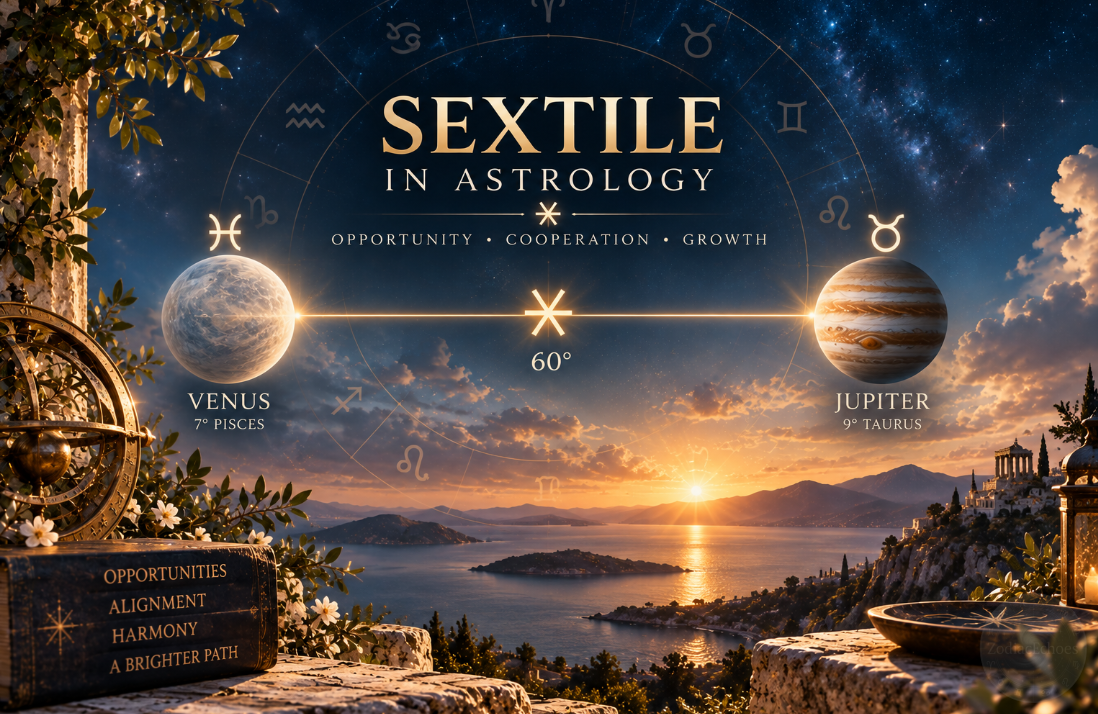
Imagine Venus at:
7° Pisces
and Jupiter at:
9° Taurus
The exact sextile from 7° Pisces occurs at 7° Taurus.
Jupiter is at 9° Taurus, producing a:
Sextile with an orb of 2°
Venus represents relationships, attraction, pleasure, values, and harmony. Jupiter represents expansion, optimism, knowledge, opportunity, and growth. The sextile suggests these two planetary functions have the potential to support and strengthen one another.
How Does a Sextile Work?
The sextile is often described as an aspect of opportunity. For example:
- Mercury sextile Jupiter can connect communication and learning with broader knowledge and perspective.
- Venus sextile Saturn may allow relationships and values to cooperate with commitment, patience, and structure.
- Mars sextile Uranus can connect action and motivation with experimentation, independence, or innovation.
But there is an important distinction. A sextile does not necessarily mean that its potential will automatically be developed. Think of it less like receiving a finished gift and more like being given an open door. You still have to walk through it.
What Is the Orb of a Sextile?
An exact sextile measures 60°. Because sextiles are generally considered less dominant than conjunctions, oppositions, or squares, many astrologers use a somewhat tighter orb. A practical beginner guideline is:
| Orb | General Interpretation |
|---|---|
| 0°–2° | Very tight sextile |
| 3°–4° | Strong sextile |
| 5°–6° | Wider sextile |
| Beyond 6° | Depends on planets and method |
These are guidelines rather than universal rules. The planets involved should always be considered alongside the mathematical distance.
Which Signs Form Sextiles?
Sextiles commonly connect signs separated by one zodiac sign. They often link compatible elements:
Fire ↔ Air
and
Earth ↔ Water
For example:
Aries sextile Gemini
Taurus sextile Cancer
Leo sextile Libra
Scorpio sextile Capricorn
The elements differ, but they can complement one another. As always, however, the actual planetary degrees determine whether the aspect exists.
Common Sextiles
| Sextile | Potential Connection |
|---|---|
| Sun sextile Jupiter | Identity + expansion |
| Moon sextile Venus | Emotions + affection |
| Mercury sextile Jupiter | Thinking + perspective |
| Venus sextile Saturn | Relationships + stability |
| Mars sextile Uranus | Action + innovation |
| Jupiter sextile Saturn | Growth + structure |
These combinations describe possibilities, not guaranteed outcomes. The signs and houses reveal much more about how those possibilities may be expressed.
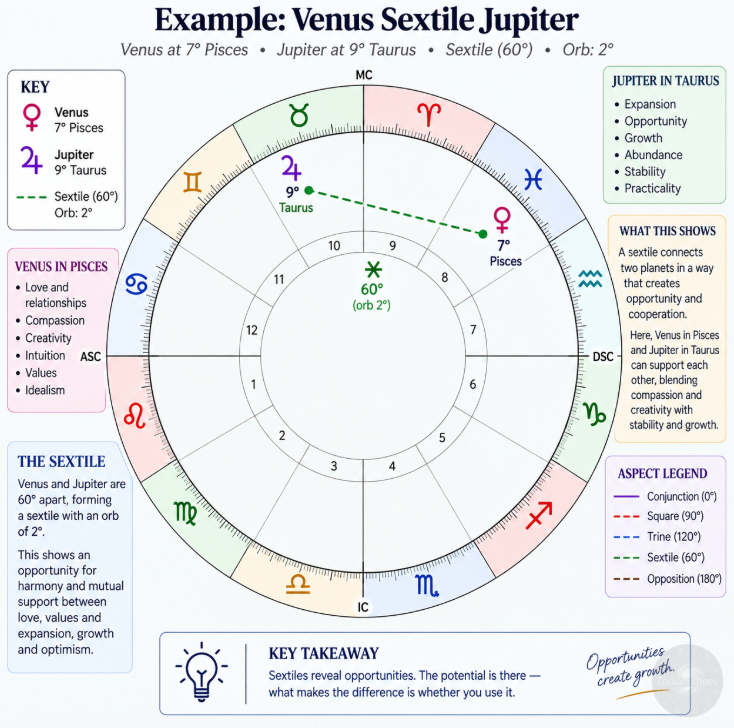
Example: Venus Sextile Jupiter
Imagine someone has:
Venus at 7° Pisces
Jupiter at 9° Taurus
The planets are approximately 62° apart, creating a sextile with an:
Orb of 2°
Venus represents affection, attraction, relationships, pleasure, aesthetics, and values. Jupiter adds growth, optimism, expansion, generosity, and broader possibilities. Pisces brings sensitivity, imagination, compassion, and intuition. Taurus adds stability, practicality, comfort, sensuality, and an appreciation of tangible value.
Together, the sextile could provide opportunities to connect imagination with something concrete, or relationships and values with growth and greater stability. But it does not guarantee wealth, romantic success, or an easy life. It describes a potentially useful relationship between two planetary functions.
Why Houses Matter
The houses reveal where the opportunity may appear. A Venus–Jupiter sextile between the: 2nd House ⚹ 4th House could emphasize connections involving values, resources, home, family, and security.
Move the same aspect to 7th House ⚹ 9th House and partnerships, travel, education, beliefs, or broader perspectives become more relevant. The sextile describes the relationship between the planets. The houses provide its life context.
Sextile vs. Trine
Both are traditionally harmonious aspects, but there is a useful distinction:
Sextile = 60° → opportunity and cooperation
Trine = 120° → natural flow and ease
A trine may describe something that operates almost automatically. A sextile often represents potential that becomes more valuable through participation and conscious use. Neither guarantees success. They simply describe two different forms of planetary cooperation.
Understanding Sextiles in Your Birth Chart
A sextile in Astrology reveals where two planetary functions have an opportunity to cooperate. Its central principle is: 60° creates opportunity. Unlike the pressure of a square or the polarity of an opposition, the sextile may quietly offer something useful. The potential is there. What makes the difference is whether you actually use it.
FAQ
What does a sextile mean in Astrology?
A sextile occurs when two planets or chart points are approximately 60° apart and is associated with cooperation, opportunity, and potential.
What is the symbol for a sextile?
The traditional symbol is ⚹.
Is a sextile a good aspect?
It is traditionally considered harmonious, although its potential may still require conscious effort to develop.
Is sextile stronger than trine?
Not necessarily. They operate differently. Trines are associated with natural flow, while sextiles are often interpreted as accessible opportunities.
Can sextiles occur between different elements?
Yes. They commonly connect Fire with Air or Earth with Water, although actual aspects are determined by degrees.
✨ Explore More from Zodiac Echoes ✨Explore More from ZE
Choose your zodiac sign to explore daily, weekly, monthly, and yearly horoscopes.