Key Points
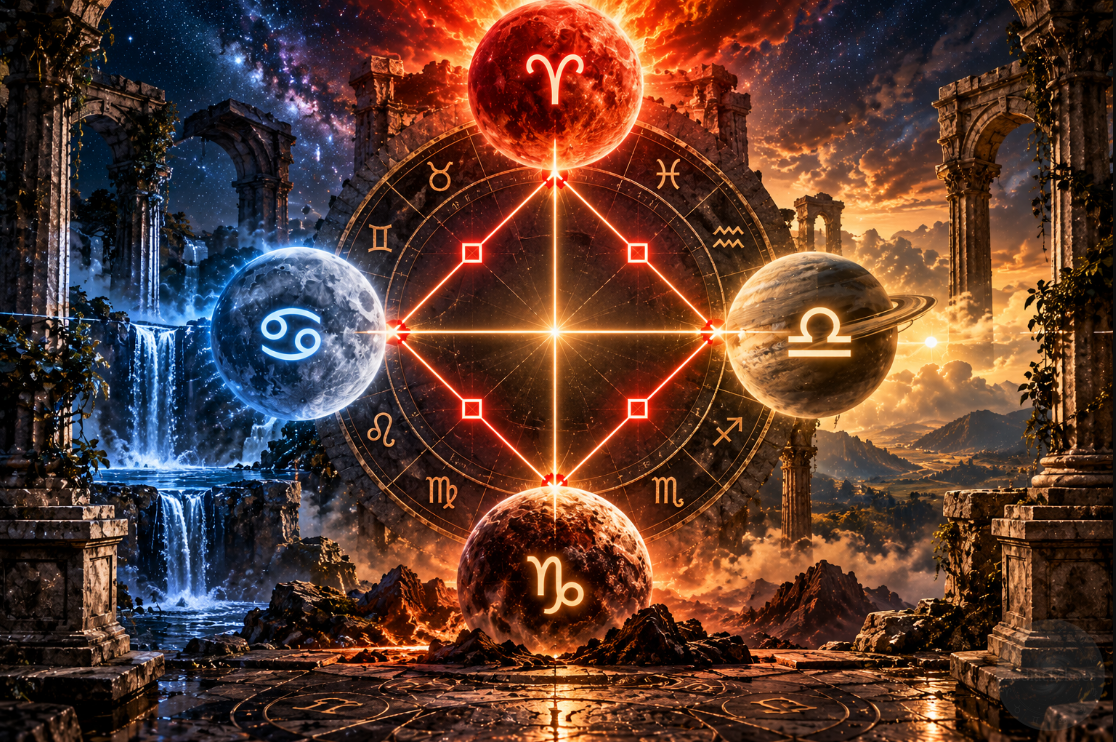
- A Grand Cross, also called a Grand Square, is a major aspect pattern involving four planets or important chart points.
- The four placements are positioned roughly 90° apart, creating a cross inside the Natal Chart.
- A complete Grand Cross contains four squares and two oppositions.
- Most Grand Crosses occur within one modality: Cardinal, Fixed, or Mutable.
- Unlike a T-Square, a Grand Cross has no missing leg — all four points of the configuration are occupied.
- The pattern is traditionally associated with tension, competing priorities, pressure, and persistent activity.
- A Grand Cross is not automatically negative. Its friction can also encourage resilience, problem-solving, and determination.
Some Birth Chart patterns immediately stand out when you look at the aspect lines. The Grand Cross is one of them. Four placements occupy four sides of the zodiac, with each planet opposing one and squaring two others. The result is a symmetrical cross filled with challenging aspects.
It can look intimidating. But understanding a Grand Cross requires more than counting red lines. The planets, signs, houses, modality, and exact orbs reveal what the pattern actually represents.
What Is a Grand Cross in Astrology?
A Grand Cross forms when four planets or important chart points are positioned approximately 90° apart around the zodiac. This produces: 4 squares + 2 oppositions. For example:
Sun — 10° Aries
Moon — 10° Cancer
Saturn — 10° Libra
Mars — 10° Capricorn
These four signs occupy the Cardinal points of the zodiac. The Sun opposes Saturn. The Moon opposes Mars. At the same time, each neighboring placement forms a square.
| Part of Pattern | Number | Geometry |
|---|---|---|
| Squares | 4 | 90° |
| Oppositions | 2 | 180° |
| Planets/Points | 4 | Four positions |
| Overall Shape | — | Cross |
Connect those aspects inside a Natal Chart and the characteristic Grand Cross appears.
How Is a Grand Cross Different From a T-Square?
The relationship between these two patterns is surprisingly simple. A T-Square contains three occupied points: 1 opposition + 2 squares. A Grand Cross adds the fourth point. That creates:
2 oppositions + 4 squares
The “missing leg” discussed in a T-Square is therefore no longer missing. All four sides are active. This makes the Grand Cross a more symmetrical configuration, with tension distributed between four different placements rather than concentrated around a single apex planet.
Cardinal, Fixed, and Mutable Grand Crosses
Grand Crosses are usually classified according to modality.
| Type | Signs | General Theme |
|---|---|---|
| Cardinal | Aries, Cancer, Libra, Capricorn | Action, initiative, direction |
| Fixed | Taurus, Leo, Scorpio, Aquarius | Persistence, stability, resistance |
| Mutable | Gemini, Virgo, Sagittarius, Pisces | Adaptation, change, flexibility |
The modality helps explain how the pattern tends to operate.
- A Cardinal Grand Cross may emphasize competing urges to initiate or take control.
- A Fixed Grand Cross can create powerful persistence but also resistance to changing course.
- A Mutable Grand Cross may produce constant adjustment between several changing priorities or perspectives.
Example: Cardinal Grand Cross
Consider this example:
Sun — 10° Aries
Moon — 10° Cancer
Saturn — 10° Libra
Mars — 10° Capricorn
The geometry is exact.
Sun ☍ Saturn — 180°
Moon ☍ Mars — 180°
And:
Sun □ Moon — 90°
Moon □ Saturn — 90°
Saturn □ Mars — 90°
Mars □ Sun — 90°
Together, these six aspects create a Cardinal Grand Cross. The Sun can represent identity, purpose, and conscious direction. The Moon relates to emotions, instincts, and security. Saturn introduces responsibility, boundaries, and structure, while Mars represents action, assertion, and drive.
With all four connected through challenging aspects, satisfying one part of the configuration may place pressure on another. For example, acting independently may conflict with emotional security. Responsibility toward others could clash with personal direction, while Mars adds pressure to take practical action.
The important point is that these planets do not operate separately. They form a single interconnected system.
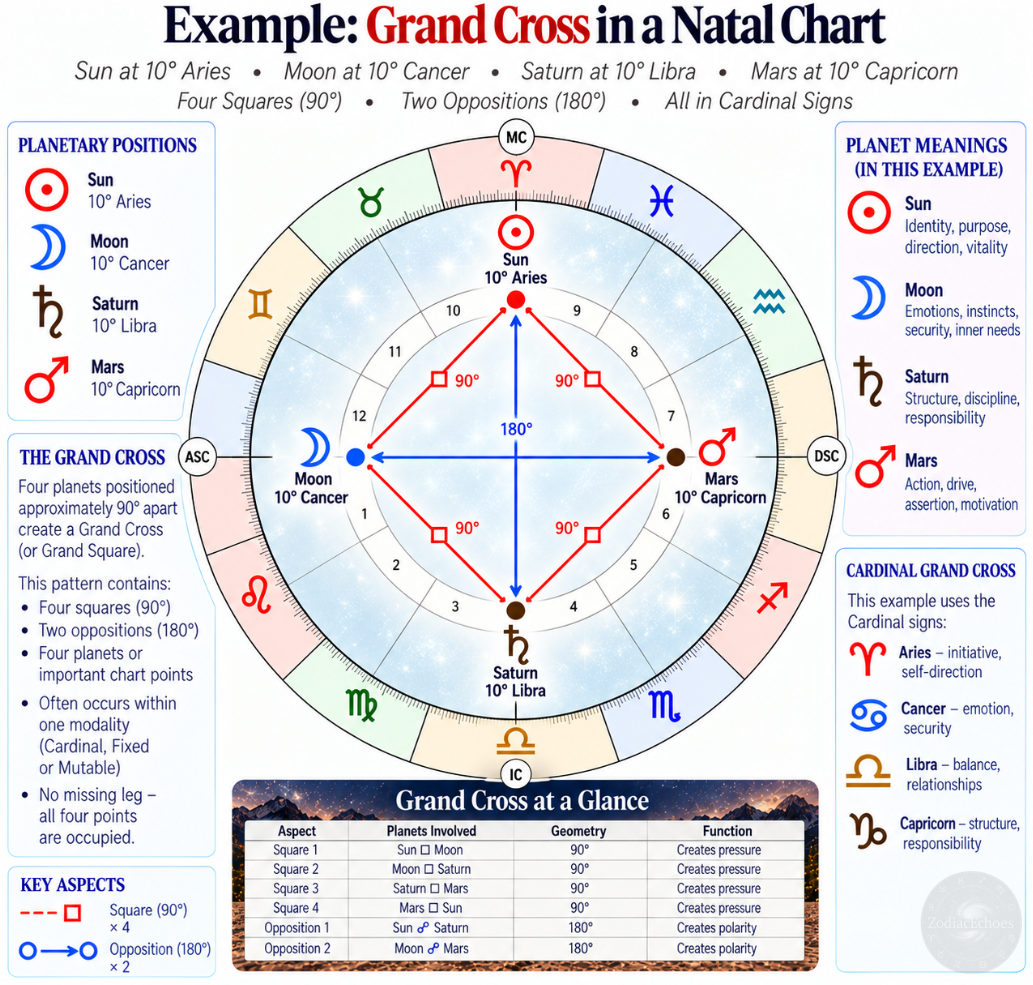
The wheel should show the four planets at 10° Aries, Cancer, Libra, and Capricorn, with four 90° squares forming the outer box and two 180° oppositions crossing through the center.
Why Houses Matter
The geometry identifies the Grand Cross. The houses show where its themes are likely to become most noticeable. Imagine a Grand Cross involving the 1st, 4th, 7th, and 10th Houses. These are the four angular houses, connecting major areas such as:
Self → Home → Relationships → Public Life
That could make balancing personal identity, private foundations, partnerships, and career direction particularly important. Place the same four planets in different houses and the practical interpretation changes considerably. This is why identifying “Grand Cross” alone is never a complete reading.
Is a Grand Cross Bad?
A Grand Cross contains several traditionally challenging aspects, so older interpretations sometimes describe it in dramatic terms. That is too simplistic. Squares create friction. Oppositions create polarity. With a Grand Cross, several pressures can operate simultaneously.
That can certainly feel demanding. But pressure also creates reasons to act, develop strategies, establish priorities, and become better at managing competing demands.
Compare three patterns:
- Grand Trine → flow
- T-Square → concentrated pressure
- Grand Cross → distributed pressure
None guarantees talent, struggle, success, or failure. They simply describe different relationships between parts of the Birth Chart.
Does Orb Matter?
Yes. A mathematically perfect Grand Cross would have planets exactly 90° apart, but real Natal Charts rarely produce perfect geometry. Astrologers therefore use orbs, allowing aspects to remain active when planets are several degrees away from exact angles.
Generally, a tighter Grand Cross will be more clearly defined than one built from very wide aspects. The planets involved also matter. Many astrologers allow wider orbs for major bodies such as the Sun and Moon than for less prominent points.
Understanding a Grand Cross in Your Birth Chart
A Grand Cross in Astrology creates one of the most visually striking structures in a Natal Chart. Four planets occupy four sides of the zodiac. Four squares create friction. Two oppositions create polarity.
Instead of looking for one “problem planet,” however, the Grand Cross is best understood as an interconnected system. Its meaning emerges from how the four planets, their signs, houses, and aspects interact. The pattern may create pressure, but it also creates something else: a powerful reason to keep finding ways forward.
Cosmic Highlights
FAQ
What does a Grand Cross mean in Astrology?
A Grand Cross is an aspect pattern involving four placements connected by four squares and two oppositions, creating a cross-like structure in the Natal Chart.
Is a Grand Cross the same as a Grand Square?
Yes. Grand Cross and Grand Square are commonly used for the same configuration.
Is a Grand Cross rare?
It requires four placements to occupy compatible positions around the zodiac, making it considerably less common than individual squares or oppositions.
Does a Grand Cross have an apex planet?
Not in the same way as a T-Square. Because all four positions are occupied, the pattern does not have one single missing leg or obvious apex.
Can a T-Square become a Grand Cross?
Yes. If another planet or important point occupies the T-Square’s missing fourth position and forms the required aspects, the configuration becomes a Grand Cross.
✨ Explore More from Zodiac Echoes ✨Explore More from ZE
Choose your zodiac sign to explore daily, weekly, monthly, and yearly horoscopes.